Taxes Worsen Education Gap
Federal education policy is nominally focuses resources on the most needy. Thus the Title I program sends nearly $9 billion to schools with low-income children.
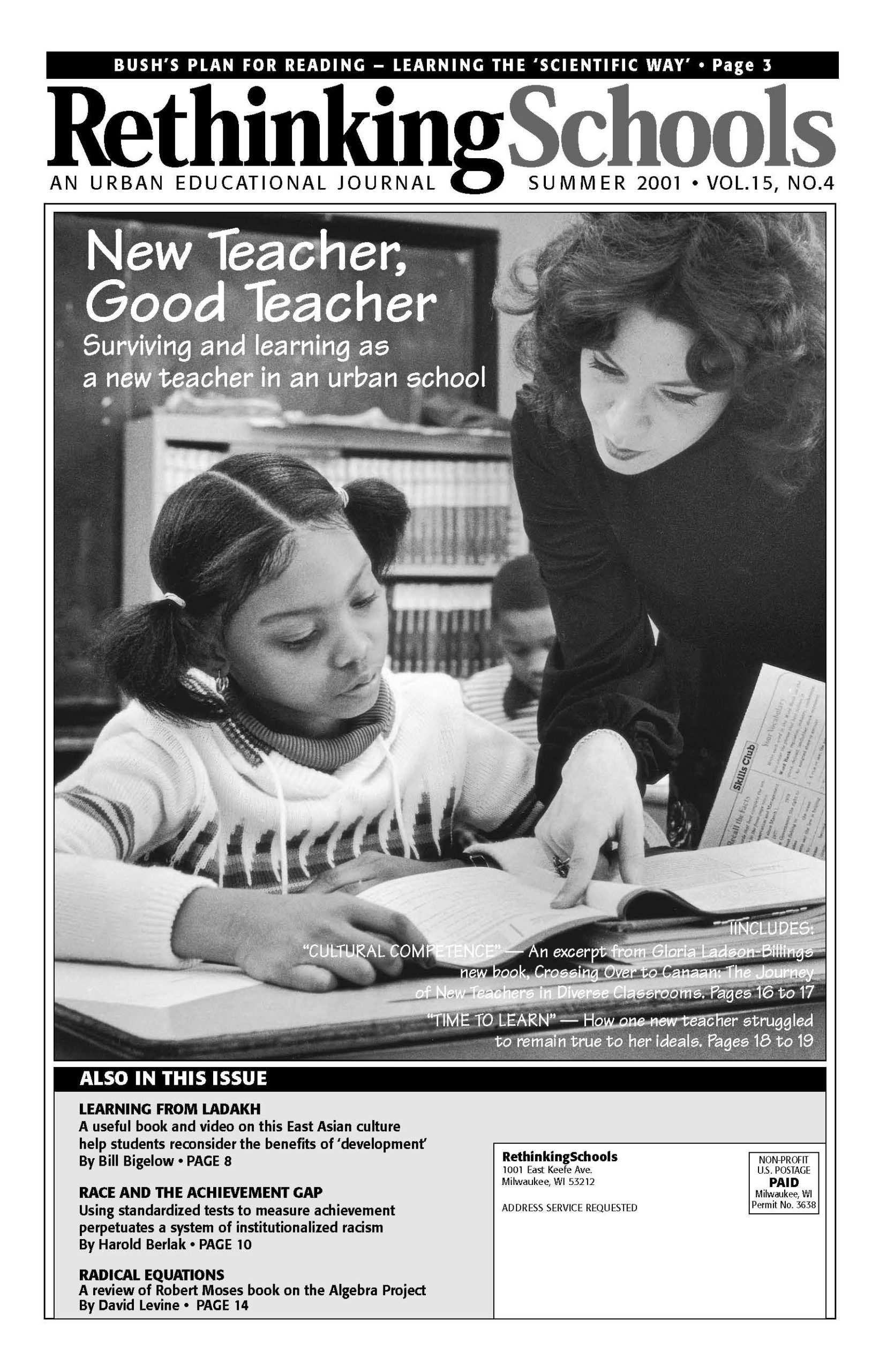
Time to Learn
The first year of teaching can be an exhausting nightmare. Here's how one teacher not only survived but stayed true to her vision of good teaching.
The first year of teaching can be an exhausting nightmare. How one new teacher not only survived, but stayed true to her vision.
Teaching and Cultural Competence
What does it take to be a successful teacher in a diverse classroom?
What does it take to be a successful teacher in an urban classroom? An excerpt from Ladson-Billings’ new book, Crossing to Canaan.
Lessons Learned
Some of the lessons that Gloria Ladson-Billings has drawn from working with the Teach for Diversity certification program, as mentioned in the article above.
Race and the Achievement Gap
Using standardized tests to measure achievement perpetuates a system of institutionalized racism and lends the cloak of science to discriminatory practices.
Using standardized tests to measure achievement perpetuates a system of institutionalized racism and lends the cloak of science to discrimination.
Resisting High-Stakes Tests
Teachers follow their principles and refuse to take part in the high-stakes game.
Ohio Teachers Give Tests an ‘F
National Board Certified Teachers Believe the state's testing policies are doing far more harm then good.
National Board certified teachers believe the state’s testing policies do far more harm than good.
Nationwide Protests Against Tests
From Washington State to Arizona, Michigan, and Massachusetts, parents and teachers organize to protest the disastrous effects of high-stakes standardized tests.
Grass-roots protests take aim at high-stakes standardized tests and call for alternative forms of accountability.
Learning to Read – ‘Scientifically
President Bush's education blueprint emphasizes money for reading instruction, but only if it is "scientifically based." What might that mean?
President Bush calls for ‘scientifically based’ reading instruction. What might that mean?
Bush’s Bad Idea for Bilingual Ed
The President proposes a three-year time limit for non-English speakers to attain 'English fluency'?
The president proposes a three-year time limit for non-English speakers to attain ‘English fluency.’ Here’s why that’s a big mistake.
Learning from Ladakh
A Video on a little-known culture prompts students to reconsider the concept of a "primative" culture and the benefits of "development."
A video on a little-known culture prompts students to reconsider concepts such as “primitive” and “advanced.”
The Case of Cultural Destruction
The complete text of roles and role play guidelines for a trial on the destruction of Ladakhi culture, as described in Bill Bigelow’s article.
Ladakh Situations
Situations facing the Ladakhi people, as mentioned in Bill Bigelow’s article
For My People
Using Margaret Walker's poem to help students "talk-back" to stereotypes and to affirm their self worth
Using Margaret Walker’s poem to help students ‘talk back’ to stereotypes and to affirm their self worth.
Radical Equations
Civil Rights veteran Robert Moses tells the story of the Algebra Project and the struggle to ensure math literacy for African Americans.
Questions are the Answer
A high school teacher poses the question, "What is global literacy?"
A high school teacher poses the question, ‘What is global literacy?’
Haiku and Hiroshima
A high school teacher uses an animated film and haiku poetry to raise awareness about the events of August 1945 and the dropping of the atomic bomb.
A high school teacher uses an animated film and haiku poetry to raise awareness about the dropping of atomic bombs in 1945.
Paper Cranes and Peace
An elementary teacher uses the book Sadako and the Thousand Cranes to tell the story of Hiroshima and the horror of war.
An elementary school teacher uses the book “Sadako and the Thousand Cranes” to tell the story of Hiroshima and the horrors of war.”
Vouchers, Accountability, and Money
Voucher backers are ignoring key lessons from Milwaukee’s voucher experience, including higher tax burdens and less accountability for academic achievement.