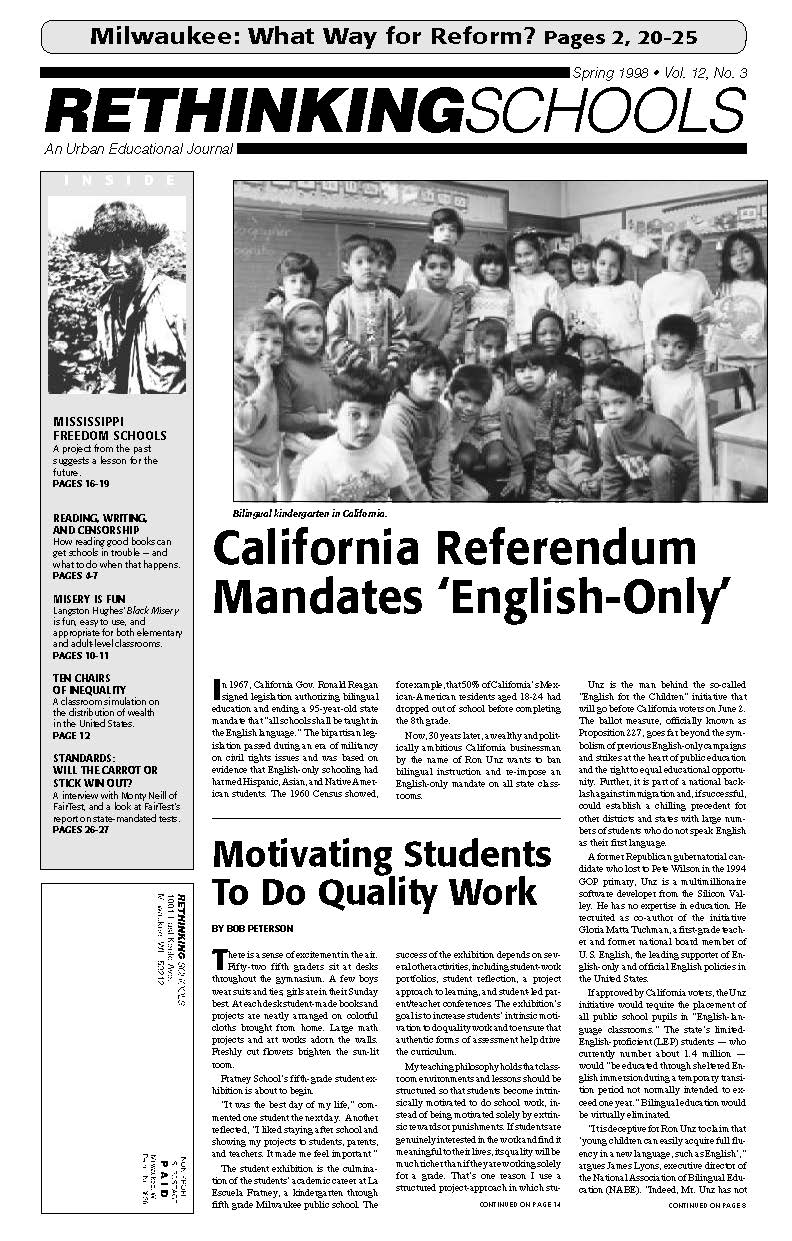
California Referendum Mandates ‘English-Only’
June 2 Vote Could Set National Precedent
The lead story in a Rethinking Schools report on the so-called “English for the Children” initiative slated to go before California voters on June 2, 1998, which would ban bilingual instruction and impose an English-only mandate on all classrooms. Includes a breakdown of the initiative’s key components and analysis of what its passage would mean for bilingual education and local control.
Number of Language-Minority Students Skyrockets
An analysis by the National Association of Bilingual Education details the tremendous growth of this population.
History of Bilingual Education
Bilingual education has been a fixture in U.S. schools for almost 150 years. Background on this history, important court cases,and why the “English for the Children” initiative could end up costing California billions in federal school aid.”
Resources on the Unz Initiative
Where to call, write or Web-surf for more information on the “English for the Children” referendum.”
Reading, Writing, and Censorship
When Reading Good Books Can Get Schools In Trouble: First of Two Articles
Censorship is alive and well in U.S. schools, often as part of a larger effort by conservatives or religious fundamentalists to impose their ideology on public institutions. Rethinking Schools takes an in-depth look at the ongoing struggle over what children can and can’t read in school.
Frequently Challenged Books
A list of some of the books most often targeted by book banners.
Is Teaching ‘La Causa’ Grounds for Firing?
How two teachers in Vaughn, NM lost their jobs for refusing to stop teaching Chicano history.
Know the Law
Some of the key court decisions that outline the legal parameters of school censorship.
Resources on Censorship
A list of some of the major organizations involved in censorship issues.
MPS: Is This the Dark Before the Dawn?
A Rethinking Schools Editorial
These are both challenging and exciting times for the Milwaukee Public Schools. With the threat of a state takeover looming, educators and community activists are focusing on MPS and searching forways to bring meaningful reform to the district. Rethinking Schools offers some essential guidelines for making sure that reform efforts have a solid foundation.
Motivating Students To Do Quality Work
A visit to a student exhibition at La Escuela Fratney, a two-way bilingual elementary school in Milwaukee, illustrates important principles for encouraging students to do their best.
Ten Chairs of Inequality
A Classroom Simulation on the Distribution of Wealth
A simple classroom exercise can help students of all ages grasp the skewed distribution of wealth in U.S. society.
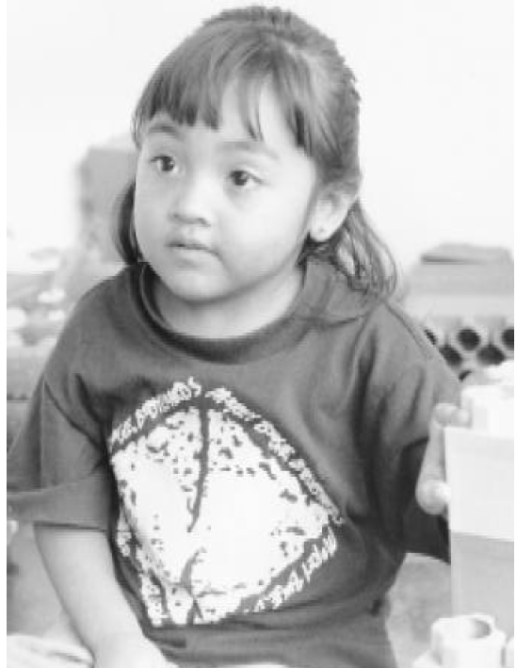
The Discipline of Hope
Lessons from a Lifetime of Teaching and Learning
After almost four decades of involvement in classroom teaching and school reform, the noted educator and writer reflects on the importance of “the refusal to accept limits on what your students can learn or what you, as a teacher, can do to help them.”
Mississippi Freedom Schools
A Project from the Past Suggests a Lesson for the Future
The 1964 civil rights program — which brought Northern whitesto Southern cities as teachers — and what it means to us today.
Neighborhood Schools, Busing, and the Struggle for Equality
Analysis of the Milwaukee School Board’s push to return to neighborhood schools, and issues that policymakers must address to ensure thatAfrican Americans don’t get shortchanged by reductioins in school busing.
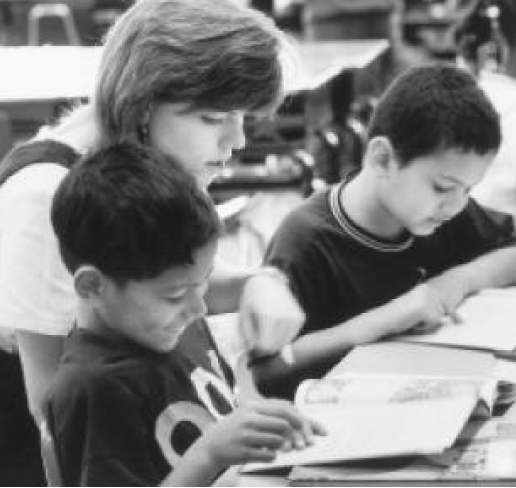
Wisconsin Experiments with Smaller Classes
Pilot Project Shows Promise in Early Grades
A look at a pilot project that cuts student-teacher ratios in some classrooms to 15-1, and early data that suggest that the smaller classes boost student achievement.

Milwaukee: Will Top-Down or Community-Based Reform Prevail?
Tides of change are sweeping through MPS — including a threatened state takeover — but will state politicians or the local community direct future reform efforts?
Black Ministers’ Reform Plan
A list of reforms advocated by the Milwaukee Minority MinisterialAlliance.
Who’s Who in MPS Reform
Profiles of some of the organizations involved in the city’s schoolreform efforts.
States Get Failing Grade in Assessment
A study by FairTest, the National Center for Fair & Open Testing,finds that most states need to make major improvements in their state assessment systems. The article includes a list of resouces on testing offered by FairTest.
Tests and Standards: Will the Carrot or Stick Win Out?
An interview with Monty Neill, acting executive director of FairTest,the National Center for Fair & Open Testing, on the results of the organization’s study of state assessment programs and the ever-more-popular cries for “tough national education standards.”
ZOOBS: A Challenge for the Hand and Mind
This terrific new toy, which has all the makings of an instantclassic, challenges kids to push their creative and intellectual limits.