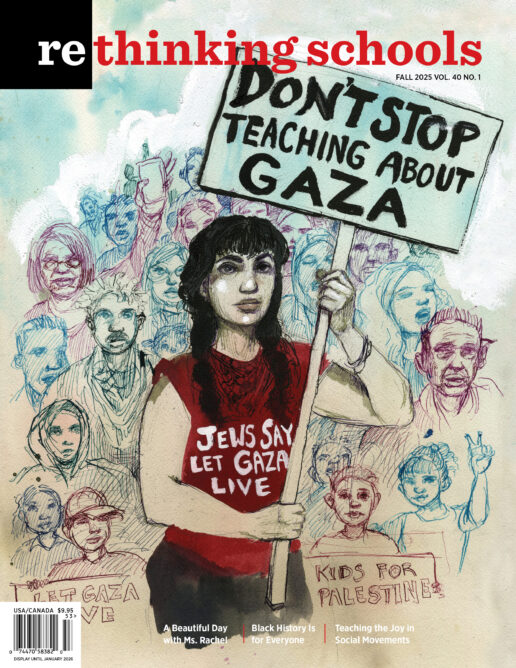
Don’t Stop Teaching About Gaza
Illustrator: Safia Latif
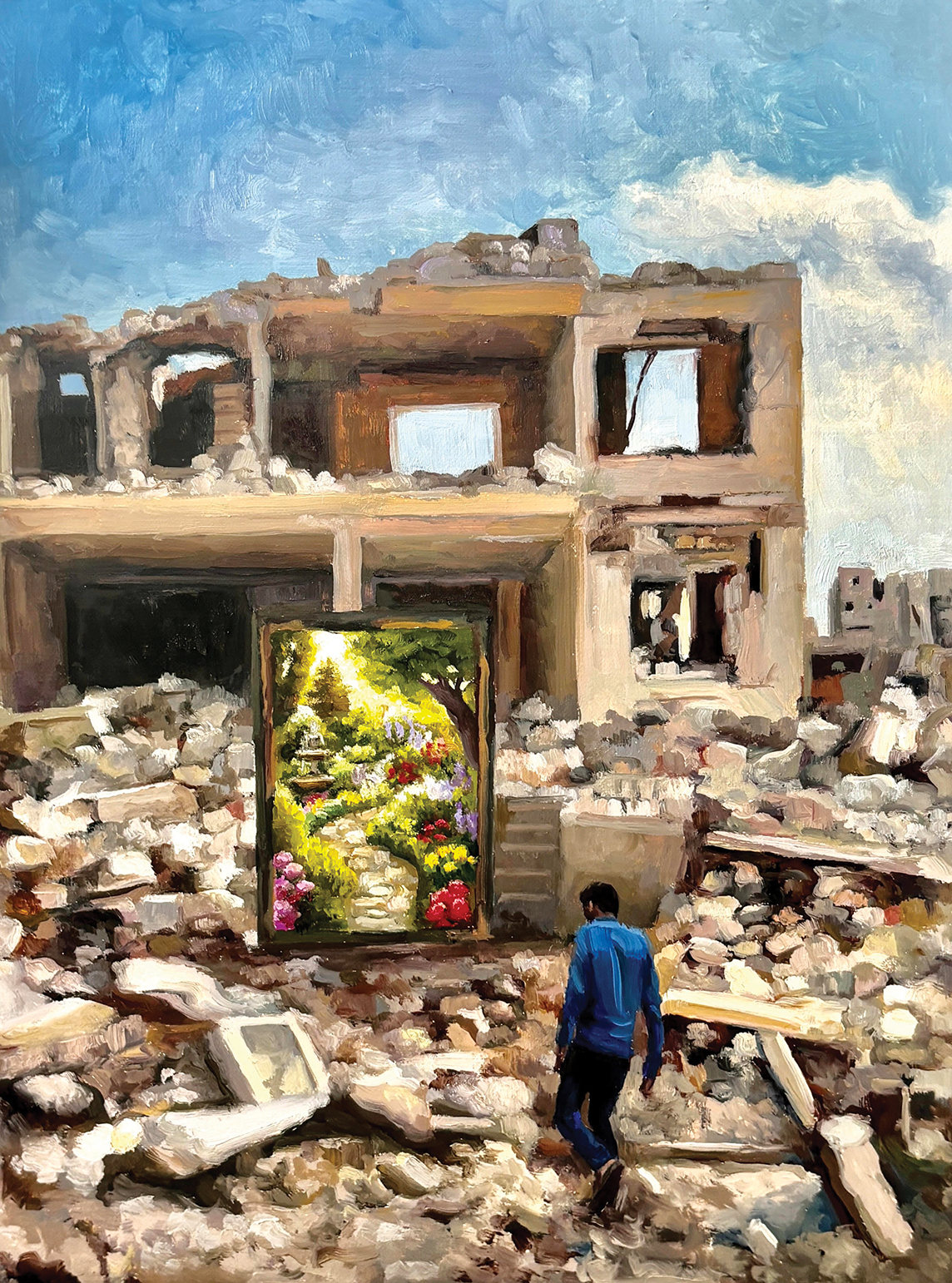
As this issue of Rethinking Schools went online, Israel and Hamas reached the first stage of a ceasefire agreement. Although it is still unclear whether this ceasefire will last beyond the first stage, we share the hope and celebration Palestinians in Gaza have expressed over the announcement that this will at least provide “relief from the massacres, killing and genocide,” as one Gaza resident told Al Jazeera. But we also know that this ceasefire deal is not a comprehensive peace and will not bring justice to the Palestinians living under occupation and apartheid, and especially Gazans who have endured two years of a genocidal assault. It may be even more vital now, as our editorial urges, that teachers “Don’t Stop Teaching About Gaza” in the classroom and on the streets so justice is achieved in Palestine-Israel.
”An average of 28 children have been killed each day — the equivalent of an entire classroom. Consider that for a moment. A whole classroom of children killed, every day for nearly two years.” This is how UNICEF Executive Director Catherine Russell explained the dire situation facing Gazan children in mid-July at the U.N. Security Council meeting.
As educators, many of us entered the profession because of the love we have for and the joy we get from children. This is why it has been heartbreaking to watch Israel expand its assault on the 2 million Palestinians in Gaza — nearly half of whom are under 18. We invite our readers to think about what you would do if a classroom full of kids in your community had been killed every day for the last two years.
And what transforms our heartbreak into outrage is the knowledge of U.S. complicity. In November 2024, the International Criminal Court issued an arrest warrant for Israeli Prime Minister Benjamin Netanyahu for war crimes and crimes against humanity, including using starvation as a method of warfare. “The United States responded by trashing the International Criminal Court, even under Biden, and then under Trump, imposing sanctions on the International Criminal Court,” Peter Beinart, editor-at-large of Jewish Currents, summarized on The Daily Show. “And so the message to Israel was very clear: You can get away with worse.”
In March 2025, Israel cut off all food, medicine, and water going into Gaza and banned UNRWA — the U.N. Relief and Works Agency — the primary organization providing aid. When Israel loosened this complete siege in May, UNRWA was replaced with the private U.S.-Israeli Gaza Humanitarian Foundation (GHF). GHF food distribution is run by Israeli soldiers and U.S. mercenaries who risk charges of war crimes by routinely opening fire on Palestinians seeking aid — killing almost 1,400 Gazans as of August. This prompted 109 organizations including the American Friends Service Committee, Doctors Without Borders, Oxfam International, and Save the Children to issue a call to “open all land crossings,” “reject military-controlled distribution models,” and “restore a principled, U.N.-led humanitarian response.” These organizations point out that
Just outside Gaza, in warehouses — and even within Gaza itself — tons of food, clean water, medical supplies, shelter items, and fuel sit untouched with humanitarian organizations blocked from accessing or delivering them. The government of Israel’s restrictions, delays, and fragmentation under its total siege have created chaos, starvation, and death.
An aid worker providing psychosocial support spoke of the devastating impact on children: “Children tell their parents they want to go to heaven, because at least heaven has food.”
Throughout the assault on Gaza, and despite widespread repression at home, educators across the United States have taught about Israel’s actions. Students and teachers have organized to end U.S. support for Israel. Rethinking Schools’ newest book, Teaching Palestine, is a product of this movement. In it, editor Samia Shoman suggests engaging students in the question “Do current events in Gaza meet the definition of genocide based on the U.N. Convention on the Prevention and Punishment of the Crime of Genocide?” Indeed, on Sept. 16, an independent U.N. commission found that Israel has committed and is continuing to commit genocide in Gaza.
Although using the term genocide for Israel’s actions in Gaza was initially controversial, several human rights organizations have used the term for nearly a year. In the months leading up to the U.N. commission report, more reluctant individuals and organizations began employing the term. This included B’Tselem, the main Israeli human rights organization; Jeremy Ben-Ami, the founder and president of J Street, a well-established liberal Zionist Jewish advocacy group; Dov Waxman and Lihi Ben Shitrit, who lead Israel Studies at UCLA and NYU; and Omer Bartov, Dean’s Professor of Holocaust and Genocide Studies at Brown University and one of the most prominent scholars in the field. One month before the U.N. report was released, more than 100 of Bartov’s colleagues in the International Association of Genocide Scholars passed a resolution recognizing that “Israel’s policies and actions in Gaza meet the legal definition of genocide.”
“The international community cannot stay silent on the genocidal campaign launched by Israel against the Palestinian people in Gaza,” stated Navi Pillay, the chair of the U.N. commission. “When clear signs and evidence of genocide emerge, the absence of action to stop it amounts to complicity.”
Teachers — especially those who live in the United States, Israel’s largest weapons supplier — have a moral responsibility to wade into the difficult territory of teaching Palestine. We believe there are good reasons to take the risk of teaching the truth in this moment, despite the increasing accusations of antisemitism leveled against educators who do so. The goal of those making accusations is to defend Israel’s actions, but in doing so they attack efforts to actualize the slogan “Never Again” that emerged in the wake of the Holocaust.
Refusing to recognize a genocide threatens the entire international legal order set up to prevent genocides like the Holocaust from occurring. Although international law, especially in relation to Palestine, has always been too weak, selectively applied, and too often abused by powerful states, failing to apply the law in this instance sets a new, perilous precedent. As Palestinian legal scholar Noura Erakat put it in May in a speech to the United Nations, “If you normalize genocide, you will have nothing left.”
Teacher unions have a duty to condemn the genocide our government is facilitating in Gaza and take every action possible to stop it. This summer delegates to the National Education Association’s Representative Assembly, meeting in July, voted to reject the Anti-Defamation League as a curriculum and professional development partner. Although claiming to be an anti-hate organization that focuses on antisemitism, the ADL has defended antisemites like Elon Musk, and wielded false accusations of antisemitism against educators who teach the truth about Israel’s actions in Palestine. (See Nora Lester Murad’s “Educators Beware: The Anti-Defamation League Is Not the Social Justice Partner It Claims to Be,” in Rethinking Schools, Vol. 39, No. 1.) The ADL has also attacked organizations like Jewish Voice for Peace that organize anti-Zionist Jews and challenge pro-Israel organizations’ claim to speak for all Jews in the United States. Indeed, anti-Zionism has a long history in the U.S. Jewish community. (See resources.)
Encouragingly, there has been a sea change of public opinion amongst Jews and the U.S. population more generally. An October 2024 Pew Research Center poll found that 28 percent of Jewish Americans said that Israel’s military operations had gone too far, compared to 24 percent who thought the opposite. A separate study completed by Israel’s Ministry for Diaspora Affairs and Combating Antisemitism found that 41.3 percent of Jewish Americans ages 14–18 believe that Israel is “committing genocide” in Gaza and 66.4 percent sympathize with the Palestinian people. This mirrors a broader change amongst left-liberal views with Democrats sympathizing with Palestinians over Israelis by a nearly 3-to-1 ratio according to a March 2025 Gallup poll and only 8 percent approving of Israel’s military action in Gaza according to a July poll.
In part, the change in public opinion is what allowed for pro-Palestinian socialist Zohran Mamdani to win the Democratic primary for New York City mayor. “I would wager that in the primary, more than 50 percent of the Jewish people voted for Mamdani,” his opponent Andrew Cuomo acknowledged at a breakfast event at the Hampton Synagogue in Long Island. “They are pro-Palestinian, and they don’t consider it being anti-Israel,” Cuomo lamented. “Especially younger people . . .”
This issue of Rethinking Schools is a testament to the growing movement behind the change in public opinion. Whether in the classroom or in the community, educators around the country are refusing to stop teaching about the genocide in Gaza and challenging the false accusations of antisemitism leveled against them for doing so.
UTLA member Shannon Paaske details the powerful organizing that led to the second largest teacher union in the United States adopting a series of pro-Palestinian resolutions, including one urging the California State Teachers’ Retirement System to divest from companies and bonds connected to Israel’s military actions in Gaza. Lara Kiswani explains the context for this action in her letter to educators to support the movement to boycott, divest from, and sanction Israel. Hannah Halpern describes a family-oriented community education series about Palestine organized by Jewish Voice for Peace — showing how Jews in the movement approach education in ways that classroom teachers can learn from.
Marcy Winograd and Rick Chertoff call for reimagining the teaching of the Holocaust and genocide in their critique of the popular Echoes & Reflections curriculum published by pro-Israel organizations, including the ADL. And Rethinking Schools editor Larry Miller describes the principled stand in solidarity with Gazan children taken by Ms. Rachel, who produces popular teaching videos for toddlers.
These educators, as well as those participating in the Teaching Palestine study groups across the country, refuse to stand by and let Palestinian humanity be bombed and starved away. They understand that Palestine is a test for the world. All life is cheapened and placed at risk because the leaders of the United States and Israel are committing a genocide — in public. But when we challenge this and insist that Palestinian lives matter — in our classrooms and beyond — we are building a future where the lives of all children and oppressed people are valued and treasured over the profit and power of a few.