
Rethinking Schools Online
Order   Who Are You
Current Issue Article Index Archives Web Resources Publications Just For Fun
Home > Archives > Volume 23 No. 3 - Spring 2009 > Letters to the Editors

Letters to the Editors

Spring 2009

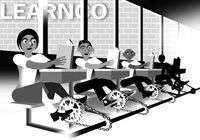
Illustration: © 2008 Stuart Carlson | Reprinted with permission of Univeral Press Syndicate

'American Girlhood' a Must-Read

Elizabeth Marshall's excellent article, "Marketing an American Girlhood" (Vol. 23, No. 2) should be read by every parent, teacher, and librarian as an example of caveat emptor. Sharon Lamb and I wrote about American Girl dolls in our book Packaging Girlhood ("A Series to Buy For") as an example of the clever marketing of girl power. Marshall's analysis of race as a commodity is especially important because we're seeing this marketing approach in lots of products of late.

Just because a doll, book series, or a website promoting a product offers up girls of different races does not mean they promote diversity. It means they're smartly casting a wide net—presenting different girls who are actually all the same in their love for a product. But American Girl promises something more than this pseudo-multiculturalism. Their history books invite girls both to imagine the challenges and struggles of different girls in different times and cultures and to identify with the inner girl—her strength, tenacity, and courage. Maybe that's why it's so disappointing to know that such inclusion is, as Marshall says, superficial (and even historically inaccurate), and to see these wonderful qualities tied closely to expensive products and interwoven with tired themes about female restraint and accommodation.

Pay attention to what mothers teach their daughters, to the representation of boys in these books, and to who gets called "pretty" or "beautiful" over and over (hint: it's not African American Addy). As psychologists studying and working with girls, perhaps what bothers us most is the way American Girl, by price alone, pits girls who have against girls who have not. So much for the inner girl.

—Lyn Mikel Brown
Professor of Education
Colby College, Waterville, Maine
Co-founder, Hardy Girls Healthy Women
(www.hghw.org)

Know Your Schools, Know Your Country

I appreciate your Open Letter to the President-Elect (Vol. 23, No. 2). Right now is the right time for such letters, a time to be hopeful and firm, to tell Obama what's right, what's real, and what he needs to do to enact the will of the people.

If I could join you to add one more imperative to the president's education agenda, it wouldn't be specific education policy prescription or reform. It would just be this: Do something to get more Americans to spend more time in schools.

America is truant. We teachers can cry till we're red, white, brown, black, and blue in the face about what schools need—and we usually know well. But most of America doesn't, and our nation can't craft intelligent school policy if our taxpaying and voting citizens don't spend time in classrooms. Just like in our wars, we send our children there, but rarely do we know what it means to live and struggle there ourselves.

The idea of citizen service in schools needs the type of amplification and promotion that Obama's voice could give. We need inspirational federal leadership, and concrete tax incentives, so that people will take themselves to school, and so employers can write off the labor hours donated. And it's crucial that this service happen during the school day: after school is important, but it's not the whole—troubling and beautiful—picture.

American citizenship was invigorated by this past election, and finding ways for America to spend more time in schools will invigorate us even more meaningfully. The very best news is that a deeper understanding of public schools will not only reform schools, it will send ripples of more enlightened thinking into other policy realms, including health care and the economy. Know your schools and you know your country. Tell America this, Mr. President.

—T. Elijah Hawkes
Principal
The James Baldwin School, New York, N.Y.

Spring 2009

CONTENTS
Vol. 23, No. 3

Cover Story
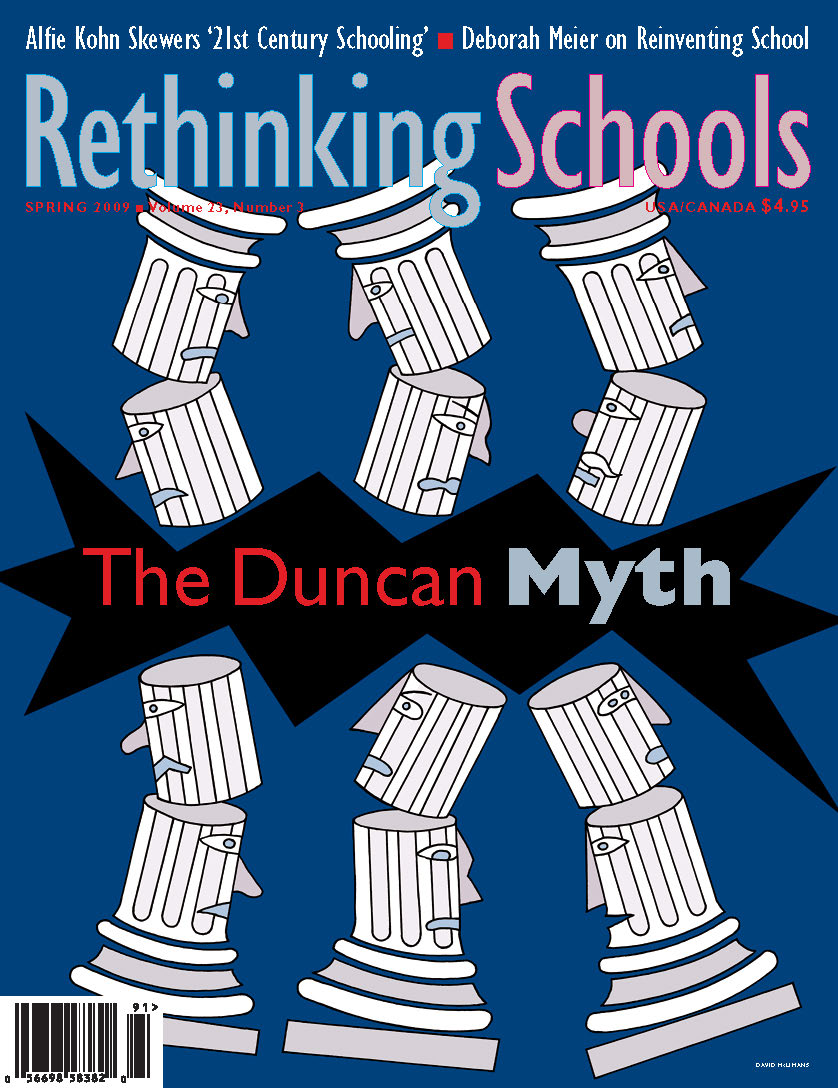
Arne Duncan and the Chicago Success Story: Myth or Reality?

Features
Dunking on Arne Duncan

When '21st-Century Schooling' Just Isn't Good Enough: A Modest Proposal

Knock Knock: Turning Pain into Power

Knock Knock

Silenced in the Classroom

Reinventing Schools That Keep Teachers in Teaching 

Tellin’ Stories, Finding Common Ground

Six, Going on Sixteen

10 Ways to Move Beyond Bully-Prevention (and Why We Should)

Dignity and a Haircut

Teaching Objection


COLUMNS AND DEPARTMENTS

Short Stuff

Letters

Editorial

Good Stuff

Resources

Order Online webrs@execpc.com Free Catalog