The Miseducation of Asian Americans
Illustrator: Cori Lin
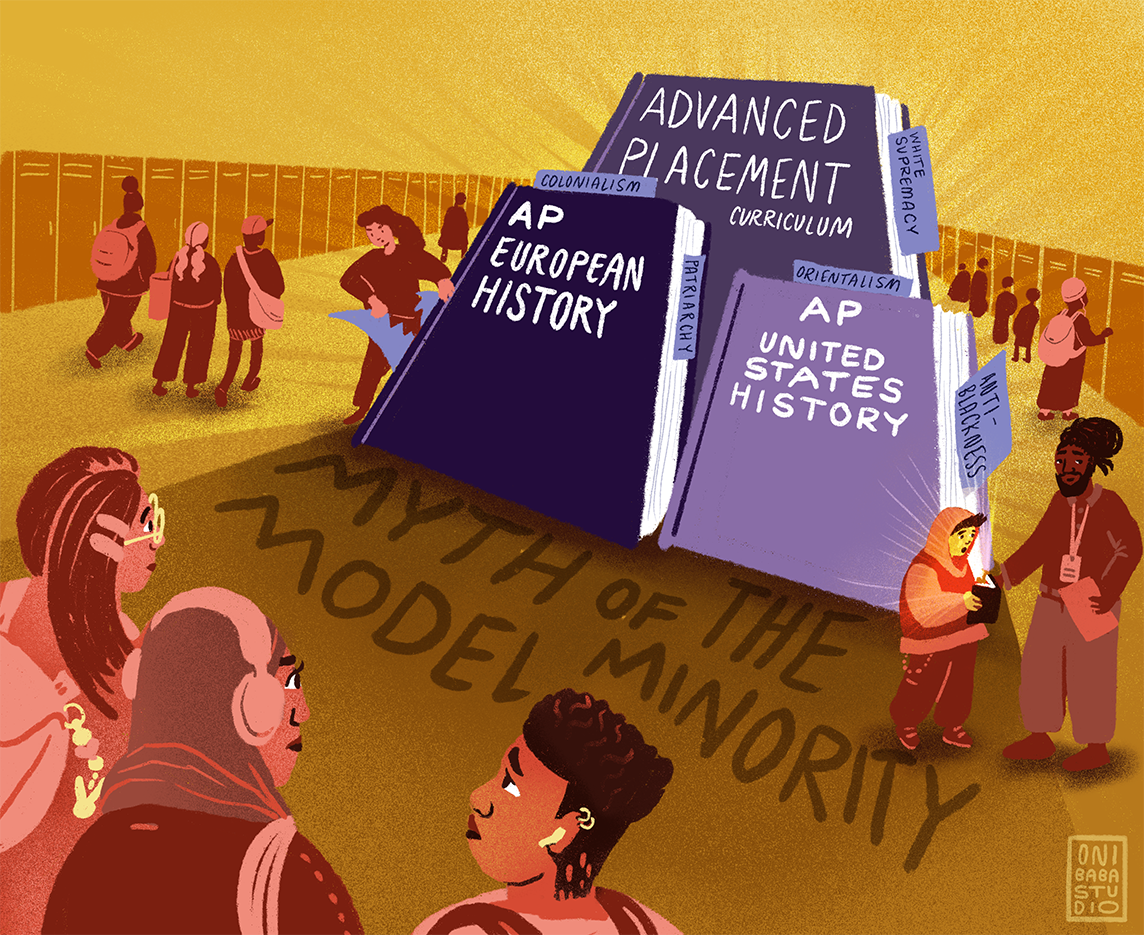
When we interviewed more than 80 ethnically diverse Asian American high school students in New York and California to understand how they make sense of race and educational inequality, we had a disturbing realization:
Most young people whom we interviewed expressed views that revealed their uncritical acceptance of the model minority narrative, which positions Asians as uniformly studious, hardworking, and high-achieving. This narrative also suggests that Black and Latine people are personally to blame for their underrepresentation in advanced courses and selective schools.
Many of these students were enrolled in Advanced Placement classes, and our interviews with them offered a glimpse of the problematic curriculum these classes teach — or fail to teach — about race and racism.
Filipina American Miley noticed that her AP classes overwhelmingly included Asian students, even at a school where more than two-thirds of the students were non-Asian, mostly Black and Latine. Like nearly all her peers, Miley attributed this tendency to Asian parenting and culture. Black and Latine students, she reasoned, did not take these courses because “non-Asian cultures are more lenient.” Similarly, Chinese American Tiffany reasoned that a uniquely Asian “culture of excellence” explains the overrepresentation of Asian Americans in New York City’s academically selective public schools.
Together, Tiffany and Miley’s assumptions obscure the complex historical and social factors, including U.S. immigration policies and race-based academic tracking, that shape racially unequal access to educational opportunity. In our conversations with Tiffany, Miley, and dozens of other Asian American students, we found that they had few to no opportunities in school to unlearn their assumptions and critique widespread narratives that position Asian Americans as uniquely valuing education. Thus, we call on educators to support Asian American youths’ racial consciousness development by incorporating texts and learning activities that push students to critically analyze race, racism, and Asian American identity. In a multiracial democracy, these analyses are essential. And we urge that high school curricula be interrogated for how these embed problematic ideas about race and power, and where found inadequate, be discarded or revised.
What Are Asian American Students Learning About Race and Racism?
Many of our interview participants were enrolled in advanced courses, such as Advanced Placement, reflecting research demonstrating that Asian Americans are more likely than other youth of color to be “tracked” into college preparatory courses. However, in Suneal’s research, he found that the AP curriculum pays little attention to racial literacy — even in courses where race might reasonably be considered, like AP history courses, AP Economics, AP Environmental Science, and AP Language and Composition.
Students in these courses described few, if any, meaningful conversations about race. AP Environmental Science students reported no lessons on environmental racism and racial inequalities that are associated with climate change. Students in AP U.S. History noted only a handful of days that dealt with race, almost exclusively in reference to enslavement and the Civil Rights Movement. In AP Language and Composition, an AP course where teachers perhaps had the freest rein in shaping the content, one student recalled only one lesson on Asians, about someone “from the Middle East when Britain took over.” When pressed, she revealed that she actually meant Gandhi, from India. For these students, the AP curriculum was thin on conversations about racial justice, and especially thin on considerations of Asian Americans.
Many AP teachers in Suneal’s study also recognized the problematic nature of the curriculum they were assigned to teach. They complained of limited curriculum to discuss race, even if they wanted to do so. “Napoleon needs to be dead by Christmas,” a white AP World History teacher remarked. A Black AP Economics teacher similarly avoided race because it was not part of the required curriculum, despite profound economic inequalities associated with race in the United States. “If AP would put [racial issues] on the exam, for sure I would cover it.”
The many Asian students who filled their schedules with such courses thus learned little about race. They expressed never having read work by an Asian author. Only one had ever heard of the concept of a “model minority.”
Miley, who said that her classes did not cover content related to the experiences of Asians in the United States, nonetheless sympathized with her teachers. “Our mindset in an AP class is to pass an AP exam, and I think that’s important,” she said. “Seeing what we have on the test and actually practicing it is a good idea. I would like to see more representation in all the classes, but I can see where the difficulty comes in from having to prepare us for an AP exam.” With the pressures of preparing for an AP exam, Asian students, in AP classes consisting overwhelmingly of Asian peers, learned almost nothing that would help them understand how this very situation came to be.
In New York, Elise found that the Asian American youth whom she interviewed similarly had little opportunity to learn about race, racism, and Asian American identity in their public schools. Before they participated in a summer weeklong youth leadership development workshop sponsored by an Asian American nonprofit, students reported that in their classes they had never encountered concepts such as the model minority, white supremacy, and anti-Blackness.
In our interviews, we found students eager to learn a more critical history. Chinese American Rosie shared, “To be honest, I didn’t really think about my [Asian American] identity” until she attended the summer workshop. Since then, Rosie explained, she grew “more curious to do a lot more research on my own time.” Filipina American Audrey similarly explained, “My school doesn’t have an Asian-centered history course or anything like that,” and nearly everything she learned at the summer program about Asian American history and identity “was new to me” and “really opened my eyes.”
Young people are not the problem. The racist curriculum is.
The “Hidden Curriculum” of Advanced Coursework and Selective Schooling
Amid limited formal opportunities to learn about Asian American identity and systemic racism in the classroom, many Asian American youth learn about these topics through the implicit norms and values communicated to students through everyday routines and structures of schooling — the “hidden curriculum.” Indeed, for students such as Tiffany and Miley, the hidden curriculum of academically selective schools and Advanced Placement — and the overrepresentation of Asian Americans in these spaces — teaches them to assume that Asian American students are more deserving and hardworking than their Black and Latine peers.
However, scholars have documented the complex social and historical factors that contribute to many Asian American students’ academic aspirations and achievement. These include their parents’ high levels of educational attainment, thanks to policies that facilitated the immigration of highly educated Asian professionals. Sociologists Min Zhou and Jennifer Lee have also argued that many Asian American students benefit from “stereotype promise,” — i.e., their teachers’ positive assumptions about their academic abilities.
Amid such widespread assumptions of Asian Americans’ studiousness and work ethic, teachers often overlook and neglect to support Asian American students who struggle academically. For example, students whose families arrived as low-income refugees from Southeast Asia have, on average, lower levels of academic achievement compared to East and South Asian American students from middle-class professional families. Educational researcher Stacey Lee points out that teachers often blame Southeast Asian American students who do not conform to model minority expectations, similar to how many teachers perceive Black students’ academic struggles as rooted in personal shortcomings. The model minority stereotype also contributes to high levels of stress and anxiety among Asian American students and a reluctance to ask for support.
Absent formal curricula that teach students such as Tiffany, Miley, Rosie, and Audrey about the complexities underpinning race and academic achievement, perhaps it is no surprise that they and others whom we interviewed drew on simplistic racial stereotypes to explain the underrepresentation of Black and Latine students in selective schools and advanced courses. In addition, these students’ experiences reveal how the formal curriculum is driven by the content of Advanced Placement and other exams, which rarely attend to students’ racial consciousness development.
Reimagining the Curriculum for Asian American Students
Although most youth whom we interviewed expressed limited understandings of systemic racism and Asian American identity, a handful described learning experiences that supported their racial consciousness development. Notably, these all took place outside the K–12 classroom, such as in the summer youth leadership program mentioned above. These non-school experiences can be transformative, but they are no substitute for the changes that must be incorporated into the formal curriculum.
For example, of the 27 students Suneal interviewed about the racial demographics of their heavily Asian AP courses, only three drew on racism and systems of inequality to explain the relative absence of their Black and Latine peers. For two of these students, they drew on what they learned in a Chicano Studies course they had taken at a local community college to make sense of the racial dynamics of AP coursework at their own school. One credited that course for saving her from an “alt-right pipeline” she had been drawn into online during the height of the COVID-19 pandemic.
Sasha, a Filipina, drew on information she came across in Michelle Alexander’s The New Jim Crow. She said, “During quarantine, when I was reading a lot, I was reading a lot of Karl Marx and a lot of Betty Friedan and Angela Davis and The New Jim Crow kind of fit in there.” She also became fascinated with Che Guevara and his criticisms of U.S. empire in Latin America. None of these is featured in the typical AP curriculum.
She credited Michelle Alexander specifically for teaching her about systemic racism, which she defined as “institutions or laws that have been established for a really long time that prevent certain races or backgrounds from progressing in society.” Based on the texts she read on her own when her school was closed, Sasha was able to develop a structural understanding of racism that led her to a more sophisticated analysis of Asian students and academic success.
The experiences of students like Sasha show that many young people are eager for material that helps them gain critical perspectives on the broader society, and on their own schooling.
There is no shortage of anti-racist curriculum. The organization Empowering Histories has developed race-focused content for AP U.S. History. Tucson’s Mexican American Studies program developed a brilliant curriculum that demonstrated how students come alive and achieve academically when they are exposed to knowledge that draws on their history and honors them as intellectuals. Other ethnic studies courses across the country provide essential curricular space to discuss race and specifically how Asian communities operate within racial dynamics of the United States.
The problem for the 80 young people we interviewed is that this critical curriculum almost never happens in AP classes. If young Asian Americans — many enrolled in AP courses — are to commit themselves to racial solidarity, we need to fight to transform the AP curriculum. In addition, we may need students, teachers, and administrators willing to sacrifice an AP class in favor of building a course in Ethnic Studies. We need electives that directly consider race and racism. And if Asian American students are to “divest from the Model Minority,” as Wayne Au argues, some of that consciousness-raising should go on into critically examining the role of Advanced Placement courses.
This will be hard. As some communities work to expand Asian American studies and ethnic studies more broadly, others at the local, state, and federal levels seek to entirely eliminate mentions of race or racism from public school curricula. Yet as education scholar Eve Ewing reminds us, now more than ever, we must continue to envision and make space for the kind of education we want for our children, and, as she says, “fight like hell to make it real.”