Teaching About the “Stuff That Is Actually Happening”
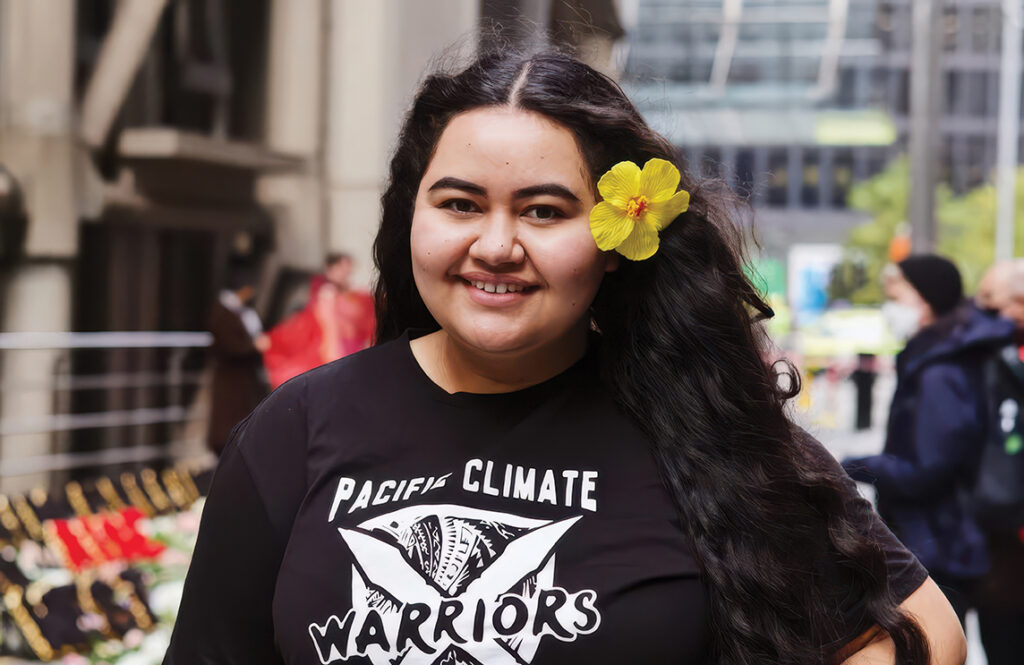
Photographer: Natasa Leoni
All of my “credit recovery” 2025 summer school social studies students were new to me and came from five different high schools and alternative programs. I had three weeks with them.
In her first-day questionnaire, Sky wrote: “I want to talk about the stuff that’s actually happening.” Yes. But with everything unfolding in the world, where to start?
What finally grabbed our classroom of 15 was learning about climate change through the eyes of climate justice activists — “today’s civil rights leaders for the planet,” as Amelia wrote in her class reflection. I wanted to show the students resilience and collective action across cultures and generations. I wanted students to see young people of their generation who are Indigenous and allies, unapologetically fighting together for a common cause. I found that power and support in the classroom through three anchors: Chamorro human rights lawyer and climate justice activist Julian Aguon’s latest book, No Country for Eight-Spot Butterflies; the documentary The Forgotten Pacific, narrated by Pacific Climate Warrior Brianna Fruean; and Naomi Klein’s young people’s edition of How to Change Everything.
No Country for Eight-Spot Butterflies
With a mix of poetry, personal narrative, and love for the people of Guam and Oceania, we heard Aguon’s voice in the classroom: “Despite what we’ve been told, the world is not ours for the taking,” starts the chapter “My Mother’s Bamboo Bracelets: A Handful of Lessons on Saving the World.” We annotated, journaled, and talked. Aguon takes us on a journey about taking action. “No offering is too small. No stone unneeded. All of us . . . all of us, without exception, are qualified to participate in the rescue of the world.”
“I feel like I’m just going to highlight the entire reading,” said my student Jasmine, marking line after line and nodding along.
The International Court of Justice (ICJ) issued a historic unanimous opinion that countries are legally bound by international law, including human rights law and environmental treaties, to protect current and future generations in the face of climate change, including limiting global warming to 1.5 degrees Celsius, as the Pacific Climate Warriors had famously been demanding. The court’s opinion was announced during my three weeks with students, and I couldn’t wait for them to see the news clip the next morning. We had done my role play on Indigenous climate justice activists from across the Pacific and learned the stories of climate impacts, but also the long-standing injustices exacerbated due to climate change. In the case of Guam, several students expressed surprise to learn what it means to be a U.S. territory and discussed the issues and brainstormed possible responses as allies from afar. A few days later, we watched a video by a panel of legal experts and youth climate activists on the ICJ Advisory Opinion. As Aguon spoke about the significance of the ICJ opinion, Sky said, “This is like a big deal, right?” I nodded. The lessons had become real and meaningful. “So now what?” Kai said from the back of the classroom. “Like what happens?”
“I don’t know,” I said. “I hope this means more justice and the world takes notice of the Pacific.”
The Forgotten Pacific
Shortly before, we watched the documentary The Forgotten Pacific, and saw the climate impacts on Fiji, Sāmoa, Niue, Vanuatu, and the Marshall Islands. They also had researched Brianna Fruean, one of the youngest climate justice Pacific leaders, who has been a prominent climate activist since age 11, when she became the country coordinator of 350 Sāmoa. She became a beloved name in our classroom.
In the documentary, she travels through the islands interviewing people from the local communities as they share experiences and worries, but also describes why and how they love their islands. It’s a love letter that seemed to leave my students moved and wondering why we aren’t all taking action. Three students wrote journal reflections about Brianna’s quote from the documentary: “I don’t actually believe that the climate crisis is the end. I actually believe it’s the beginning. The beginning of an environmental renaissance.” “Teachers should be teaching all of us about this. She [Brianna] is right. If we know that the islands in the Pacific are going through all of this first, why aren’t we trying to figure out how to do right by them?” wrote Dani. With a documentary less than a year old, the students related to the current state of the planet and the journey of Brianna as a young activist, modeling who they can be too.
How to Change Everything
Naomi Klein’s book for young readers, How to Change Everything, was our steady guide to capture the entire unit’s ideas and thinking — unpacking unfamiliar concepts. Gentle in the way that the pages lay out, Klein’s chapters were helpful for my students who ranged in reading levels from early elementary to college; everyone could enter into talking about and analyzing the reading. We repeatedly came back to her words that “the movement to stop climate change must be a movement for social and economic justice as well.”
My students learned about sacrifice zones, the role of the coal industry, the meaning of climate debt, and more. Klein asks us to imagine what would happen if “disasters were turned into opportunities to empower and strengthen the public good.” How to Change Everything anchored our discussions, our unpacking of stories from multiple sources of Indigenous communities and activism by allies.
We said our heartfelt goodbyes after our three-week summer school journey, with so many unfinished conversations and opportunities for connections.
That night, tsunami warnings hit across the Pacific, from my home islands of the Ryukyus to where my extended family reside in Hawai‘i, and my friends on islands across the Pacific Ocean. Fear spread quickly among my family and friends, uncertain whether this was the big one that would devastate lives and communities, or just another emergency warning that we are now accustomed to — or both. My mother did not have to evacuate, but we chanced it. My auntie on another island did evacuate inland. And my best friend’s cell signal dropped mid-conversation, two hours before the tsunami was to hit Maui. Thankfully, everyone is OK. This time. But what about next time?
I wish I could regroup my summer school class to talk together and be in community, as they saw these news flashes on their social media feeds. I would confirm to students: Yes, science tells us that the tsunami was a direct effect of the 8.8 earthquake off the coast of Russia. But there are other layers of atrocity. And these are human-made. And as Naomi Klein wrote, we must learn in these moments of disaster so that we can make positive change. We are all qualified to help the planet right now, as Julian Aguon so beautifully writes, drawing on the precious lessons he received from the late Marshallese global justice activist Tony de Brum: “To remember that in the face of injustice, there is nothing more important than impatience. Because the time for justice is always now.”