Six Stories, One Fight
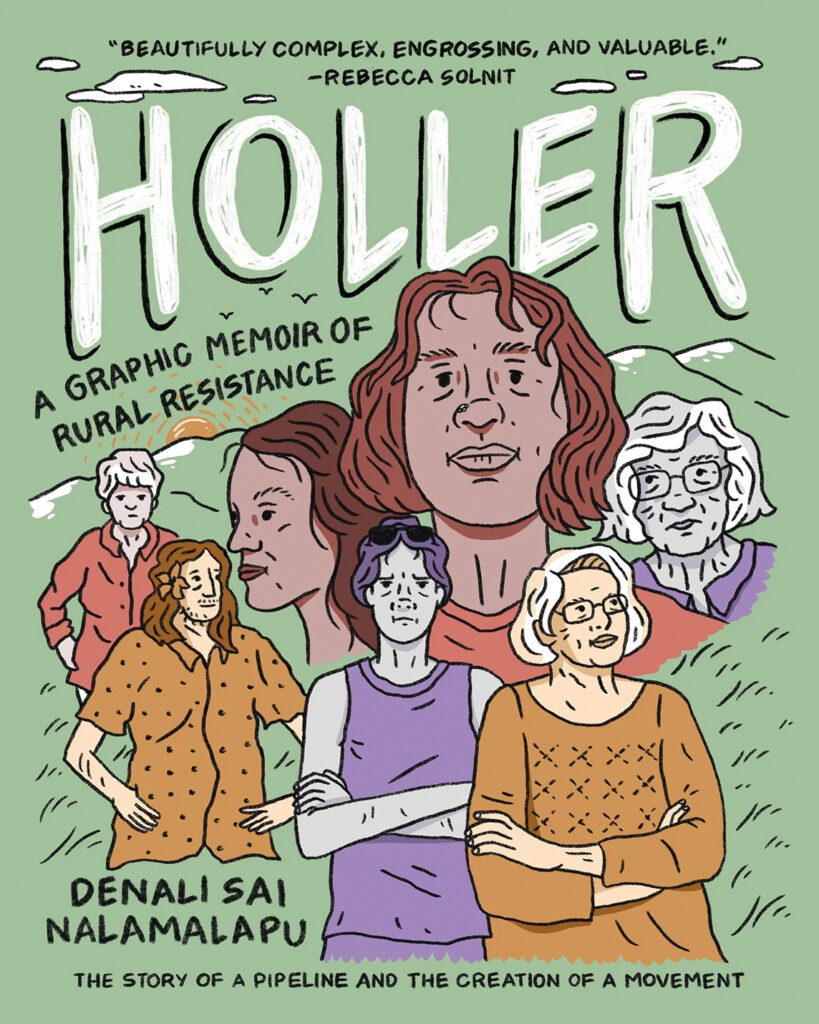
Holler: A Graphic Memoir of Rural Resistance
By Denali Sai Nalamalapu
(Timber Press, 2025)
171 pp.
In her excellent Rethinking Schools article “Protesting Pipelines” (Volume 35, No. 1), Ursula Wolfe-Rocca wonders about the absence of these “terrible tubes” in our classrooms: “Given the pure physical immensity of fossil fuel infrastructure in North America, one would think pipelines would be a more prominent fixture of our consciousness and curricula.” Agreed.
Here is a new resource that helps our students consider not only the environmental awfulness of pipelines, but also the beauty of the popular movement to fight them: Denali Sai Nalamalapu’s graphic memoir Holler.
The book is the story of Nalamalapu’s growing awareness of the everyday heroism of rural resistance against the Mountain Valley Pipeline (MVP) in Appalachia. What I love about the book is its celebration of “ordinary” activists — even when they “lose.” In fact, the book implicitly critiques the wrongheaded win-loss calculus that often infects our thinking about the accomplishments of social justice activism.
“Protect what you love,” Nalamalapu begins. “That’s why we resist the Mountain Valley Pipeline.” In the book, we meet six Appalachian residents who became pipeline resisters: Paula Mann, a West Virginia photographer; Karolyn Givens, a Virginia nurse; Becky Crabtree, a West Virginia teacher; Crystal Mello, a single mom in Virginia; Michael James-Deramo, a Virginia student; and Desirée Shelley (Monacan Nation), a Virginia seed keeper.
But the story begins with Nalamalapu, a child of South Asian immigrants raised in coastal Maine. A big-hearted child, “The world often felt heavy with suffering.” It was Nalamalapu’s love of the outdoors combined with an encounter with climate justice organizers from marginalized communities that led them to join — and to chronicle — the fight to stop the MVP. We learn about the stupidity, greed, and danger of the pipeline through Nalamalapu’s portraits — simple drawings combined with brief stories of each of their interlocutors.
Paula Mann grew up in West Virginia: “My mommy and I would walk through these woods and she would teach me about the plants and critters that lived here.” Disgusted by the doubletalk of an MVP informational meeting, Mann traversed the countryside with her dog Rusty, photographing potential impacts of the pipeline. Its route ran through boulders, over aquifers, and through the Jefferson National Forest. Mann’s photographs became part of the educational campaign against the pipeline. Thanks to anti-pipeline activism, the Forest Service forced a change in the MVP’s route — a small victory, but one that kept Mann continuing to document pipeline threats. As Nalamalapu concludes after their time with Mann: “Can you imagine if more people turned their love of the land into action?”
Cancer survivor, former nurse, and science professor Karolyn Givens focused first on what would happen if the pipeline exploded — which it could. “If you’re in the blast zone, near the pipeline, you’re vaporized. Nothing is left of you but gas.” Givens shared her research at pipeline resistance meetings, in court, in congressional hearings, and before regulatory agencies. Givens credits her early fight with childhood cancer with her capacity to continue the struggle against the pipeline. Nalamalapu concludes: “There is so much heartbreak in uncovering the true horrors of a pipeline project this reckless and poorly planned. And yet for the most determined this hurt is necessary for survival.”

West Virginia high school science teacher Becky Crabtree describes her teaching modestly: “Some days I’m not sure I’m a good teacher” — a doubt that will feel familiar to many of us. But Crabtree strives to get her classes outdoors to connect students to nature — “this class is my quiet resistance to those people who put money above everything.” When agencies and courts ignored the science, “my faith in the system was shattered.” Nalamalapu describes the impact of Crabtree’s activism: “Your love for your home grew as you defended it.” Crabtree turned to civil disobedience, chaining herself “to my beloved 1970s Ford Pinto to stop construction” of the pipeline. The segment on Crabtree ends: “I know I am standing up against powerful forces. But that doesn’t scare me. I am at peace.” Her Pinto’s bumper sticker reads hopefully: “THE FIRE IS SPREADING.”
Crystal Mello had her first child when she was 16, while her daughter’s dad was in jail. Mello’s consciousness of racial injustice grew, as she saw how her child’s Black family was treated compared to her treatment as a white woman. She joined protests against white supremacy in Charlottesville, Virginia. As cops protected the pro-Confederate demonstrators, they tear-gassed anti-racist protesters. Out her window, she later noticed the cut in the hills for the MVP. She heard about the tree-sits near her home and she went to join them, buoyed by banners like NO PRISONS, NO PIPELINES, connecting issues she cared about: “I’ve seen how different types of injustice hurt each of us in different ways.” Mello’s working-class sensibility makes her long for a fundamentally different society: “Because we do a lot of the grimy work. The housecleaning, retail gigs, grocery store cashiering . . . we have an important perspective on the better world ahead. That’s why you work so hard. You feel the stakes are too high to rest.” Nalamalapu notes that Mello’s tough life “can tear some people down . . . or it can make you want to fight to protect people.”
Michael James-Deramo grew up in the Blue Ridge Mountains. He saw the environmental violence of coal mining and was a founder of the Virginia Student Environmental Coalition — educating, launching get-out-the-vote efforts. And then Trump was elected. “His election emphasized how powerless we felt working within the system. It made us want to build our own power rather than appealing to people in power.” James-Deramo’s anti-capitalist consciousness grew as he landed on the key insight that “the whole system prioritizes wealth.” And although James-Deramo and colleagues found the exhilaration of direct action against the pipeline, it took a toll on his health. The book is clear-eyed that people are not struggle-units — they get tired, they get discouraged, and they lose hope. But Nalamalapu’s conversations with James-Deramo reveal his resilience: “Can you think of anything more beautiful than standing alongside those you love and staring hopelessness, isolation, and collapse in the face?”
Desirée Shelley is a member of the Monacan Nation (also with Polish roots). She urges place-based communities: “Because if you’re not connected to the land you live on, you might not fight as hard to protect it.” Shelley grew up in Baltimore but moved to Roanoke County, Virginia, to be closer to her ancestral homeland. “By reincorporating our Native traditions into my life, I grew increasingly connected to the land.” But the Mountain Valley Pipeline threatened the land, and even crossed Indigenous burial mounds on Bent Mountain: “I went to Bent Mountain and saw an Eastern Siouan burial mound like those built by the Yesah people.” This sparked Shelley’s commitment to fight the MVP, even though it did not cross the land she personally lived on.
But, no. There was no balloons-in-the-air victory over the Mountain Valley Pipeline. West Virginia’s Joe Manchin, the despicable senator from the coal industry, extorted Joe Biden and got the final approval for the MVP. So we lost. And yet.
Holler calculates victories and losses not only in terms of pipelines built or pipelines stopped, but in terms of the consciousness nurtured, the flowering of intersectional organizing, the ties between diverse communities, and the commitment of so many to continue to work for something better. Nalamalapu writes: “As the world I know collapses because of human greed and extraction, all I have is these warm hearts. And this gentle breeze.”
We need more Hollers — books that chronicle and celebrate the capacity of ordinary people to imagine and build toward a new world.