My Student Yamato’s Story
Illustrator: Keith Henry Brown
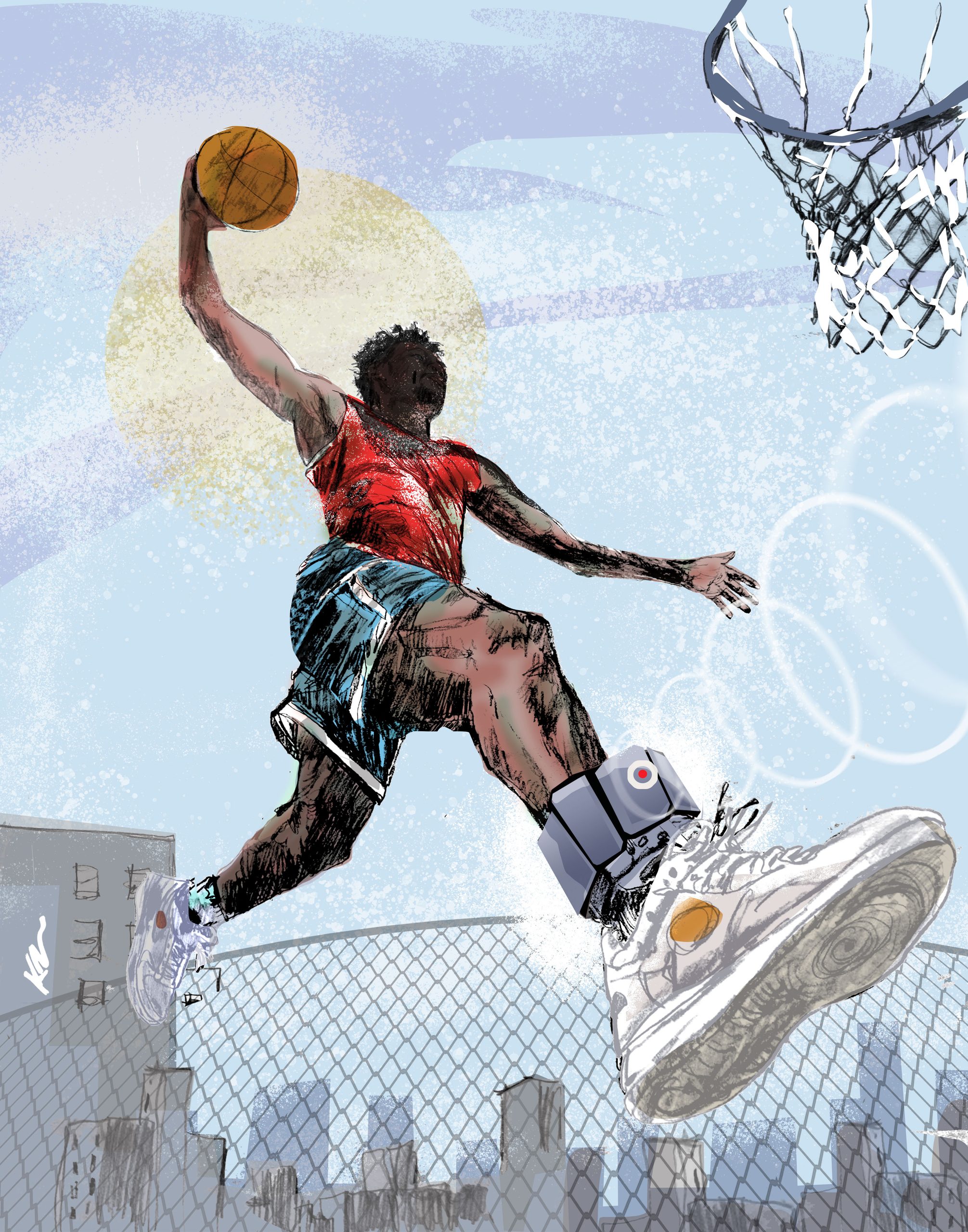
If you wanted a good chuckle, you could watch me try to play basketball — my old bones creaking up and down the court, my Will Ferrell look-alike body offering only marginal skill. You might wonder if there’s a reboot of Semi-Pro being filmed. In stark contrast, there is nothing funny about Yamato Sow’s basketball game. There is only the effortless ease, the soft twist of his body, the natural jump shot you expect to see on ESPN from young college players who carry the love and skill for the game in their very being.
It’s early Sunday morning, and Yamato and I are playing basketball at a gym near the Jet Propulsion Laboratory in Pasadena. About 20 rotating old guys play pick-up here each week. I’ve been coming for the past decade or so, whenever my body heals enough to make another go at it. Yamato joins us at 6:30 a.m., only he hasn’t played basketball for seven months.
For seven long months, Yamato Sow was locked up by Immigration and Customs Enforcement (ICE) in a detention center in El Paso, Texas.
I look down at his ankle and he catches my gaze. Protruding from his sock is a black plastic monitor — an electronic ball, only with a digital chain.
“Do you like it?” he asks, smiling. “It’s my sponsorship. I am sponsored by ICE.”
A few of the guys who don’t know the story send puzzled looks. The ankle monitor keeps a digital record of his movements, a condition of his recent release. Before this sponsorship, Yamato was nearing the end of his high school years in Altadena, a suburb of Los Angeles. But to understand how he ended up here — on a basketball court, free but not free — you have to go further back.
On the drive home, Yamato tells me he knew early on that he wanted to play basketball, and that the dream was always Los Angeles. He played at a recruitment school in Senegal, a preparatory program where young players trained while waiting for scouts who might open a door to the United States.
“The scouts saw me,” he says, “and I had some height and talent. So they brought me to L.A.”
He was placed in a preparatory school, but his handler didn’t like the situation with the coach and urged him to transfer. That decision, made by adults, not by Yamato, is where the trouble began.
International students come to the United States on one-year I-20 visas. The I-20 is everything: proof of enrollment, permission to stay, a passport of sorts that determines whether your life can continue uninterrupted. When Yamato left his first school, they refused to give him his I-20. The next school issued a new one.
“That was the big issue with my visa,” he tells me.
For the next two years, Yamato transferred from school to school, and his faulty paperwork followed him like a shadow.
Back at the gym, one of the old guys sidles up to me on the sideline. Nodding toward Yamato, he says, “He’s not even trying; he makes it look easy.”
The game ends. Guys line up to shoot for next. Almost on cue, Yamato strolls to the rim and reverse dunks the ball effortlessly.
“To jump like that,” I say. “It might take me a trampoline to do the same.”
As an administrator in Altadena, I got to know Yamato when he came to Aveson in the fall of 2024. Yamato is outgoing and friendly, and I make it a point of getting to know new students. By April of 2025, Yamato boarded a bus headed from Los Angeles to an Amateur Athletic Union tournament in Memphis, Tennessee. In El Paso, Border Patrol stopped the bus. Agents collected paperwork. Yamato handed over his I-20 and waited outside the bus.
An hour later, he was in a holding cell.
“The only thing they didn’t do was put a muzzle on my face.”–
“They had these bright lights on me,” he tells me later. After hours alone, an agent informed him he was being detained.
“Do you want a last cigarette?” the agent asked.
As a practicing Muslim, and not about to start a habit built on self-harm, Yamato declined.
The last game at the gym winds down. Yamato sits beside me on the floor and takes off his shoes, a basketball ritual. When his aunt finally let me know that Yamato was being released, I asked her if he wanted to play some basketball to keep his spirits up, and I can tell these old players are not much by way of competition for Yamato. He nonetheless enjoys the run. In the car, I ask him about the detention center.
“Mr. Ian,” he says, “it was the worst of the worst. The only thing they didn’t do was put a muzzle on my face. In there, you have no rights at all.”
ICE agents confiscated his phone, his backpack, his school computer, and his tasbih — prayer beads, the Muslim equivalent of a rosary. Alone, stripped, and dressed in a prison uniform, they placed Yamato in a holding cell with 80 other detainees, one of the youngest among them. The humiliation continued. Not long after first arriving, while taking a shower, guards stood watching him and laughing.
He kept expecting someone to come help him. No one came.
He tells me about El Haj, another Senegalese young man he met inside. El Haj was locked in a brightly lit room for 48 hours with no food and no water. He drank from the toilet to survive. Three days after being told his papers were clear, and that he was returning to his home on the east coast of the United States, El Haj was deported to Senegal.
“This is how they take the dignity out of somebody,” Yamato says quietly.
Medical care was almost nonexistent. Yamato developed a skin condition that persists to this day. Detainees were separated by color, blue jumpsuits for those without criminal charges, orange and green for others. Even so, the treatment was the same.
“They speak to you like you are not human,” he says. When he asked why, no one answered.
Some days, Yamato tried to harden himself. “My auntie would call me on the phone. She told me that I couldn’t let them get to me, that I couldn’t let them take away my dignity. She told me to think of a large rock. Nothing will move the rock. Nothing will break the rock. Be hard like the rock. Nothing will get through. I told myself to be like a rock,” he says. Other days, he had nothing left to say at all.
He worried about his sisters. He worried they might forget him.
“I didn’t do anything wrong,” he told his mother. “I’m supposed to be a good example.”
Back at the gym the next Sunday, Yamato runs the court lightly, like gravity is optional. The ankle monitor clicks softly against his shin. He smiles. He jokes. He shoots threes. He dunks. He plays.
And still, the question lingers — unanswered, unavoidable: how a system that should educate and uplift young people instead delivered one of them to a cage, and then returned him to us wearing a digital chain. In November of 2025, Yamato was released from his confinement in El Paso. The journey to get him there was anything but simple. I spent hours working alongside his pro bono attorney, speaking with his auntie, tracking down missing paperwork, correcting a broken I-20, making calls, sending emails, and pressing wherever pressure might still work. None of this appears in any curriculum guide. And yet, this is education today, the fruits of fascism, of racism, of a system that is both dependent on immigrants and deeply antagonistic toward them, a system that criminalizes young people for administrative errors they did not create.
Yamato’s fight to pursue his dream of playing college basketball has only just begun. I am now working with him to connect with local coaches who can help him navigate what comes next, and we are looking for ways to fund his tuition at a local community college. But Yamato’s story forces an uncomfortable reflection for educators. We can teach, mentor, coach, and love our students fiercely, and still, it may not be enough. The new reality demands more. Educators must now learn how to help students navigate the treacherous waters of immigration systems that lurk beyond the classroom doors. For educators today, our most important work begins where the classroom ends: helping a student hold onto a dream when the world seems determined to take it away.