An Ode to Altadena:
What I Did When My Home and School Burned Down
Illustrator: Frances Murphy
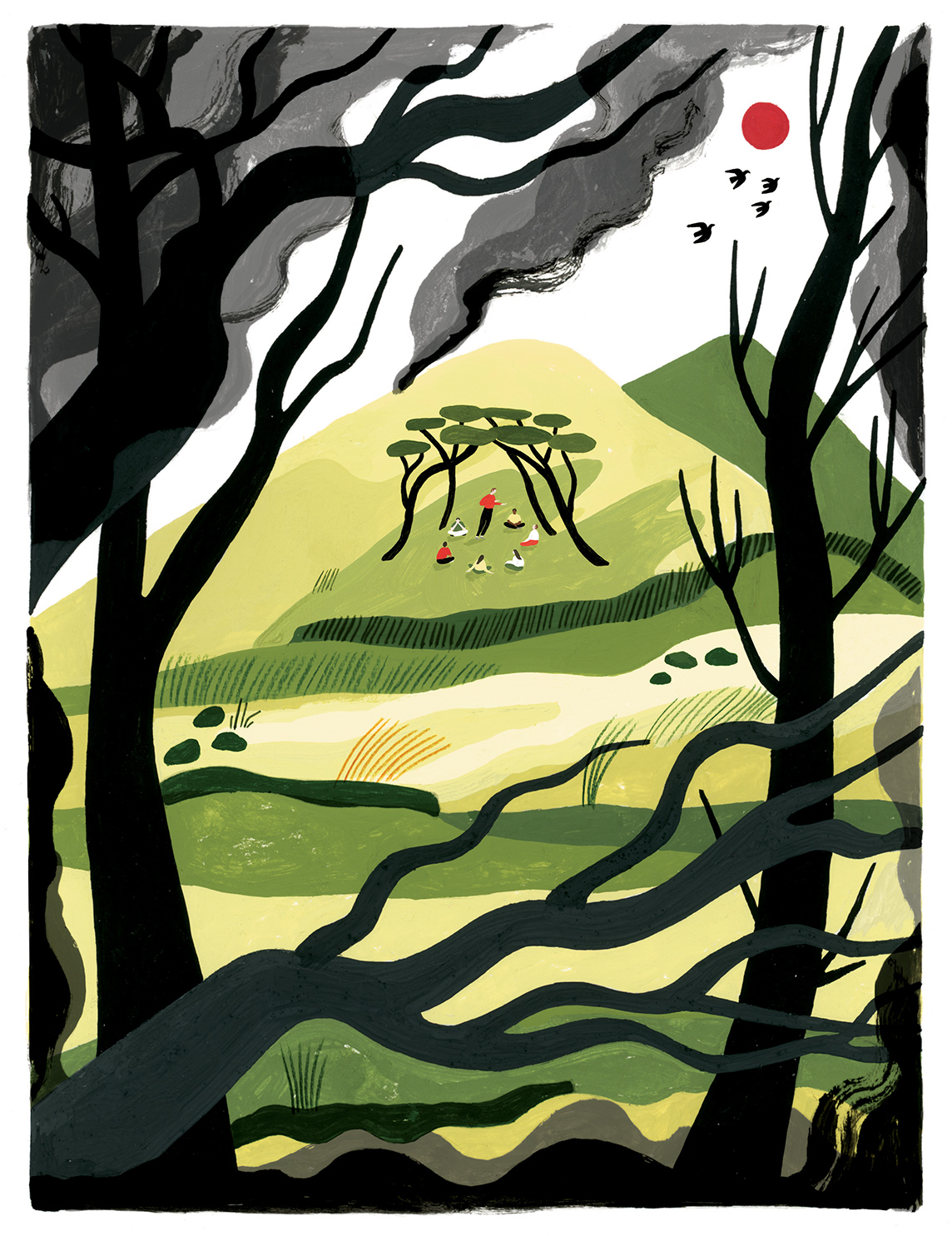
My ode sings
for our teachers
advising our students
while wearing other
people’s chino pants, or
work shoes a size too tight
Your patience in
rooms of half-size, with
white bed sheet walls
and one bathroom for 30 adults
it sings for you my ode
My ode asks that
we too sing for others
Lives spalded on a burn scar
Of Alta pine
or Concha, Wapello, Mount Lowe, Dolores
or Sunnyoaks Circle, Stonehill, or
Windfall or Palm, or Lincoln, or Lake
On January 7th,
From Olive, or Laurel, flames
lit Poppyfield and poppies,
Laurel and hills waves of flame
A monument to our Anthropocene
My ode shines upon staff
Just as Ali sings his immigrant ode from
Iran
To us all,
He did not lose his home in the fire
He said,
“But I know what it is to lose —
When I came to America
I too lost
everything.”
I did not watch the news after the fire. I didn’t need to. Destruction was everywhere. Watching a broadcast felt sterile in comparison to the reality; the difference between marching in a protest and watching one on Fox News. On Jan. 7 of last year, when the Eaton Fire swept through Altadena, it tore 19 lives away, destroyed 12,000 structures — 7,000 of them homes — and left schools, including our own, in ashes. Among the wreckage, my own home swept away among the lost.
A few days after the fire, perhaps a week or so, as the superintendent of Aveson Schools, I met reporters from the New York Times at our burned down campus. As we walked around the debris, I tried to find something positive to hold on to amidst the destruction. Classrooms were reduced to melted steel girders, attached to protruding pipes, roofing nails, ash, half melted tricycles, charred file cabinets, the remnants of a teacher’s desk. At the visitor parking lot, I remarked to the reporter that the large pine trees were largely untouched by the fire. I remembered a quote from Richard Powers’ The Overstory:
A forest knows things. They wire themselves up underground. There are brains down there, ones our own brains aren’t shaped to see. Root plasticity, solving problems and making decisions. Fungal synapses. What else do you want to call it? Link enough trees together, and a forest grows aware.
Perhaps trees did this during the fire — sharing resources, sending nutrients to protect those that would survive the calamity. I’m convinced that the pine trees at our school didn’t just survive by chance; the natural world, through its response to chaos, protected them. Our stories too provide nutrients. We share stories with our families, we share them with our loved ones, we share them with our closest friends when we find a relaxing Saturday afternoon. Our stories are the connective tissue of our communities — roots from trees that extend beyond our own lives and that sustain and nurture those around us, especially during times of hardship.
Altadena Odes
After the fire, and after my family and I moved four cities east of Altadena, I would wake up late at night and write. My thoughts kept returning to images of our neighborhood. I pictured the small things: coffee shops, pizza joints, the local pub, the way the afternoon light would turn the mountain purple in October. A friend recommended that I read a poet whose writing focused on those small things, places, and people. In Gary Soto’s 2005 Neighborhood Odes you find wonderfully poignant poems centered around his neighborhood, childhood, and the small things found in one’s life that carry profound lessons. For Soto, he explores ideas such as his “parque” or “chicharrones” or his brother’s shoes in these brilliantly crafted poems that help put a shape on the small things of our lives that carry big messages. I wanted to use these poems as a place to ground community writing in the often overlooked small things that we all were missing in the aftermath of the fires. When we evacuated our own home, my children scrambled to find anything of value they could gather. Our two young girls remarked later that not one of their stuffed animals was left behind. Our elder child also tried to grab the Grist & Toll, our special cooking flour. I turned that idea away, a dull brain moment of mine that overlooked the small wonders of a household and the voice of our child.
A Community Gathering
Shortly after the fire, our school community, a small public charter district with two schools and 20 years of history, gathered now in Duarte, about three towns east of Altadena. As a public school, we accept students from the surrounding area, mostly from Altadena, with the purpose of centering their experience as inspiration for study and learning. At our middle school, we reflect the diversity of Altadena, with more than half students of color, and more than a third from families who struggle economically in the increasingly high-cost Southern California. The town hall meeting was our first gathering, and the fires had not completely been contained yet. Folks filed into a full banquet, provided by Mercy Chefs, who made beef stroganoff and Italian salad with French bread for the hundreds of folks in our community. Once in the auditorium, I began by letting the community know that we were going to do some writing. The English teacher in me never dies. I asked them to remember our campus, to remember things that were special to them; I asked them to remember the stories, and the memories, and the history; to remember their place in our community; I asked them to write and not stop writing, to let their writing honor our school, or Altadena, or their experience; I asked them to write their minds, reflecting personally. I didn’t need to let them know that this was a quiet exercise. About 500 people, community members, students, parents, grandparents quietly settled into their chairs as administrators and I scrambled to hand out paper and pencils and any journals we could get our hands on.
When they finished their writing, I asked them to turn to a partner, to listen with their bodies and to take turns sharing what they wrote, or what was on their minds. Trees, in moments of peaceful coexistence, will grow to the boundaries of nearby trees, leaving a separation that allows the other tree to grow into the space.
Students’ words were impossible to forget. Leo, a 3rd grader shared what he admired about our school: “I love Aveson. I miss Aveson. I wish I could be back. I feel heartbroken, sad, scared, and worried. We are still here and we will help. I will help. Hopefully you will help and Aveson School will be back. We are the heart of Aveson.”
Levi, a board member, parent, and avid conservator of nature, had just finished a project where he tore up concrete to put in natural paths for students to play in during recess. The project was spectacular, the kind that is centered around climate resilience and it was his second such project in as many years. On a walk of the campus in the fall he brought up a familiar refrain: “The land needs to cool, and we can help it get there. Run your hand over the concrete to feel how intensely hot it is; now do so on the dirt here. See the difference?”
Levi’s reflection that night hit at some harder truths:
when the mountains sent fire
i am here at the feet of the mountains
they have sent fire on the wind
the smoke has cleared and ashes remain
quiet
friends reach out
to connect
touch
stories begin to form
deep breaths
catching air in my lungs
we are alive
survivorsthe story shifts
what are our needs
what happens next
what can be saved
what has been lost
what comes next, and then after that . . .
Writing in this context was about processing pain — creating a space for our community to breathe, to be close with one another; to be present. I was less interested in the sort of meeting where a few of our loudest voices were heard over the totality of everyone’s experience. I didn’t want a lecture, but a space that provided a template for how folks might do their own processing in their own time. I wanted to begin with healing and that begins with reflection and listening.
Our board member president Juan Carlos Perez joined me at the front of the auditorium to say a few words about community. “We just want to say how deeply moved and inspired we are for the work that our community is doing for each other, how they are showing up for each other.” He was effusive about the work of our Aveson Community Organization (think PTA), which had organized to provide survival to our impacted families. So much of that work centered around clothing drives, systems of thoughtful and kind intervention; the way families showed up with trucks to help move families who were being moved from hotel to hotel; the way those without clothing or toiletries were given those necessities. The lists of activities were powerful demonstrations of our community resilience. I offered a small anecdote that a friend of mine from Portland reminded me about after the fire: “Hope is a verb. You don’t have to be optimistic, but you do need to be active.” A few weeks later, in mid-March, I gathered up staff from our middle school and high school for a writing workshop.
Staff
As staff settled in for our workshop held at the Armory in Pasadena, we read aloud Soto’s “Ode to Mi Parque.” I asked them to write down words or phrases that struck them, and then had them share with their shoulder partner after about 10 minutes of thinking time. Soto’s poem explores Sundays in Soto’s neighborhood park, and is chock-full of details that speak to the uniqueness of his culture and community:
And bark from
The eucalyptus,
Those tall trees
Like elephants.
Wind shoves smoke in
My face, stinging
I asked our staff to create lists of places or particular memories of our school, our neighborhood. Details flew around the room: Unincorporated Coffee, Fair Oaks Burger, the farmer’s market at Loma Alta Park. As they wrote, I wrote down their lists on large notebook paper. Arlynn, who lost her home and has lived in the community for more than two decades, wrote about her growing up near a favorite restaurant: “. . . my Uncle Alex lived in the guest house on Palm Street behind Fair Oaks Burger. When I stayed at my aunt’s house, and we would share a twin bed with my three children, we were like chicken apple sausages in a tube.”
Other staff focused on trees in the community, or their commute down Altadena Drive in the morning on their way to school, or the scuff of trees left standing at the top of Eaton Canyon, seemingly untouched by the destruction like a “crown of green” amidst the barren ash gray. Over the coming weeks, staff sharpened their writing for future reading events.
Students
An ode to the apple tree in all its glory,
Every spring you would arise,
Every fall your leaves would die,
Giving nectar to the butterflies every night,
While in the day the squirrels would climb up at sunrise,
I would read there sometimes, quiet and calm.
We’ll never forget you, great apple tree.—Christopher, 5th-grade student
In mid-April, Amelia Weinstock, our 5th-grade teacher, and I co-taught the same lesson with students, but focused on Soto’s “Ode to Los Chicharrones.” I passed out chicharrones that I picked up from Vallarta Supermarket that morning, and had students try a bit. The crunching was cacophonous, as students chomped away. Jules, a student at the front, let me know that “I don’t eat chicharrones without Tajin. Do you have it?” Of course, I had forgotten to pick that up, but he held firm to his eating standards.
I had students describe what they ate to their partners. I asked them to be as descriptive as possible. As students raised their hands for seconds, Amelia and I walked around the room to listen in. “Chicharrones are like concrete sponges, they have holes in them, but it feels like it could break my teeth.”
And: “I like the flavor, but the crunch hurts my gums.”
We then read Soto’s “Ode to Los Chicharrones” together. Soto revels in the musicality of this particularly delicious food, how the “music is a crunch on the back molars,” and he alternates between Spanish and English with dexterity and purpose. I wanted students to think of the place that food holds for them in their lives, in their own upbringing. I also wanted them to appreciate the rich and varied food from Altadena. More than this though, I wanted students to engage with their memories, and food helps connect us to our past. My hope was that by engaging with memory, students could engage with the trauma of losing their school, and for many of them, their homes. The renowned doctor Gabor Maté writes that “Children don’t get traumatized because they get hurt; they get traumatized because they’re alone with the hurt.” I wanted students to be together in community, to have memory of what we loved together. I had them list out places and foods they connected with. A student mentioned Pizza of Venice, a local establishment that made Pizza Bolognese; Julie reminded me to not forget “their bomb chicken wings.” Robert, another student, mentioned Minik Market, a small locally owned organic food store that had opened a few months before the fire. “Don’t forget Side Pie Pizza,” another student responded.
Over the coming weeks, Amelia wrapped up the lesson by honing students’ drafts with Byron Flitsch, a talented colleague who also lost his home in the fire. They created an anthology “Rise from the Ashes,” a collection of writing and photography from Aveson’s 5th-grade classes. The compilation held stories, odes, and images that told a broader story of loss and hope.
Each fall and spring our school engages in what we call the “Celebration of Learning.” It’s a moment in the evening when families and students gather to see the work students have produced. Students present their work to authentic audiences, sharing insights and observations about their learning in real time. That spring, although our school had been relocated to a temporary facility, co-located with another school community, families filed in to see the creativity of our students and staff. The energy was a mixture of joy and pain. I watched as families bought out all the copies of the poetry and photography compilation, whose proceeds went to support victims of the fire. I also watched a father who had lost his home crying while reading his child’s poem outside of the classroom. Families hugged one another while picking up cookies donated by our ACO. One parent told me that “this celebration of learning inspired me to do my own writing.”
Summary and Reflection
In the aftermath of the Eaton Fire, the Aveson community discovered that rebuilding is certainly about structures and edifices, but also about stories. The poems, odes, and firsthand reflections written by students, parents, families, and staff became a living monument of our resilience. They revealed that when grief and climate devastation threaten to silence us, writing can offer a way back to one another, a reminder that voice is both healing and organizing. Placing community voice, placing student voice, at the center of recovery is foundational, not just symbolic. Our youngest voices, in their grief and stubborn hope, taught us that resilience is an act of naming, remembering, and imagining together.
The work of our ACO was instrumental in making this possible. Their quick mobilization provided food, shelter, and clothing for the neediest in our community; care for families who had lost everything they had. Equally important, our ACO created the conditions under which our families continued to gather, listen, and act in the interest of one another. The ACO’s work made clear that hope is not merely a sentiment, but is a verb, embodied in showing up for one another and holding together the roots, the strength of the Aveson community.
As I reflect back, I know that the poetry workshops and writing events we held spoke truth, honored loss, and helped bind our community together in moments of pain. The reality is that these stories have become all too common —so much a part of human discourse that many folks ignore the realities of our climate crisis. Nothing that happened on Jan. 7, 2025, was natural. The winds that day were not “natural”; they were at the extreme end of naturally occurring weather events. Yet, this climate catastrophe yearns for more of our study and more of our reflection as a community. As a leader at Aveson, my responsibility to center this crisis so that others might learn from it has been front and center in my thinking. I will need to move this thinking toward hope, toward action in the coming months so that our tale is not increasingly echoed across the planet. The roots that sustain our community must reach outward into building systems that protect life, and derail climate change.
Writing is where to begin. It grounds us, reminds us that our own stories are in and of themselves valuable places to start. Poetry can be central to the telling of our stories. Howard Zinn reminds us that “they have the guns, we have the poets. Therefore, we will win.” If that is true, may our poetry nourish our community, and may our roots extend far beyond Altadena.
All the Walls Came Down: A Film by Ondi TimonerAs someone who lost their home and their school in the Eaton Canyon Fire on Jan. 7, 2025, watching Ondi Timoner’s Oscar-nominated film All the Walls Came Down rekindles trauma and hardship. It’s a tough watch. I know the story well. All The Walls Came Down follows multigenerational families in Altadena as they deal with the aftermath of the Eaton Fire. As the families sift through the ashes of their lives, we are drawn into the competing interests of people and politics; viewers are left with testimonies that linger long after the short film finishes:Altadena was what we called home. My parents worked hard to provide us a home. My mom loved that home and asked me, did I want to keep it. I told her yes it’s for the family. Whatever I need to do. Our lives were lived there and our families were there and my parents and my children and my grandchildren. . . . We would lift each other up. That is what Altadena was about. And everything is gone now. The film frames the backdrop of Altadena’s diversity against redlining practices that segregated much of the area, and led to the large percentage of Black and Brown ownership in Altadena. The power of All the Walls Came Down is certainly its backdrop, the devastating Eaton Fire, yet we are compelled to action as we ride alongside My Tribe Rise’s Heavenly Hughes, an activist from Altadena. “The Black community is not surprised that we were not informed,” Hughes states. “You moved into a Black community, where we were not on the priority list to save our lives.” The profile of one multigenerational family is a powerful anchor in the film. Family members find themselves in temporary housing, something my family was all too familiar with. For the young man Kael, he has accepted the loss: “I’m at the Travelodge because I lost my house. I lost everything. I lost it.” All the Walls Came Down might also serve as a touchpoint for study around our climate crisis. “We might be the first climate refugees you meet personally,” Timoner narrates. “But we won’t be the last.” After watching the film a second time, I am left with Timoner’s own question: “I don’t know if I want to live here. I don’t know what to do. What would you do?” |