“Make Sure to Add Joy, and Take a Friend with You” — Student Organizing for Climate Justice
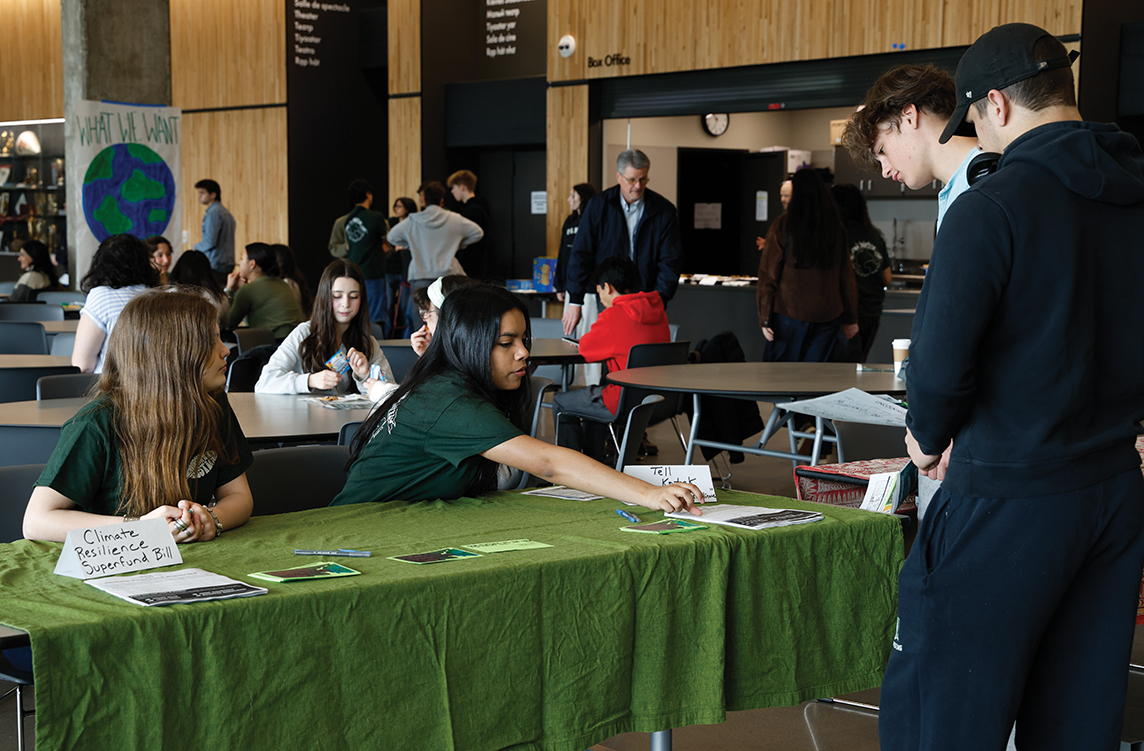
In my social studies classes, it’s been a hard couple years to teach with a sense of hope for a better future. Students express feelings of despair and defeatism, and most days the list of global calamities that I feel responsible to help students make sense of seems overwhelming. But recently I was reminded of the power we still have to transform these narratives within our school communities — and perhaps equally as importantly for ourselves — through the power of collective action.
I teach an Environmental Justice class at Lincoln High School in Portland, Oregon, and this year worked alongside my students as they organized the Student Voices for Climate Justice Summit, which brought together students from at least five area high schools, a dozen community organizations, and more than 100 participants to our high school on a Saturday in April. My students co-planned the summit with the Eco Action Club at Ida B. Wells High School. The event included a keynote panel that blended student and adult community activists, workshops led by local organizations and students, collaborative art projects, a clothing thrift pop-up, and a raucous sing-along to conclude the day, led by our local Raging Grannies chapter. The day was filled with joy, community, and student activism — and from the conversations we had as a class afterward, proved to be an antidote to their feelings of despair.
The idea for a summit grew out of a conversation with my friend and social studies colleague Brady Bennon, about how our students at two different high schools might work together to amplify the impact of grants available for student-led climate justice projects through the Portland Clean Energy Fund (PCEF). Portland voters approved PCEF in 2018, placing a 1 percent surcharge on retail sales for companies that make more than $1 billion per year. [See “Tax the Rich, Fight Climate Change,” in the Winter 2018–19 Rethinking Schools.] Surcharge receipts fund community climate justice projects — and for the last two years this has included student-led projects in Portland schools. The projects have been creative and varied, including school gardens and outdoor classrooms, biking infrastructure, clothing swaps, and the publication of a children’s climate book written by high schoolers. Brady and I knew that physical infrastructure projects were unlikely to be approved at either of our schools, and we both hoped to support our students in a project that could hone organizing skills that they’ll need to continue advocating for climate action beyond high school. We thought a summit might offer a real-world opportunity for our students to nurture their activist skills and create something in their community where the impact of their work would be visible.
We used grant funds to bring our students together for a joint planning day in February in the Lincoln library. After an initial meet-and-greet activity, we were pleasantly surprised as students created mixed groups from each high school and began to brainstorm, filling up poster papers focused on possible speakers, musicians, community organizations to connect with, location options and other logistics, local climate issues to address, and how they would get the word out to other students. Some of what was discussed that day never found its way into the final summit schedule, but Brady and I were encouraged to see our students work together, exchange contact information, and make plans for how to organize the event moving forward.
In the weeks leading up to the summit, our class time in Environmental Justice was spent with students in subcommittees focused on press and student outreach, food and materials, workshop planning, and logistics. Sometimes it was messy and hard to measure progress. But this is true with most organizing I’ve been involved with over the last 25 years. Subcommittees created proposals about the schedule, ordered lunch, created a website, and communicated with outside organizations. Watching students participate in this process, including inevitable challenges and frustrations, made me grateful that I teach a class where part of the curriculum includes space for students to take action together, something confirmed by my student Brooks, who wrote:
Making this summit happen taught me invaluable lessons on organizing and building a movement. The truth is, one person can’t do it all. It was only by having a group of people working alongside each other did the summit happen.
Students’ energy in the classroom reminded me of the student organizing in Portland and cities across the world, leading up to the youth climate strikes of 2019 that brought millions of people into the streets for climate justice. During the 2019–20 school year, I watched in awe as students in my Environmental Justice class — already active with local climate groups like Sunrise — organized citywide climate strikes out of our classroom, often collaborating with community activists. It was the kind of real-life education in how to change the world that I could have hardly imagined just a few years earlier in my teaching career, and even though the pandemic paused much of the youth climate movement, the possibility of creating space for students to have similar experiences has been with me ever since.
On the Thursday before the summit, two students — one from Wells and one from Lincoln — were interviewed on our local NPR station about the summit and some of what they hoped it would accomplish. My student Leah wanted the host to recognize the difference between conservation and environmental justice. She emphasized that environmental justice:
was born from the conservation movement and how that was a movement that separated the land from the people, preserving the land and not acknowledging the connection of the people in the land, not honoring the connection, for example, of Native Americans to their Indigenous land.
This commitment to center Indigenous perspectives led students from Wells to invite to the summit Keeya Wiki, a 17-year-old Yurok environmental activist from Ashland, in southern Oregon. Our students heard Keeya speak at a climate advocacy event in Salem a few months prior and thought that her voice at our summit would make an important contribution to the day. They were right. She spoke on the keynote panel and also led a workshop about her participation in the first kayak trip of Indigenous youth down the length of the Klamath River, after the largest dam removal process in U.S. history. Wells students awarded her what we hope will be the first annual Oregon Voices for the Climate Award. In her acceptance speech, Keeya emphasized the significance of youth climate action and the importance of finding joy in this work:
It’s really important for youth to take initiative — to look around and ask what isn’t working for me and what isn’t working for my community and what can I do about it? There are so many ways for youth to get involved with organizations and so many ways to take action. And it’s also important to incorporate joy and community in this. . . . That’s what Paddle Tribal Waters was, a bunch of kids laughing and kayaking down the river for 30 days. So that’s what I leave you with: Take initiative, make sure to add joy, and take a friend with you wherever you go.
Throughout the day of the summit, I found myself again in awe of the remarkable capacity of students to pull off all kinds of tasks with poise and enthusiasm, which I don’t usually see in the classroom. From greeting and orienting community members at the door, facilitating the speaker panel, leading workshops and art activities, serving food and cleaning up afterward, it was clear that this was their event — they weren’t looking to adults to run the show or answer questions; their sense of agency as organizers was on display. I’ve been buoyed ever since and feel a renewed sense of hope as a teacher about what’s possible in our schools when we offer the space and support for our students to find themselves as organizers and active participants in the broader community.
My student Claire, the summit’s wonderful emcee, wrote about the significance of being part of a curriculum that challenges despair:
We succeeded at our goal of bringing hope to the community, but we also brought hope to ourselves. Even just watching the transformation of my classmates’ understanding of environmental justice and what it means to be involved in the environmental movement has given me hope that change is possible. We proved to ourselves that we can change, that we can act, and that those actions have an impact. What could be more hopeful than that?