The Educational Costs of Standardization
More testing might sound nice as a policy soundbite. But as Texas shows, the move toward high-stakes tests shortchanges learning in the classroom.

More testing might sound nice as a policy soundbite. But as Texas shows, the move toward high-stakes tests shortchanges learning in the classroom.
As early as 1976 the Association for Childhood Education International (ACEI) called for a moratorium on standardized testing in the early schools years. A decade later, it strengthened its positions, saying: “We now believe firmly that no standardized testing should occur in preschool and K-2 years. Further we question the need to test every child in the remaining elementary years.”
Hundreds of high school students from across Massachusetts boycotted the state’s high-stakes test this April.
An elementary teacher, weary of gimmicks such as Gum Day and Hat Day, turns to social action to build classroom community.
A high school English teacher uses a “tea party” – in which students give brief previews of good books – to entice reluctant readers to read.
An elementary principal tells of his journey to openly gay administrator.
An 11-year-old student takes a stand against homophobic slurs.
A middle school student organizes to defend a student newspaper.
A handy rundown of the free-speech rights students have under current law.
High-Stakes testing is the latest reform designed to save public education. But this reform du jour is a recipe for disaster.
A working draft outlining eight principles to guide school reform.
While enthusiasm for multiculturalism has waned, proponents have faith in the movement’s ability to endure.
A look at one district reveals both the promises and challenges of sustaining multiculturalism
“Some people say there is too much talk about race and racism in the United States
The Massachusetts 10th-grade world history test is a Eurocentric exercise in trivial pursuit.
What’s on the 10th-grade test in Massachusetts?
Too many white educators think multiculturalism ends with ethnic food festivals. Here’s why multiculturalism needs to be placed in the context of the Civil Rights struggle for freedom, political power, and economic integration.
A politically popular sound-bite has morphed into a Frankenstein’s monster, destroying children in its path. It doesn’t have to be that way.
Society’s misplaced priorities are moving too many youths from the educational system and into the penal system.
What if we take seriously the idea that people can become smart?
The much-touted policy is starting to draw fire from educators and civil rights activists.
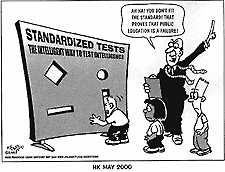
Milwaukee plans an unprecedented expansion of testing. Here’s why it’s a mistake.
In this era of demands for teacher quality, it is crucial to develop culturally relevant ways to assess teachers.
Parents call upon School Board to find money to offset $32 million deficit.
Wisconsin march in June 2000 will protest spending caps.