
Welcome to the fifth installment of Rethinking Schools’ climate justice newsletter.
Dear Rethinking Schools Teach Climate Justice friends,
It’s been a while. Happy New Year, if it’s not too late to say.
The U.S. regime’s terror on the streets of our cities and imperialism across the world continue at an astonishing clip. But dotting this landscape of cruelty is a growing number of people who refuse it, together. There is no better evidence to reinforce this truth: We make each other braver.
Reinforcement is important. We’re reminded of Rebecca Solnit’s essay in defense of “preaching to the choir.” The phrase implies that there is little to be gained from talking to our friends and allies. Not true. To preach to the choir — and to listen, when the choir sings back — is to reiterate and refine our commitments to each other. It’s the motivation we need to sustain political work in perilous times.
Solnit recalls people grasping at poll numbers to determine how many Americans think climate change is real. “They seemed convinced that if everyone could be made to believe, the crisis would be solved. But if people who believe climate change is real and pressing do nothing to address the problem, nothing happens.” We have to do more than know the stakes of the crises in front of us. We have to act on the world, to keep trying for a more survivable future. “Agreement is only the foundation,” Solnit continues. Talking, listening, teaching, and learning together is how we build “strong communities of love, spirited movements of resistance.”
This issue of our newsletter assembles the three latest “Earth, Justice, and Our Classrooms” columns published in Rethinking Schools magazine. In each one, we hope you glimpse the possibilities of building something new and good in the rubble of a world on fire. And if you have an idea for a climate justice related article for Rethinking Schools, check out the submission guidelines here. This work belongs to all of us.
— Bill Bigelow and Mimi Eisen
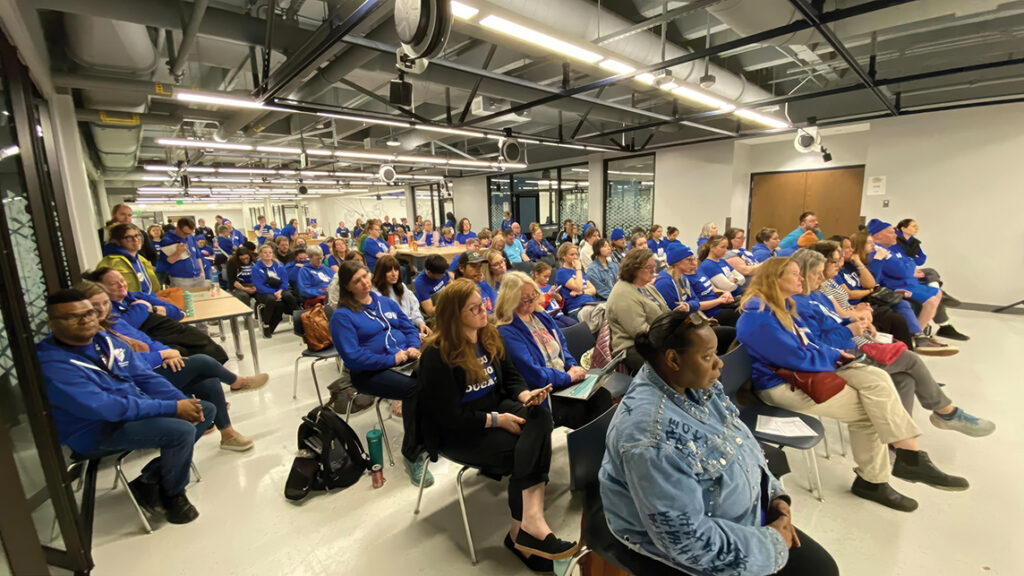
Photo: Minneapolis teachers engage in open bargaining during their 2024 contract negotiations.
The Power Is in Our Hands. It’s Time to Use It.
In the winter 2025–26 issue of Rethinking Schools is Matt Reed’s celebration of a valuable new report on how unions are using the “Bargaining for the Common Good” imperative to center climate justice, Bargaining for Green Schools, Good Jobs, and Bright Futures, from the Labor Network for Sustainability and Building Power Resource Center.
In his article, “The Power Is in Our Hands. It’s Time to Use It.,” Matt writes: “This short and accessible report showcases three specific case studies, drawing lessons from each and offering ideas and action steps that educators can begin implementing tomorrow within their unions or communities.” The case studies focus on United Teachers Los Angeles (UTLA), the Chicago Teachers Union (CTU), and the Minneapolis Federation of Educators (MFE).
CTU negotiated successfully around a suite of environmental justice demands including cutting lead in school drinking water with 200 new filtered-water fountains, expanding indoor air quality monitoring, upgrading school building heat pumps, installing solar panels at 30 schools and more. UTLA demanded guaranteed access to clean drinking water, that every school has efficient HVAC systems, green spaces and shaded areas on every campus, teaching material that “infuses climate literacy with a racial justice lens,” and internships and Career and Technical Education opportunities for students to learn about “green” jobs. MFE has organized for free bus passes for students and rigorous air monitoring with updated HVAC systems and school closures when air quality is unsafe.These unions are leading the way in climate dreaming that is as practical as it is imaginative. As Matt writes: “The poet Lucille Clifton wrote, ‘We cannot create what we cannot imagine.’ Indeed, what can ultimately chart us as educators away from the doom and gloom of climate despair is a bold, imaginative vision.”

Photo: Sāmoan climate activist Brianna Fruean, 23, addressed world leaders at the opening of COP26. Photographer: Natasa Leoni
Teaching About the “Stuff That Is Actually Happening”
The fall 2025 “Earth, Justice, and Our Classrooms” column is one by Portland, Oregon, high school teacher Moé Yonamine, “Teaching About the ‘Stuff that Is Actually Happening.’” She describes working with her summer school class and how they came alive when they began to study “climate change through the eyes of climate justice activists” — as one of her students wrote: “today’s civil rights activists for the planet.” Moé reports three classroom “anchors” she used with students: “Chamorro human rights lawyer and climate justice activist Julian Aguon’s latest book, No Country for Eight-Spot Butterflies; the documentary The Forgotten Pacific, narrated by Pacific Climate Warrior Brianna Fruean; and Naomi Klein’s young people’s edition of How to Change Everything.”
Moé walks readers through how she used these resources with students, focusing especially on how she celebrated Pacific Island climate activists. She concludes her article with a quote from the late Marshallese activist Tony de Brum: “To remember that in the face of injustice, there is nothing more important than impatience. Because the time for justice is always now.”

Illustrator: Amir Khadar
Parable of the Sower and Climate Futures
The summer 2025 issue included Mimi’s piece on “Parable of the Sower and Climate Futures,” drawing attention to Octavia Butler’s extraordinary dystopian 1993 novel. The story, set between 2024 and 2027, is told by the teenage protagonist Lauren Olamina. Butler’s novel describes horrific ecological collapse and unspeakable violence as some people turn on each other.
But Mimi focuses on the book’s hopeful message. She writes, “Lauren and two other survivors stumble upon each other and set out on a journey up the California coast to find a new safe haven. Swarms of people are headed in the same direction; most seem untrustworthy at best, dangerous at worst. But as Lauren and her companions learn to trust and protect each other, they begin to take chances on new people. They innovate. They make each other braver. And their little community grows.”This article is about “climate futures,” but takes off from “climate past,” drawing on the classroom-friendly, interactive Climate Crisis Timeline at the Zinn Education Project. As Mimi points out, “There is much to learn from this past, like who to be mad at and who to draw inspiration from.” This orientation allows students to feel that history is not just the past, but what we do “today, tomorrow, and every day after.”