
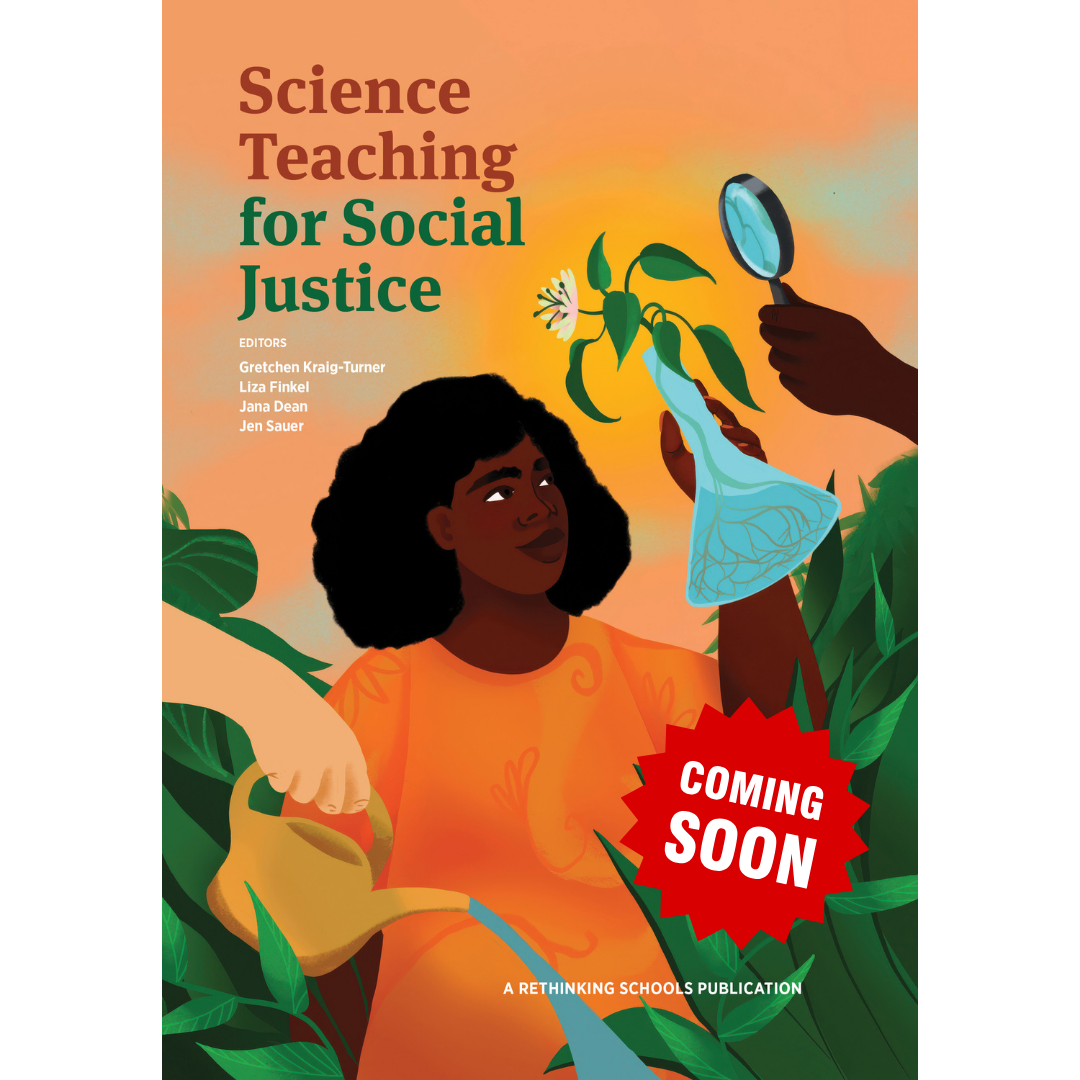
Science Teaching for Social Justice shares stories of educators and students who explore how social and political systems shape science. From preschool to graduate studies and across disciplines, this book contains lessons that empower students to use science as a tool for equity and justice. Illuminating methods to center social justice in science education, these stories help students go beyond the standards and dig into ways science is used both as a tool of oppression and as a means of liberation.
TABLE OF CONTENTS
Introduction
Why Teach Science for Social Justice?
By Gretchen Kraig-Turner, Liza Finkel, Jana Dean, and Jen Sauer
Section 1: Ways of Knowing and Understanding Science
Black Land Matters
By Leah Penniman
Centering Indigenous Knowledge: Exploring Barriers to Incorporating Indigenous Knowledge in Outdoor Classrooms
By Launa Purcell
Traditional Ecological Knowledge in the Preschool Classroom: An Interview with Nichole Efird
By Jen Sauer
The Voice of a Seed: Honoring Indigenous Voices with 1st Graders
By Caitlin Blood
Section 2: Grounding Science in Students’ Lives and Communities
“I Used to Love Science . . . and Then I Went to School:” The Challenge of School Science in Urban Schools
By Gloria Ladson-Billings
“There Is No Way for Science Teaching to Be Apolitical:” Preparing Science Teachers for Social Justice
By Liza Finkel
Sex Talk on the Carpet: Incorporating Gender and Sexuality into 5th-Grade Curriculum
By Valdine Ciwko
What Makes a Baby, Really? : Co-Creating Inclusive Resources About Human Reproduction with Middle School Students
By Lewis Steller
“You Have to Be Willing to Look Deeply:” Situating Science and Engineering in Communities
By José Rios
Carbon Matters: Middle School Students Get Carbon Cycle Literate
By Jana Dean
Personalizing Climate Change Through Place-Based Learning
By Lauren G. McClanahan
Section 3: Science Teaching to Expose Injustice
Medical Apartheid: Teaching the Tuskegee Syphilis Study
By Gretchen Kraig-Turner
Rethinking Teaching About the USPHS Untreated Syphilis Study at Tuskegee: A Revision that Centers Resistance
By Gretchen Kraig-Turner
Ebola: Teaching Science, Race, and the Media
By Alexa Schindel and Sara Tolbert
What’s in the Water? Teaching About Environmental Racism
By Ursula Wolfe-Rocca
Sweet Stuff: Teaching About Sugar Subterfuge in Biology Class
By Amy Polzin
Facing Cancer: Social Justice in Biology Class
By Amy Lindahl
“More People Get What They Need:” First Graders Explore Light, Sound, and Accessibility
By Sarah Arnett
Beyond Just a Cells Unit: What My Science Students Learned from the Story of Henrietta Lacks
By Gretchen Kraig-Turner
Ecological Footprint Calculators Are Bad for the Environment
By Ursula Wolfe-Rocca
Green, Blue, Yellow, Red: Mapping Spatial Injustice
By Jacob Barton
Section 4: Broadening Participation in Science
Blood on the Tracks: Why Are There So Few Black Students in Our Science Classes?
By Amy Lindahl
Designing for Justice in and Beyond the STEM Classroom: An Interview with Chris Emdin
By Ayva Thomas
“I Just Can’t See How We’re Going to Learn Any Actual Biology Stuff Here:” Building a Student-Centered Biology Course
By Lyle Dandridge
“Did Any of You Just Search for ‘Physicist’?” Exploring Racism and Privilege in Physics Class
By Moses Rifkin
What Is a Family? Inclusive Teaching About Genetics and Reproduction in K–12 Life Sciences
By Sam Long
“I Get It Now:” Teaching the Physics of Climate Change
By Elissa Levy
Science Language for All
By Amy Lindahl
Section 5: Teaching Science for Hope, Joy, and Action
Celebrating Skin Tone: The Science and Poetry of Skin Color
By Katharine Johnson
Honoring Exonerees: Poetry and Art as a Background Activity for a DNA Electrophoresis Lab
By Gretchen Kraig-Turner
Community Building as World Building
By Cristina Paul in collaboration with Olivia Lozano and Nancy Villalta
Teaching About Global Warming in Truck Country: A Middle School Teacher Helps the Heirs of Truck Culture Examine Climate Change
By Jana Dean
Science for the People: High School Students Investigate Community Air Quality
By Tony Marks-Block
Action Research for Environmental Justice in the Kindergarten Classroom
By Kimi Waite
“I See Birds Everywhere I Go:” Engaging Urban Students in the Natural World
By Ellen Royse
Why Teach Science for Social Justice?
“Are we going to come back this year? Will six weeks be enough?” Caleb asked in one of our biology classes, a question so many of us heard versions of when our schools closed and the world seemed to shut down in March 2020.
Multiple hands shot up around the class and the students asked more questions that couldn’t be answered yet. “What is this virus?” “Why are people getting so sick?” “Are we in danger here?” — eager questions we imagine all science teachers heard at the start of the COVID-19 pandemic.
In that moment, the connection to what we told our students about how science works and how the work of scientists impacts their lives seemed urgent. Science concepts, like how viruses are different from bacteria and how vaccines work and are developed, became directly relevant to students’ lives in a new way.
“My mom isn’t going to be able to stop working, is she going to get sick?” “Are we going to do school from home? I don’t think that will work for everyone.” “When will we get a vaccine?”
Students’ questions oscillated quickly from science to societal, many of which were rooted in questions of social justice even if they did not explicitly say so. The questions were answered over the next year. Which jobs became “essential” and which became “remote,” who had access to virtual learning, how health care was commodified and then who it was distributed to all became functions of privilege following the shutdown. As COVID-19 itself became politicized, any illusions of science as an objective practice dissolved for many people, including our students. We were watching in real time how science intersects with political and social forces as it always has, with our classrooms at the nexus.
* * *
We began collaborating on this book a couple of years before the pandemic, but our work shifted as we responded to scientific and societal changes in recent years. As the fight against equity for our students intensifies and many voices are being censored in multiple arenas, we need to address the increasing importance of centering social justice in our science classrooms as well as standing in solidarity with people most impacted by systemic injustices. STEM fields still lack diversity in both personnel and perspectives. Environmental issues unjustly and disproportionately affect communities of color. Our health care systems and medical research continue to leave out and even traumatize many groups of people. The onslaught of injustices — the push to shut down diversity, equity, and inclusion initiatives, the unraveling of environmental protections, the open oppression of gender expression, the targeting of immigrants students and their families, the xenophobic expulsion of international students, and the outright erasure and denial of scientific research and information — reveals that science and the teaching of science is inherently political.
But the societal shifts of the past years have also given educators and our students a deeper ability (and vocabulary) to name injustices and fight for more inclusive and expansive science and science curricula. Recent social justice movements (particularly Black Lives Matter and the fights for transgender rights and Indigenous sovereignty) have illuminated aspects of science and science teaching in ways that encourage us to shift our practices to be more inclusive, joyful, and deeply rooted in our students’ lives. Many teachers are creating more nurturing classrooms that honor students’ experiences and identities. Many are finding ways to inspire the next generation of scientists to think critically about systems that support scientific discovery. Leading our science classrooms from a place of hope for our future is a form of resistance.
This book provides examples, stories, and resources for teachers wanting to dig in and do the work to make our science teaching transformative and just. Articles in this book demonstrate how to do so through various perspectives. We hope the exemplars of teaching science through a social justice lens found here will show what is possible for your classroom.
The sections in this book are based on the following questions:
Section 1, Ways of Knowing and Understanding Science: How do we acknowledge and understand a diversity of science methods that allows for more meaningful science teaching? How can educators advance an understanding of science reflective of more than one worldview?
Section 2, Grounding Science in Students’ Lives and Communities: How can educators leverage the background, experiences, and curiosities of students to provide dynamic meaningful science instruction and a joy of learning through science?
Section 3, Science Teaching to Expose Injustice: How can science teaching be a liberatory practice? How can we teach science in ways that empower students to notice, analyze, and address injustice?
Section 4, Broadening Participation in Science: How do we teach science in ways that expand students’ understanding of who can be a scientist and allow them to critically examine the social context of scientific inquiry?
Section 5, Teaching Science for Hope, Joy, and Action: How can knowledge of science be used to make the world more joyful and hopeful for ourselves, our peers, our families, and our communities, and even the world? What transformations can occur when science teaching leads to action and activism?
We see these questions as guides to make our classes more inclusive, to teach science in ways that explicitly connect the content to students’ lives and concerns, and perhaps most importantly, to talk openly about and work toward fixing the social injustices that are a part of science. In this way, teachers encourage a more diverse group of young people to consider careers in STEM fields and help all children see science as something that helps them understand, and even change, the world around them. Curiosity about the natural world is an innate human quality and right, and our job is to encourage this curiosity for all students even as much of the world seeks to vanquish it or narrow who has ownership of science learning.
This book is a touchpoint on the path to teaching science for social justice. Just as we acknowledge and consider that science and science teaching in this country are missing voices and perspectives from multiple groups and are situated in whiteness, we must also do so for this collection of articles. Having the time and space to write about teaching experiences is a function of privilege, a privilege historically and presently not available to all educators, particularly educators of color and educators of underrepresented gender expressions and identities. With our gratitude, we recognize that phenomenal and inspiring social justice science teaching is happening in classrooms globally and is not fully represented in this book. We also acknowledge that in this political landscape even small actions can carry heavy consequences for educators and those consequences are not equal for all.
Whether this book is read start to finish or picked up for a new lesson, we hope every reader gains new ideas, an assurance that your work is meaningful, and a call to continue along what can feel like a hard and sometimes lonely path. This book is for teachers who are brave and hopeful enough to examine their beliefs about what science teaching is and how those beliefs show up in their classrooms, who dream about what science teaching can be, who are ready to further their science teaching along the path toward social justice, and who have the audacity to believe that all students are scientists in and out of the classroom. This book is created in the belief that all science educators have the capacity to teach with compassion and joy in ways that center the principles of social justice teaching, expand definitions of science, and remain steadfastly optimistic as we work to make our communities and world better for each generation.
We hope that you find inspiration and solidarity in these pages, and we celebrate you for each step forward in teaching our next generation of scientists how to use science for liberation, justice, and joy!
Gretchen Kraig-Turner, Liza Finkel, Jana Dean, and Jen Sauer