The Power Is in Our Hands. It’s Time to Use It.
It’s hard not to feel gloom and doom — and utter powerlessness — about the state of the Earth’s climate.
A recent U.N. report found that the world is not on track to limit global heating below 1.5 degrees Celsius. The supercharged storms of Hurricane Melissa, Typhoon Kalmaegi, and Typhoon Halong killed dozens and displaced thousands across Jamaica, the Philippines, and Alaska in recent weeks. And the Trump administration continues to give away public lands to coal and gas companies to pollute our skies and waterways while continuing to ban the use of terms such as “climate change,” “green,” and “decarbonization” from government agencies.
Bargaining for Green Schools, Good Jobs, and Bright Futures, a recently published report from the Labor Network for Sustainability and Building Power Resource Center, seeks to flip the doom-scroll script about the climate crisis. The report highlights how educators are winning real gains toward climate justice within their communities through union contract negotiations.
This short and accessible report showcases three specific case studies, drawing lessons from each and offering ideas and action steps that educators can begin implementing tomorrow within their unions or communities.
The first case study details the Chicago Teachers Union’s successful campaign to negotiate around several environmental justice demands, including:
- Cut lead in drinking water and install up to 200 filtered-water drinking fountains
- Expand monitoring of indoor air quality
- Increase cooking-from-scratch capability in school cafeterias and expand lunchroom composting in 25 schools
- Replace windows and upgrade HVAC equipment (e.g., heat pumps)
- Advance building electrification and install solar panels at 30 schools
- Construct new school facilities to meet LEED Silver-certified standards or higher
- Collaborate with unions such as the International Brotherhood of Electrical Workers (IBEW) to create more pre-apprenticeship opportunities for students
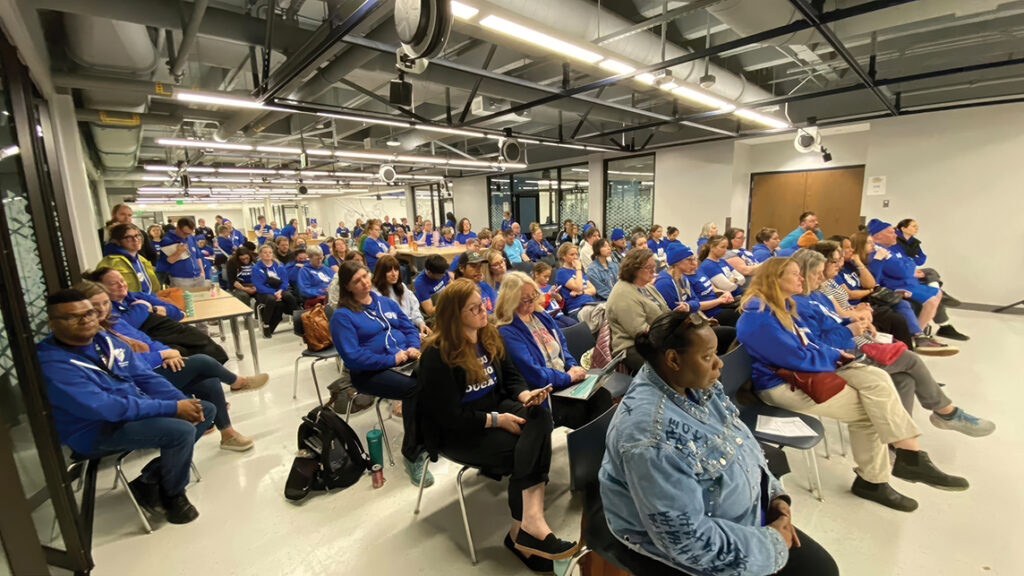
Key to this campaign was the organizing and educating of rank-and-file members to connect the “climate priorities to issues that broader membership cared deeply about, such as toxins in school facilities.” CTU Vice President Jackson Potter describes how this organizing required deep conversations to make connection between climate justice and building conditions urgent and real for members:
When we started [organizing], it almost felt like people in the membership, in the community, viewed it as a niche issue. Like, “Oh, isn’t that cute, you care about green technology.” As we figured out how to think about it and talk about it and probe where people were having issues in their schools, it became really obvious that when you started talking about asbestos, lead, and mold remediation — and helping communities that have been hit the hardest with cumulative impacts and carcinogens and how those things are present in schools — that became much more tangible. Or even quality food and lunch and breakfast for students who are low-income.
The second case study details United Teachers Los Angeles’ (UTLA) effort to win an entirely new contract article for “Clean, Healthy, and Green Schools.” Among their demands are guaranteed access to clean drinking water, ensuring every school has functioning and efficient HVAC systems, green spaces and shaded areas on every campus, a robust Climate Literacy Task Force to create teaching material that “infuses climate literacy with a racial justice lens,” and creating internships and Career and Technical Education opportunities for students to learn about “green” jobs.
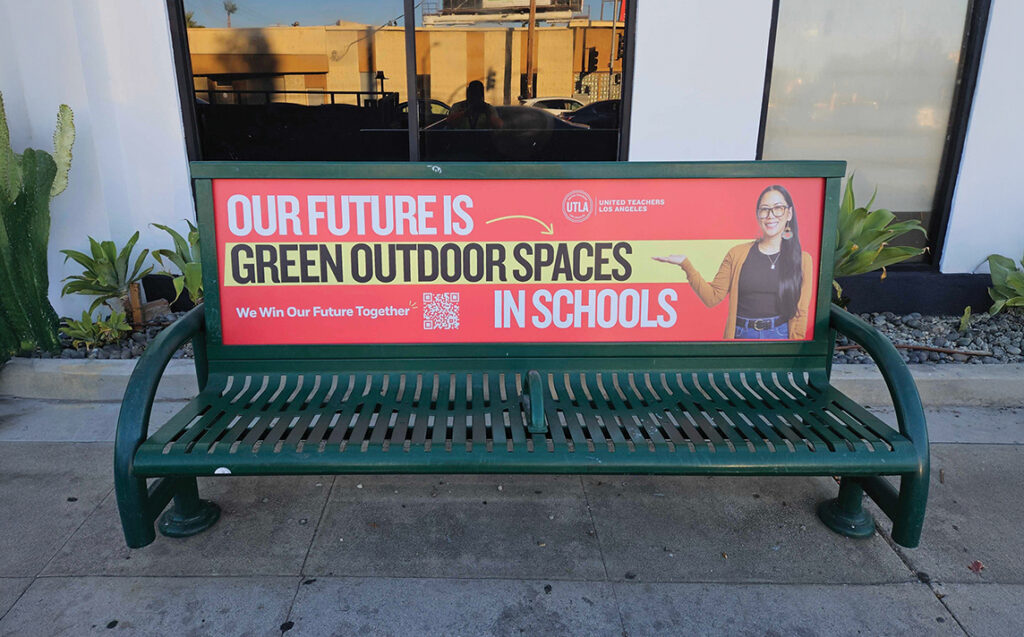
UTLA’s fight for these proposals is driven in part through the larger parent and community coalition movement (Reclaim Our Schools LA) that arose during their historic 2019 strike. UTLA Vice President Julie Van Winkle also credits the deepening ties between UTLA and the building trade unions and environmental justice organizations of Los Angeles, which provided research and policy ideas that shaped the union’s negotiation proposals.
The third case study discusses efforts by the Minneapolis Federation of Educators to win free bus passes for all students, a joint labor-management EcoJustice Task Force, and greater air quality protections, including air monitoring, updated HVAC systems, and school closures when air quality is unsafe. These proposals build upon work between community organizations and the union to address environmental pollution and racial injustice in and around their schools.
Put together, these case studies show it is possible to leverage union contract negotiations to secure material environmental justice gains. This is especially true when, as the report recommends, union demands include some of the following elements:
- Push for ambitious district climate goals with specific metrics for projects
- Prioritize school communities most harmed by environmental injustice
- Fight for projects that will save schools money but require savings to be reinvested into the classrooms
- Win structures that ensure accountability and transparency
- Include green jobs training programs opportunities for students
What these three unions have in common is their involvement in the Bargaining for the Common Good network, a project of the Action Center on Race & the Economy. At its core, Bargaining for the Common Good challenges unions to build deep and durable relationships between unions and community groups and use the process of contract negotiations to win broadly supported demands. The network supports this work by training union leaders how to develop a shared analysis of the villains — the corporate bosses, developers, and politicians — who stand in the way of environmental justice demands and how unions and community groups can work together to build the kind of working-people power needed to challenge these villains. This approach contrasts with how unions and community groups are too often siloed in their analysis of common problems or demands, or are only engaged in superficial or transactional relationships.
Another similarity between these three case studies is that each union dedicated years and resources toward shifting their union’s culture away from a “service model” toward an “organizing model” of unionism, dedicating years of time and resources to forge deep relationships within their memberships and communities. Each union has led successful, high-participation strikes in recent years that have not shied away from bold and visionary demands and deep coalitional politics. As the authors of A Planet to Win: Why We Need a Green New Deal wrote in 2019, “Strikes teach people how to fight and win. When workers organize their workplaces, they’re ready for other political battles.”
And let’s face it, winning clean, healthy, and green schools will require much more than laying out logical facts or reasoning. If it did, we would have already won. The report makes a compelling case for why it’s urgent and necessary for educators to incorporate environmental justice demands into their contract negotiations. Years of disinvestment have led to crumbling infrastructure, and unsafe water and air in buildings has made teaching and learning conditions unsafe for far too many students and educators. A “New Deal for Schools”-type program would bring much needed upgrades to schools and has the potential to lower costs. But as the report reminds us, “Every dollar spent today is a choice: lock schools into decades of fossil fuels use and costs, or invest in renewables for lower bills and healthier communities. The difference is organizing and political will. Green healthy school improvements can be a win-win for learning conditions and budgets, but decision makers aren’t likely to see this until organized workers present the vision.”
The poet Lucille Clifton wrote, “We cannot create what we cannot imagine.” Indeed, what can ultimately chart us as educators away from the gloom and doom of climate despair is a bold, imaginative vision. But as Bargaining for Green Schools, Good Jobs, and Bright Futures shows us, the vision already exists. The vision is forged through deep organizing within union membership and our larger school communities. It’s through a commitment to struggling to create the power to move the villains and decision makers in our communities to prioritize climate justice and secure real material gains. The existential crisis of climate change is about power. And our greatest source of power available to us to tackle the climate crisis is in the number of people we can organize to take collective action. This includes in our schools, our unions, and in our neighborhoods. If the path to power is within our hands, what’s holding us back?