Teaching Autism: Using Books as Bridges
In “Not ‘Burdens’ or ‘Saviors’: Picking Children’s Books Showcasing the Autistic Experience,” Jevin Morris lays out guidelines for selecting children’s books that accurately portray the beauty and complexity of the autism spectrum. The book list below is in response to Morris’ call to action.
These books span reading levels, formats, target audience, and genres. The list also emphasizes books created by autistic writers and illustrators.
Stories that explicitly say that characters are autistic
Language is powerful. To be able to name one’s own experience can be a meaningful form of validation, of knowing that you are not alone. Starting with a real person can be one way to name an experience, to introduce readers to both the challenges and the triumphs that might be part of that experience.
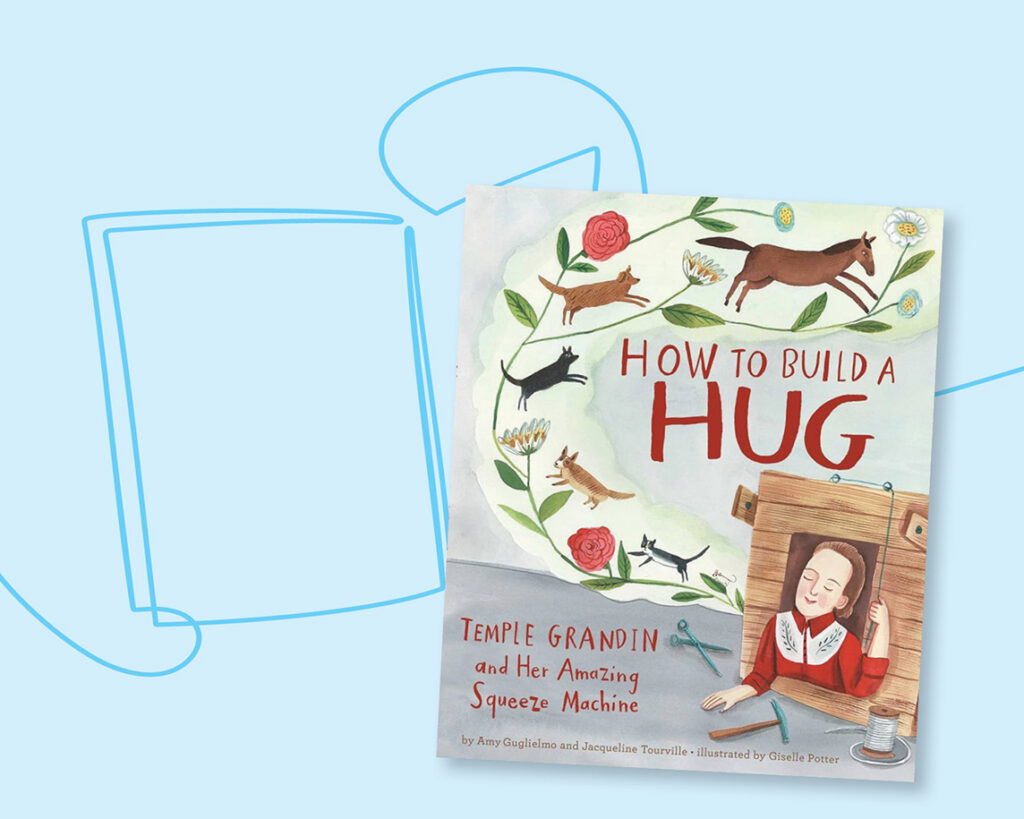
How to Build a Hug: Temple Grandin and Her Amazing Squeeze Machineby Amy Guglielmo and Jacqueline Tourville provides many entry points for readers to learn about a famous autistic scientist, speaker, writer, and advocate. Starting from Temple Grandin’s early childhood, readers learn about her challenges and strengths.
Fighting back against harmful stereotypes: Picture books and early chapter books as a place to start
Often, the first books published about a historically marginalized group are “problem novels” — stories about how having that identity can be hard. In this way, the danger of a single story is not only that a person might be reduced to a stereotype, but that people of a shared identity might be reduced to challenges faced by people with that identity. Although these stories can spark empathy, they can leave readers with the false belief that hardship is the only story about people who share that identity. That is why I start with stories of everyday life, stories of joy, stories that show the ways we connect and the ways we are each wonderfully unique.
Flap Your Hands: A Celebration of Stimming is a beautiful example of the ways we might find connection even through our uniqueness. In his author’s note, Steve Asbell asks “Have you ever impatiently tapped your feet, paced nervously back and forth while talking on the phone, or anxiously twirled your hair? If so, you’ve done something called ‘stimming.’” Immediately, readers connect to the actions that four unnamed, neurodivergent characters exhibit in this book. In just a few sentences, Asbell creates an opportunity for understanding, showing readers who do not have autism that they might connect to the experience of and need for stimming, while also validating that this action is actually “a natural and healthy thing to do!” whether you have autism or not.
“Stimming is not just natural and healthy but even necessary for autistics,” Asbell explains. “It is an important part of our everyday behavior, and inseparable from our self-identity and culture.” The book is, as the subtitle describes, “a celebration of stimming” with four different characters stimming in four different ways for four different reasons. The digital illustrations, reminiscent of colored pencils or scratchboard art and done in a myriad of colors, evoke emotions matching each character’s journey from sensory overload to emotional regulation. While Asbell does not name the characters in the story, nor name autism in the text of the story, he does name autism and himself as a person with autism in the book’s introduction: “Autistics like myself stim for all those same reasons.”
Similarly, A Day with No Wordsby Tiffany Hammond is an invitation. In her author’s note, Hammond writes, “Our story is a vehicle for connecting: Aidan’s world to mine, our family’s world to yours, and ultimately, all of us to one another.” This story, about a boy and his mom spending the day together, offers many points of connection to readers who may also like to go to the park, dance in the wet grass after the rain, or eat their favorite food with loved ones.
As Aidan ventures to the park with his mom, he shares with readers that:
I do things many people do not understand.
I like to stare through the parted fingers of my right hand.
I comfort the trees with hugs when the sun disappears.
I like to spin barefoot on soft grass after the rain clears.
Unlike the other people who stare and sneer at Aidan in the park, those who read this book along with Flap Your Hands: A Celebration of Stimming will have the vocabulary and understanding to recognize when Aidan jumps and flaps that he is stimming.
Throughout the story, Aidan and his mom both use tablets to communicate. As Hammond notes, “Every button on Aidan’s device is an image associated with a word, and a word is spoken each time he pushes a button.” So, their day together is, in contrast with the title, full of words. Hammond chose to juxtapose these two ideas to illustrate that not all words, not all communication, is spoken. This again offers a bridge to connect readers with the characters and creators in this book. We all communicate in myriad ways, some may be like Aidan and his family, some may not.
In his essay, Jevin Morris mentions Henry from A Friend for Henry by Jenn Bailey when writing about books with well-rounded autistic characters. Author Jenn Bailey and illustrator Mika Song paired up to write several more stories, this time early chapter books, about Henry, and his friend, and ally, Katie. Each book takes place at school with Henry and the other children in Classroom Ten. Through everyday adventures, and misadventures, readers get to know how Henry and his classmates learn and grow together. In the first book of the series, Henry, Like Always, Henry and another classmate do not want to participate in the class parade. They have their reasons for not wanting to participate but help each other out. Despite his initial discomfort with this change in routine and the overstimulation typical of a parade, Henry “found his own way. Just like always.” The newest book in the series, Henry’s Picture-Perfect Day, is about a common and exciting rite of passage — losing a tooth. It’s also a validation that “Henry did not have to be perfect. He just had to be Henry,” a reminder that all children need.
Middle-grade novels that model excellent allyship
If only every child had a parent or caregiver who understands and advocates for them as beautifully and as powerfully as Aidan’s mom in A Day with No Words. If only every child had a friend as supportive as Henry’s in Henry’s Picture-Perfect Day. Allies can be found in families, in friends, in trusted adults at school or in the community. And allies can also be found in books.
In Frankie’s World, a middle-grade graphic novel by Aoife Dooley, Frankie’s friends help her through the highs and lows of their final year in middle school. In the first part of the novel, Frankie and Sam support each other through humor, a shared love of video games and sweets, and shared disdain for school bullies. Their humor, hijinks, and consumption of sugar only increase when they welcome Rebecca into their friendship. Rebecca and Sam take extreme and creative measures to support Frankie on a field trip where she stands up to the classmate who has bullied her, and to aid in her quest to find her biological father to gain clarity into why she is who she is. There are costumes at a wake, bullies covered in pig poop, plans that go awry, and answers to be found when these three friends stick together.
Similarly, in Phil Bildner’s Rip and Red series, the two basketball-loving best friends have each other’s back. Allies abound in this middle-grade series that spans four books and one 5th-grade school year. Both boys face big changes. Each one handles the hardships in their own way. But through the challenges on and off the court, they find allies — in each other, in their new teacher and coach, in their classmates, and in themselves.
Role models, both real and fictional, aren’t defined by their neurodivergence.
To be an ally to one’s self is to embrace the full experience of who you are. Our identities inform who we are, how we move through the world, and, sometimes, how others perceive us and treat us. And while our identities shape us, they do not have to limit who we are. Common threads in both fiction and nonfiction accounts of autistic people not limited by their neurodivergence include self-compassion, self-advocacy, and a sense of pride, or self-love. l
Bibliography
Asbell, Steve. 2004. Flap Your Hands: A Celebration of Stimming. New York: Lee & Low Books.
Bailey, Jenn. 2019. A Friend for Henry. San Francisco: Chronicle Books.
Bailey, Jenn. 2023. Henry, Like Always. San Francisco: Chronicle Books.
Bailey, Jenn. 2025. Henry’s Picture-Perfect Day. San Francisco: Chronicle Books.
Dooley, Aoife. 2022. Frankie’s World. New York: Graphix, an imprint of Scholastic.
Hammond, Tiffany. 2023. A Day with No Words. New Egypt, New Jersey: Wheat Penny Press.