Student Essays that Matter — Defying Formulaic Writing
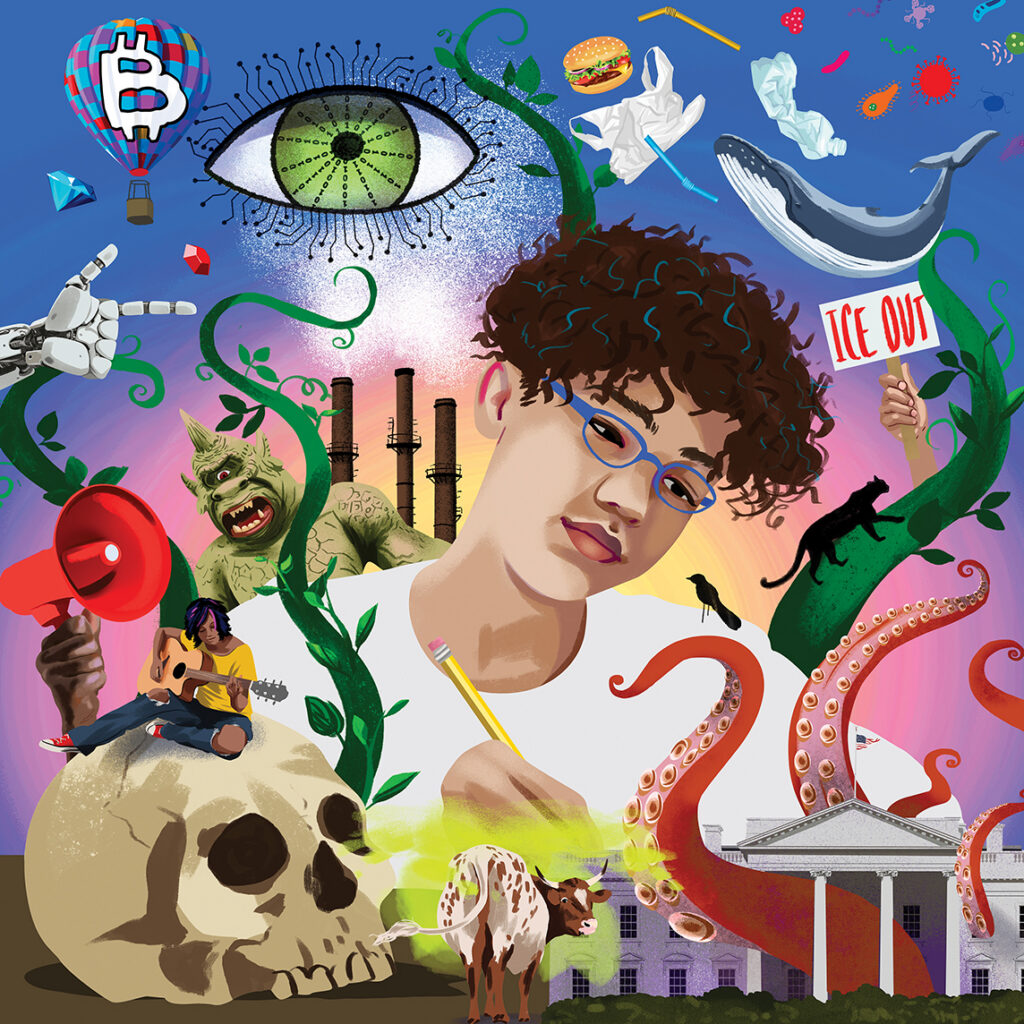
Illustrator: Olivia Wise
When students reach high school, the literary analysis essay is often the only genre of writing taught in language arts classes. In fact, one literary analysis per quarter is de rigueur in some schools.
I don’t question the idea that students should write about texts, peel back the layers, argue with each other, persuade us of their ideas. They should. The problem is the essay prescription accompanying most literary analysis teaching lays waste to student imagination and voice.
The tight reliance on a format stifles students’ real ideas and real thoughts for the sake of the formula. I’ve seen hundreds of handouts over the years filled with lines, diagrams, the first words of sentences, transitions, and phrases to end the essay. Students must bend their language and ideas around the formula. There is no singing, no laughing, no poetry in these papers. No one wants to write them and no one wants to read them.
What’s unwritten in these handouts is the profound distrust of the student’s capacity to write with coherence on their own. This distrust for students mirrors the distrust that corporate textbooks, too many graduate education programs, and school district curriculum departments have for teachers — treating them as script-followers rather than as imaginative professionals. I confess that during the early years of my career, I used formulas because I feared my students’ poor performance would reflect badly on me. Their essay drafts were messy, unfocused, and by compelling strict adherence to the five-paragraph essay, for example, my students’ papers were airbrushed into looking like they knew how to write. They didn’t. They’d learned how to comply.
Teaching an “unbound” essay requires acts of patience because as teachers we have to strip back years of compliance to a formula, unteach the habit of cutting and pasting evidence, and wait for students to secure their own thinking about a piece of literature instead of looking to us for the “answer.” An unbound essay requires an unbound classroom where we reward students for taking risks, experimenting, making mistakes, and trying again, where teachers are willing to forgo safe, predictable easy-to-score rubrics in favor of trusting students’ capacity to learn, even if the drafts are messy.
The over-teaching of the prescriptive literary analysis essay is not only a time-waster, it misteaches contemporary essay writing. Take a look at essays in the Paris Review, Orion, the New Yorker, Rattle, the Rumpus, or Vanity Fair. Nikole Hannah-Jones, Clint Smith, Roxane Gay, Hanif Abdurraqib, Ross Gay, Kiese Laymon don’t lay out their arguments in tidy paragraphs of thesis, evidence, analysis, transition leading into the next paragraph. There are no hamburger formats in their writing. They construct their essays more openly than that — both in terms of content and style. They explode the genre by infusing narratives and poetry into the bellows of the essay. Their paragraphs sing with imagery, clutch the reader’s throat with their storytelling. They laugh, chortle, double-Dutch, pirouette across the page — writing about basketball courts, the death of a beloved coach, or schools.
And they always make the reader face truths about race, class, and social issues that many would rather stay hidden. Let me emphasize this. One thing that leads to poor writing is when students are tasked with writing about topics they don’t care about and are not socially urgent. A key part of nurturing powerful essays is encouraging students to write about issues that matter in the world.
As I drove back to Portland from visiting my daughter in Tacoma, I listened to Pádraig Ó Tuama’s podcast Poetry Unbound. As a poet, theologian, former leader of Corrymeela, Northern Ireland’s oldest peace and reconciliation organization, Ó Tuama meditates on the poetry he brings to the radio. After bingeing on the podcast, I discovered that he does have a rough outline for each episode. At the podcast’s opening, Ó Tuama ruminates about what poetry means to him, then he might discuss his connection to the content of the poem, the poem’s connection to the world, or the literary elements he delights in. Sometimes he throws in something about his life or the poet’s life. His “outline” is loose, and he changes it up depending on the poem. His analysis of text is personal, layered with his understanding of the poet, politics, and poetry.
As I drove, I wondered what would happen if the literary analysis essay became unbound using Ó Tuama’s podcast as a model. Students could write about a poem or song that mattered to them after examining his podcast as a mentor text. In the first iteration of this lesson, I collaborated with Dianne Leahy at Jefferson High School during the pandemic. Teaching during the pandemic was not a picnic, but even within the shaky walls of Zoom, Dianne’s 9th-grade students’ essays bloomed with passion. I decided to try the lesson again at Grant High School, my other teaching home, in a sophomore English class with my friend and teaching partner Dylan Leeman.
By using the Poetry Unbound podcast and encouraging students to bring in poems and songs they love, Dylan and I hoped students would discover that both poetry and analysis are already part of their lives, the world, and the words that they already swim in. At its core, literary analysis is writing or talking about a text. Students do this daily: They analyze text messages, songs, films, Instagram photos, video, and computer games.
The Podcast: Modeling a Literary Analysis Essay
Dylan and I started the unbound essay unit in the opening days of the school year. Because we wanted to help students re-envision essays, we asked them to write in their composition books for five minutes about what they know about writing an essay. “We are looking for honesty here. No judgments,” we said. “What do you love or detest about essay writing? How do you approach writing? What process, if any, do you go through when writing an essay?”
After the quick-write, some students talked about their difficulty getting started, how they hated the formulaic essay writing process that felt stifling. Later, looking through their writing, what stood out was that they felt essays are a “high-stakes” genre that made them feel tense when writing. “I think of writing essays as the template that I was taught to use — claim, quote, analysis, end,” one student wrote. “I think that’s actually a bit wrong. Otherwise, I hate it a lot.” Another student wrote, “I have never been one to really enjoy essay writing because it has always felt repetitive to me. . . . Essay writing has always been a little stressful because I feel like my essay is going to make or break my grade.” Jonah’s reflection caught the general tone of students’ attitudes: “I do tend to enjoy [essay writing] more the less structure is required. It usually feels like the structure smothers the creativity out of my work.”
Before introducing them to Ó Tuama’s podcast, I shared how listening to this podcast made me understand poetry better, but also opened me to new ideas about ways to write about literature, how to find multiple roads into an analysis, whether that was about literature, history, or politics. The prompts we give students matter. We don’t want to dictate content to them, but we want them to know that the best essays are often defiant, heartfelt, and sing justice. Dylan and I introduced Ó Tuama’s episode focused on Ada Limón’s poem “Wonder Woman.” We chose this session because Limón’s poem is stunning and hopeful. It’s about a woman who suffers from chronic pain, and then sees a young woman by the Mississippi River in New Orleans dressed as Wonder Woman, for no reason at all, and she found hope:
She strutted by in all her strength and glory, invincible,
eternal, and when I stood to clap (because who wouldn’t have),
she bowed and posed like she knew I needed a myth —
a woman, by a river, indestructible.
Ó Tuama’s analysis is pithy and straightforward. We printed the transcript and distributed it so students could follow along as they listened. Our directions were simple: “First, enjoy the poem. You may choose to read along as Ó Tuama talks. Think about the role of each paragraph: What work does it do? What does the paragraph teach the listener about the poem?” In the Oregon Writing Project, we call this “raising the bones,” which means examining the anatomy of a piece of writing. In this case, how did the writer construct the essay? What was the point of each paragraph? What work did it perform for the essay? This is a tool we use with every genre and a skill that we hone with students over the year. My hope is that “raising the bones” becomes so ingrained that students take it as a tool for life, especially for all those students who talked about freezing when they had to get started. How do I ice skate? Let me watch an ice skater. How do I hem pants? Let me watch my grandmother. How do I write an essay? Let me read some essays and figure out how other writers started theirs.
What I love about Ó Tuama is that he doesn’t get highfalutin about poetry. He speaks directly and exposes truths about poetry and the world: Poetry gives us fortitude; it helps us get through hard times. We wanted students to notice that Ó Tuama talks about the story Limón’s poem tells, his personal connection to the poem, the use of alliteration, and the allusion to Wonder Woman, who she is and why she is important.
As we listened to the podcast, we stopped multiple times to orient students to what we were asking them to do with the text. “What is the first paragraph about?” Tristan raised his hand and talked about how Ó Tuama discusses what poetry is. When Dylan prompted him to say more, he shared lines from the podcast: “Poetry is really interested in stopping in small moments and telling the story of that moment.” Later, we paused as Ó Tuama discusses his own attachment to Wonder Woman:
I have loved Wonder Woman since I was a child. I loved the 1970s television show, which I consumed on a Sunday afternoon. I’ve had a Wonder Woman belt buckle, possibly for the last 10 years. And sometimes, somebody has said to me, “Oh, do you put it on when you need the strength?” Some of why I wear that belt buckle is because, certainly, as a boy growing up in Ireland — I suppose it was the early ’80s by the stage I was watching Wonder Woman — very definitely I got the message, really clearly, to say, well, as a boy, you shouldn’t be interested in Wonder Woman, because female superheroes are just for girls. And that was powerful, to me.
We wanted students to understand that adding a personal connection in an essay is not off-limits.
Although this might sound tedious, I’ve observed that listening without a task allows students to drift off. In fact, when we first started the podcast, some students put their heads on their desks. Ó Tuama’s voice is soothing. I could listen to him forever, but students had a job, and while Tristan was on it, others were not. Dylan and I also figured some students weren’t sure what we wanted. This pausing together to discuss along the way brought others into the conversation and prepared them for the next piece of our lesson.
After we listened and discussed the podcast, we said, “This podcast is a literary analysis. We want you to think about what elements comprise this style of essay writing. In your table group, talk about how Ó Tuama organized his podcast: Discuss the elements of literary criticism he used. What did you notice about the jobs of each paragraph? Take notes. Create a list of the elements and an explanation for each so that the entire class will be able to write a literary analysis based on your directions.” Then Dylan and I distributed poster paper and asked students to create a poster of the elements in a literary analysis. While some groups immediately got to work, others lagged behind. After visiting each group and reviewing the task, most groups put pen to paper. For the groups who were stuck, we encouraged them to “take a lap” and talk with other groups about their posters.
Providing time to generate the elements of essay writing helps students define the genre in their own language, solidifying their understanding so we hope when the next essay comes along, they find purchase in moving forward. Dylan and I used their posters to create a document for them to refer to what they had written. At the top of the document, we wrote:
There is not one way to write a literary analysis, but there are some common elements that you might employ. As you move into writing your own literary analysis of a song or poem, think about the list that you and your classmates generated when you get stuck. Think about writing it in pieces, then arranging and rearranging for effect. These bullets are not a to-do list, but a toolbox of ideas, or a grab bag of possible paragraphs.
The phrasing in the list respects students’ ways to look at essay writing. We used students’ words:
Break down the sections of the piece:
- How does it start?
- How does it end?
- Where are the shifts in the piece? What job do they serve?
- Are there characters? What are their actions? Why are they important?
- How does the author use poetic devices?
- Elaborate on lines/sections
- Discuss powerful words/lines — discuss with examples
- Zoom in on a line, take it apart
During the following class period, which are 90 minutes every other day, we distributed the essay I wrote on the poem “Gurl,” a piece by my former student Mary Blalock. Mary’s poem is sassy and student friendly. Again, note that my prompts are about issues in the world that matter. I want to nudge students in that direction with their writing, even when it is “unbound.” After I read my essay about Mary’s poem out loud, Dylan asked students to comment about what they noticed or liked. Pam said she liked how I zoomed in on certain lines for analysis. Jonah noticed how I connected the word “gurl” to Alexandria Ocasio-Cortez to create a connection from the poem to the world.
Even using the word “gurl” instead of “girl” shows Blalock’s ferociousness. “Gurl” is a liberatory word, rejecting the “sugar and spice and everything nice” association of girl. A “gurl” is a young woman who struts, who owns herself, who discards the gendered limitations of society. Today, Alexandria Ocasio-Cortez provides an illustration of the word made manifest: Red lipstick, power suits, and a refusal to bend to male power — even on the steps of Congress.
Jude noticed that I quoted the poem throughout my essay. And Addie said, “You broke down each point of the poem and paired it with allusions.”
While we resist formulas, we understand the students’ need for the language of literary analysis. There is a vocabulary to this genre, specifically for poetry and songs, that students need to become familiar with: listing, allusion, rhyme, alliteration, image, etc. But instead of stuffing them full of language, or pre-teaching huge lists of words, we worked them into the framework of the lesson. For example, we discussed the term “allusion” because it is one of the vocabulary words we needed students to understand, but we did it in the context of the poem. In “Wonder Woman,” Ada Limón alludes to Wonder Woman and Pádraig Ó Tuama spends a paragraph discussing allusion. We brainstormed other poetic terms with students, both to understand the depth of their background knowledge and to remind them of the terminology: alliteration, concrete details, imagery, etc.
Group Rehearsal
After analyzing Ó Tuama’s podcast episode and my model essay, we turned to a common text to build a collective essay as a group rehearsal for their writing. Because this was the first essay of the year, we provided students with waves of instruction to help them navigate writing the essay. The poem “In the Aftermath” provided the perfect opening. C.J. Suitt, poet laureate of Chapel Hill, performs the poem in a YouTube video. In the poem, Suitt speaks about what he yearns for and misses during the pandemic. We taught the lesson five years after the lockdown. These students were in 4th and 5th grade when schools in Portland shut down. Students could relate to both the sense of loss and hope Suitt wove throughout the poem. We distributed the written text. Our directions for the first time through the poem were simple: “Listen to/watch the poem. Write your reactions in the margins: What do you love? What resonates with you?”
In the aftermath of all this
I’ll sing with you
In a choir stand
On street corners and at my favorite karaoke night
Stroll aimlessly around the mall
Even though I hated the mall
We’ll brush shoulders and walk
down the same aisles
After watching the poem, we returned students to the text of “In the Aftermath,” and asked, “What do you love about the poem? What do you notice?” Tristan’s hand flew up, “I love the lines about the ice cream and the potlucks. I didn’t see my grandparents for four years and I missed them.” Parker talked about the line “stroll aimlessly around the mall.” He said that he too hated malls but that after being shut inside for so long, he wanted to go places in public and be around other people. Jonah talked about how lonely it was during the lockdown without friends and family.
Once students shared, we asked them to return to the poem. “What elements do you see in this poem that you could write about in the way that Pádraig Ó Tuama and Ms. Christensen wrote about? Discuss the poem in your table group. Refer to the handout of elements in a literary essay that you listed.”
Before sending them off to write a group paragraph about the poem, we brainstormed possible paragraphs. They came up with the following:
Breakdown the poem:
- What is the poem about?
- Talk about the literary elements: alliteration, lists, characters
- Discuss personal connections: How the poem relates to you
- Connect with other texts/current events/history
- Dive deep into one stanza or particular language
For the remainder of the period, students worked in their table groups creating an analysis paragraph about Suitt’s poem using our essay models and their literary analysis posters as references. Once students completed their task, they posted their paragraphs on a class slideshow.
We started the following period by reviewing their paragraphs and as a class, discussing the kind of literary analysis they explored in their paragraph and specific details they noticed. Our goal was to use these pieces as another round of models for them to return to if they got stuck in their upcoming song analysis. Finn, Hiab, Rawad, and Andrew took a section of the poem’s first stanza and discussed the language of the mathematics to reveal the larger theme:
In the poem “In the Aftermath,” we find the lines — “I’ll add up my subtractions/ Stand in the great divide/Multiplying the things I have left” — very interesting and intricate. The author uses a mathematical vocabulary: Add, subtract, multiply, and divide, which was a unique way to emphasize his thoughts. When he talks about adding up his subtractions, he uses opposites to convey how he’s putting together what he lost during the pandemic. For example, he talked about missing “taking a spoonful of your ice cream” or “you taking a forkful of my dessert.” He then talks about multiplying what he has left, and we thought it represented how he’s trying to amplify any social interaction he still had in his life, using what he had to stay OK.
Once we shared and annotated their delicious paragraphs, we told them to choose a song or a poem that they wanted to analyze. “‘Wonder Woman’ and ‘Gurl’ involve issues that address both personal and social issues. As you select a song or poem to write about, choose one with substance, that can bear the weight of analysis. In your notebook, write about why you chose this poem.”
Afterward, they shared in their table group and large group. “If you start the essay and you realize that you want to change to a different song or poem, that works. Just find something that you want to spend time with.”
Student Essays
After the preparations, the rehearsals, the models, students still panicked when they opened their notebooks to start their drafts. After writing brilliant group paragraphs on Suitt’s poem, they reverted to a haplessness reminiscent of Olive Oyl in old Popeye cartoons. “Help me!”
“How many paragraphs?” Risa wanted to know. “As many as it takes you to discuss your song thoroughly,” Dylan replied. “How many words?” Frank asked, hunching over his notebook. “I don’t know where to begin,” Matt said. Dylan and I grinned at each other. We’d spent a couple of weeks making the bones of essay writing visible and concrete. They knew what to do, but they needed to be reminded of all the steps we took along the way to this moment. Dylan struck the meditation bowl to gather students’ attention. “You’ve got this, scholars. Remember this is an unbound essay. Start anywhere. Look back at Pádraig Ó Tuama’s essay. Look back at Ms. Christensen’s essay. Look back at the paragraphs you wrote about ‘In the Aftermath.’ Look at the list of potential analysis ideas you brainstormed. Ó Tuama wrote about what Wonder Woman meant to him, about alliteration; he zoomed in on words and lines. Ms. Christensen focused on the word ‘gurl’ in one paragraph. Find one model paragraph. Use that to get started. Write about something that really matters to you.”
Ultimately, the students became the experts, teaching us because they wrote about songs that mattered to them. They wrote about songs I had never heard of: “Foreigner’s God” by Hozier, “Supermodel” by SZA, “Space Oddity” by David Bowie, “When We Were Younger” by grentperez; others surprised me by diving back into songs from my youth: “Operator” by Jim Croce, “Stand by Me” by Ben E. King, and Bob Dylan’s “Blowin’ in the Wind.” They owned the expertise and analysis with the same air of authority that Ó Tuama brought to his podcast. They were able to write more freely because of their deep connections with the pieces. I was impressed with their analysis of the literary elements; however, it was their paragraphs about their personal relationship with the piece and connections they made between their song and the world that gave me a deeper appreciation for students’ lives today — what they are going through and what they’re thinking about.
Gigi wrote about Irish singer Hozier’s song “Foreigner’s God”:
The song also reminded me of the problems our current world is facing specifically the religious control and genocide happening in Palestine. Native Palestinians are being persecuted into extinction. The feelings Hozier describes aren’t just specific to one time period, but a repeating prophecy of trauma. Hozier’s song “Foreigner’s God” isn’t just a love song, but a lament for anyone who has ever experienced the grief and anger he encompasses in his lyrics.
Gigi’s piece sent me on a journey of discovery about this Irish musician and his lyrics.
Kiyomi wrote about David Bowie’s “Space Oddity.” In her opening, she wrote, “Every playlist of mine has some David Bowie in it. Riding the bus always includes Bowie, a party at my house, Bowie, walking the dogs, and listening to Bowie.” Later she shares why this particular Bowie song is meaningful to her:
I chose this song because I relate to the feeling of isolation. Sometimes I feel like I’m on a different wavelength than everyone else. I feel like I’m on the windy path, watching everybody else a few feet away on the straight and simple path. I like this song because it has the feelings of loneliness without being as depressing. I don’t always mind being on a different course than people around me, and this song makes it seem like I have someone else floating around space with me, watching down on everyone together.
Mariano wrote about his personal connection to Bad Bunny’s lyrics and music:
La Gran Migración. During the recovery stages of World War II, the U.S. experienced a massive labor shortage. Because of this, flights from Puerto Rico to New York were offered for as little as $25. Puerto Ricans saw this as a chance to pursue the “American Dream” and escape the cycle of poverty their families had faced. Shortly after the passing of my abuelo, my abuela decided to take the chance, moving to the U.S. so my Papa and his brother could have a better life. My Papa grew up in the Bronx, New York, surrounded by a culture that pulsed through every block. The streets were alive with Spanish voices, corner stores blasting salsa, and the rhythm of reggaeton mixing with the sounds of the city. It was there that Puerto Ricans made their mark, not just by living in New York, but by transforming it.
When Dylan and I looked at their first drafts online, we saw things that we needed to circle back to: how to block quote, how to integrate quotes, and how to determine the order of paragraphs. While they hadn’t figured out every piece of writing the essay, they had moved from Olive Oyl’s helplessness to a fearless discussion of a piece of literature that mattered to them. We swooped back in for a lesson on how to integrate quotes and how to capitalize titles. We encouraged them to return to their essays, read them out loud to a partner, and figure out the best order for their paragraphs. When they were completed, students’ pieces were less formulaic. They took chances with their interpretations, with their language and exhibited more courage about including their stories as part of the composition. They were, in fact, essays unbound.
* * *
For students to learn to write with passion and power, or to dance, understand history, science and math, or play baseball, they must be freed to learn to think and to create. But this doesn’t happen with one assignment. Re-teaching students how to write about literature and the world, how to tap into their own knowledge, how to glean structure from models requires multiple waves of instruction, requires years of education where students learn how to learn. And it requires that teachers help students locate their joys and fears and aspirations in a social context.
It has become a cliché that our teaching should be “culturally relevant,” should be grounded in students’ lives, should be about things that matter — and yet too much language arts essay teaching still begins from a stance of distrust of our students’ insights and their often culturally specific ways of expressing those insights. Instead of reaching for the Ikea instructions, let’s give our students permission to “read the word and the world,” and to offer their thoughts in essays with power, authenticity, and poetry. These are the essays our students need to make sense of society — and to change it.