Seven Questions to Rethink 1776
Here we reproduce a series of questions created by our Zinn Education Project (a collaboration of Rethinking Schools and Teaching for Change) to invite inquiry and surface thoughtful discussions about the American Revolution and founding of the United States. Find more resources to teach the American Revolution at zinnedproject.org/american-revolution.
1. How revolutionary was the American Revolution? What does “revolution” mean?
In stories about the U.S. founding, the definition of “revolution” often goes unstated — as if everyone knows its meaning and agrees that it is an accurate term for the era when the Thirteen Colonies broke from Britain. But “revolution” means different things to different people. Not everyone who lived through or has studied or taught the American Revolution would describe it as revolutionary. Students should reflect on the nature of “revolution,” in and beyond its application to the U.S. founding.
2. How did Black, Native, poor, and colonized peoples envision freedom? How did they use words like “liberty,” “equality,” and “justice”?
These words blare across the U.S. founding documents as if their meanings are self-evident. But most of the signers of the Declaration of Independence and Constitution opposed democracy and social equality. The founders had narrow conceptions of all of these terms, which they used to enshrine “unalienable rights” for wealthy white men like themselves at the expense of — and in an effort to conquer or control — most people. At the same time, a multiplicity of voices across race, gender, and class lines wielded these same words to challenge an unjust status quo and articulate other ways that the world might be organized. Students should examine these more expansive meanings alongside the founders’ motives.
3. How did colonists’ invasion of Native lands — and Indigenous peoples’ resistance to it — shape the Revolutionary War and the founding of the United States?
A key trigger of the American Revolution was the Royal Proclamation of 1763, and the British refusal to provide the legal authority and military protection to white settlers who sought to move west onto Native peoples’ land. The Declaration of Independence announced a struggle between white men over who would control lands appropriated — often through violence — from the original Indigenous inhabitants of the land. The Declaration charged Britain with trying “to bring on the inhabitants of our frontiers, the merciless Indian Savages.” After the founding of the United States, settler attacks on Native communities intensified. U.S. leaders demanded that Native nations sign away huge tracts of land in flimsy “peace” treaties designed to erode Native sovereignty. The American Revolution was among the most destructive conflicts between European and Indigenous Americans in all of U.S. history; students should learn why.
4. How did colonists’ enslavement of Black people — and their resistance to it — shape the Revolutionary War and the founding of the United States?
A major flashpoint in the American Revolution was Lord Dunmore’s Proclamation in 1775, which strategically offered freedom to those who would revolt from their patriot enslavers to join the British forces. Thousands of enslaved people escaped to British lines, and the threat of losing an enslaved workforce drew many patriots into open rebellion against Britain. Most signers of the Declaration of Independence enslaved people, and the Declaration accused Britain of “exciting domestic insurrections” — in other words, slave revolts. Some Northern lawmakers fielded pressure from abolitionists and slowly ended slavery in their states, but most Black people promised freedom during the war were denied it after. The Constitution allowed the continuation of U.S. participation in the international slave trade until 1808 and made no provision to end slavery anywhere in the United States. Students should study the American Revolution’s place in the long Black freedom struggle.
5. Which groups fought on either side of the American Revolution? Who benefited, and who didn’t? Why would some groups not support — or actively oppose — the Revolution?
Colonial elites engineered the American Revolution, but poor people did much of the fighting and suffering. For most people, neutrality was not an option, and they joined the side that seemed more likely to improve their lives. Forced to choose, Native communities largely allied with the British. Invading settlers were a far more immediate threat to Native sovereignty than was a distant British government. While some Black people joined the patriots in hopes that the Revolution would pave a way for racial justice, far more sided with British forces — who promised freedom to thousands of enslaved people. White working-class people fought as patriots or loyalists, but most were swept in by the possibilities of liberty and equality on the other side of the Revolution.
In the end, wealthy white men held onto power and reneged on most of the promises they made. The Revolution had opened up a space of struggle to fight injustices against a variety of intersecting, often disenfranchised groups — Black people, Native people, poor people, and women — but this is not what the founders intended, and they worked hard to stamp out activities that threatened their interests. Students should examine these tangled threads of power and possibility.
6. How was the Revolutionary War part of an “Age of Revolutions” and colonial battles across the world?
The Revolutionary War was one theater of a world war waged between European empires. The French, Spanish, and Dutch governments allied with the Thirteen Colonies to shrink Britain’s economic power and open up new trade opportunities for themselves in North America. Without these allies and the pressure they mounted on British colonial outposts across oceans and continents, the United States would not have emerged victorious in its war for independence.
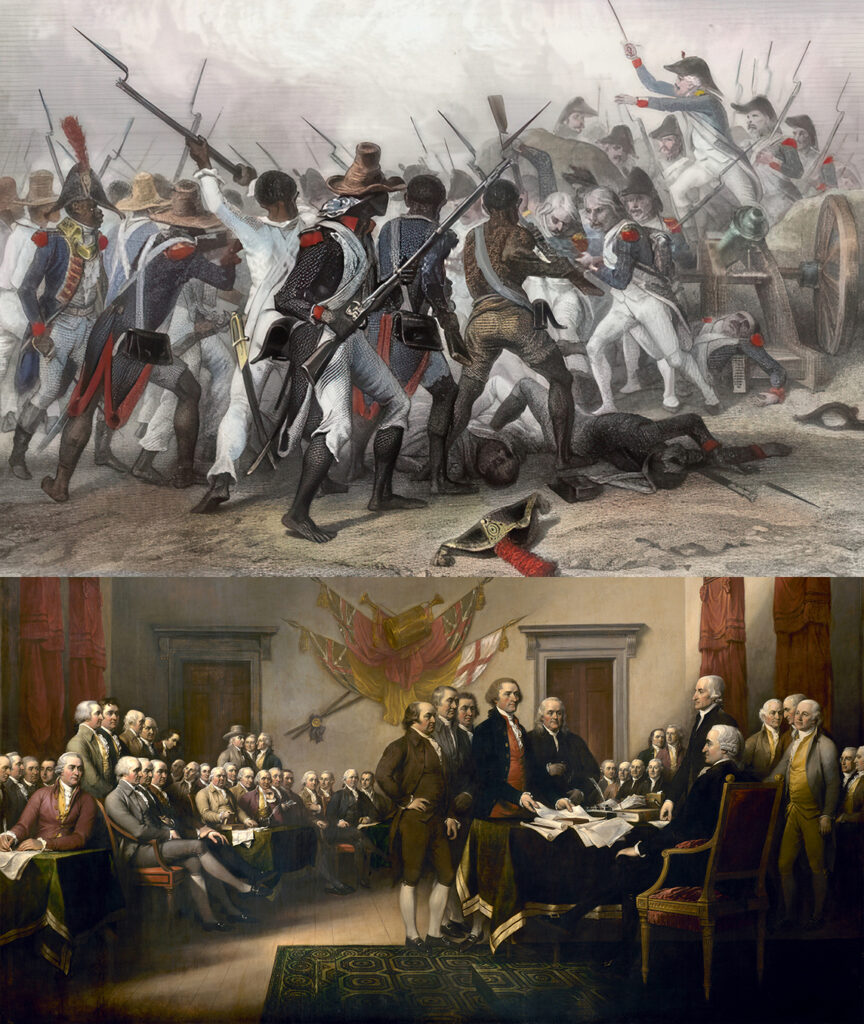
The American Revolution was also the first in an “Age of Revolutions” that included rebellions in France, Haiti, and much of Latin America stretching into the 19th century. The American Revolution expanded freedom primarily for white property-owning men while maintaining the institution of slavery. In contrast, the Haitian Revolution expanded the very meaning of freedom by abolishing slavery and redefining who could claim full human rights. Students should compare the American, Haitian, French, and Latin American revolutions to analyze how different groups defined “freedom,” whose independence movements fulfilled those ideals, and whose remained unfinished.
7. What happens to our understanding of “American freedom” when we center the voices of those it excluded? What do popular stories of the American Revolution claim about how history and progress are made? What do they hide? What purposes do they serve?
Under a heading called “What Teachers Should Consider,” the Hillsdale College 1776 Curriculum insists that the United States is unprecedented “most significantly in the opportunity all its citizens have to pursue unmatched conditions of freedom, security, and prosperity. The country owes its unprecedented success to an unprecedented founding, a beginning forged and canonized in the Declaration of Independence, the War of Independence, and the U.S. Constitution.” This “consideration” hides the truth: The founding documents were written in a way that protected slavery, excluded most people from political participation, expanded settler colonialism and the dispossession of Indigenous nations, and secured the power of wealthy white men.
Hillsdale College is a right-wing institution, but the idea that the founders were imperfect geniuses who set the United States on an ever-widening path toward freedom for everyone is a fairy tale that infects countless textbooks, museums, and monuments. This top-down framing has been used to justify domination throughout U.S. history, erasing the grassroots movements that have actually fought for freedom and expanded its meaning, and stifling critique of today’s inequality in wealth and power. Students should analyze such stories that masquerade as “objective” history and study voices silenced in these narratives.