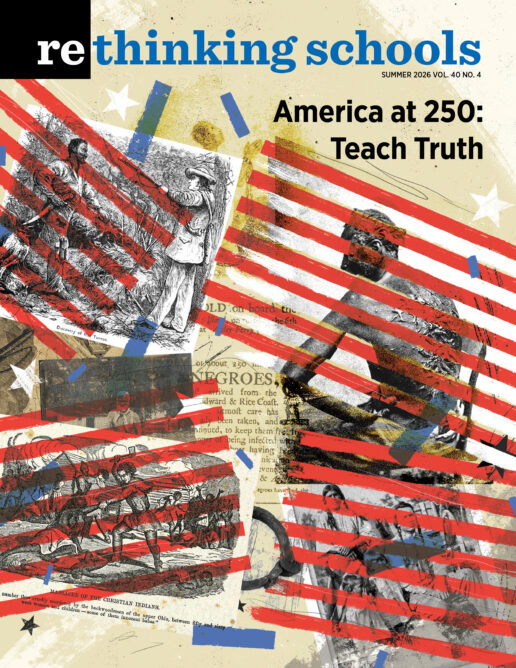
Rethinking the American Revolution
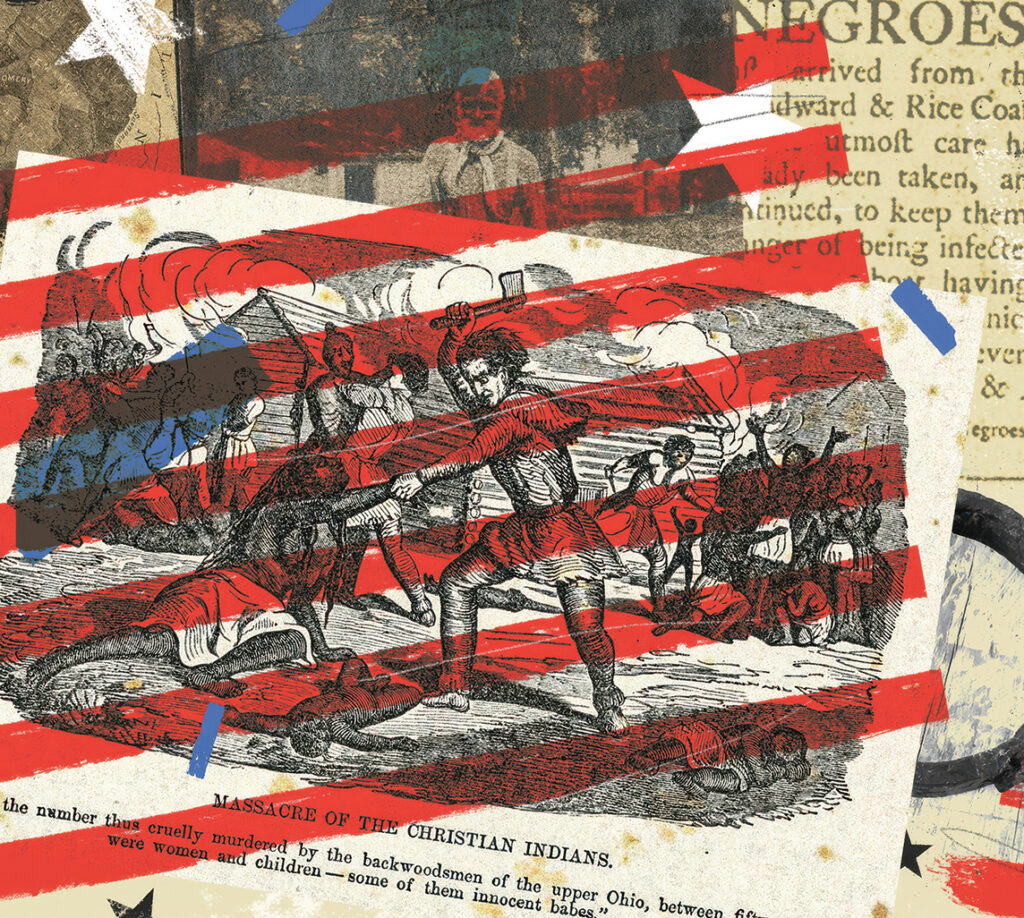
Illustrator: Nate Kitch
Here’s the fairy tale version of the American Revolution that so many of us grew up with: A series of British laws in the 1760s imposed new taxes on the American colonists. When the colonists rebelled against this “taxation without representation,” the British punished these protests leading to outrage throughout the 13 colonies in North America, provoking a revolutionary war against British tyranny.
It’s the simplistic story that Donald Trump wants to make official through what he calls “the most spectacular birthday party the world has ever seen” — the 250th anniversary of the Declaration of Independence. By declaring all men equal with unalienable rights — life, liberty, and the pursuit of happiness — the authors of the Declaration of Independence, in Trump’s words, “began the greatest political journey in human history.”
A rogues’ gallery of right-wing and Christian nationalist education organizations are helping Trump push this fable through taxpayer-funded initiatives. These include PragerU’s “Freedom Trucks,” six semitrucks filled with conservative educational content touring through red states, Turning Point USA and the Department of Education’s “History Rocks!” tour, and the “Story of America” video series Hillsdale College produced for the White House, which compares Trump to Abraham Lincoln.
It is a story that erases Indigenous people, enslaved African Americans, poor whites, and women. It turns all of “us” into white male colonists. It’s the American Book of Genesis: In the beginning, there were oppressed, freedom-loving people; we defeated our oppressors and today we are still brave and true.
Social reality in 1776 was more complicated. To begin: 41 of the 56 signers of the Declaration of Independence enslaved other human beings. At the time, white American colonists enslaved as many as almost half a million Black people. For most of our “Founding Fathers,” one crucial piece of freedom consisted of the freedom to enslave others.
And although the American Revolution was fought against the British Empire, it was also fought to create a new empire. The Declaration of Independence itself named Native peoples as “merciless Indian savages,” making clear that the language of liberty was bound from the beginning to a justification for conquest. The drive for independence was shaped in part by conflicts with the British Crown over westward expansion. When the British attempted to limit settlement through the Proclamation of 1763 — drawing a line along the Appalachian Mountains and prohibiting colonists from moving west to reduce conflict with Indigenous nations — many colonists, particularly land speculators, resented the restriction. Independence removed those constraints — and opened the door to an aggressive expansion into Indigenous lands.
Another feature of our nation’s founding is class struggle — most famously revealed in the so-called Shays’ Rebellion, when white farmers, many of them Revolutionary War veterans, sought to shut the courts in western Massachusetts and prevent the expropriation of farms for failure to pay unjust taxes. Poor people in arms frightened U.S. elites, and the Constitution created a national army that could suppress “domestic violence.” At the time Americans elected their first government in 1789, voting rights were so restricted to white men who owned property that only 6 percent of the population could vote in the first national elections.
But this outcome was not inevitable in 1776. The fight against the British monarchy required a mass mobilization that sparked debates about democracy, equality, and freedom that resonate to this day. In a Philadelphia broadside posted across the city in June 1776, author James Cannon insisted that delegates of “honesty, common sense, and a plain understanding” must draft the new constitution, warning that “overgrown rich men will be improper to be trusted, they will be too apt to be framing distinctions in society, because they will reap the benefits of all such distinctions.” Indeed, two years later in another Philadelphia broadside, some in the Revolutionary militia — which was made up mostly of poor men forced to serve with minimal pay and supplies — accused rich merchants of using wartime shortages to charge more for goods. “We have turned out against the enemy,” they wrote, “and we will not be eaten up by monopolizers and forestallers.” Days later, militiamen threw more than 20 wealthy men in jail for overpricing and formed a committee to lower the cost of goods. (Both of these broadsides are featured in Mimi Eisen’s lesson “‘Founding’ Documents We Don’t Learn About,” available at our Zinn Education Project website.)
We are not urging a “feel bad” history of our nation’s independence. We simply advocate a truthful history. The nation was founded through a war for national independence from a feudal monarchy that left both slavery and settler colonialism in place. It had both democratic and anti-democratic impulses. When students learn the truth about the revolution’s limitations and accomplishments, they better understand the roots of our country’s ongoing inequalities and conflicts. When race, class, and empire are scrubbed from the Revolutionary era’s curriculum, students are ill-equipped to recognize how these appear throughout the nation’s history, and how they are central to understanding today’s world.
Because the struggle for racial justice and social equality have always been at the center of U.S. history — but also settler colonialism — it requires intentional effort to tear these out of public iconography. Thus, last March, in an Orwellian executive order titled “Restoring Truth and Sanity to American History,” Trump directed the National Park Service to remove signs and other materials from our national parks and museums that state the land once belonged to Native Americans. And park workers at Independence Mall in Philadelphia near where the Declaration of Independence was signed used crowbars to peel off plaques that commemorated the nine people George Washington enslaved there while he was president.
The crowbar is an apt metaphor for what the right wing is using to pry themes of racial and social justice out of the curriculum. As Jesse Hagopian points out in his book Teach Truth: The Struggle for Antiracist Education, almost half of public school children in the United States live in states that restrict teaching about race and racism. And yet we know that teachers in the reddest red state are defying prohibitions on teaching truth.
As Trump et al. prepare for their “spectacular” propaganda festival for the 250th anniversary of the American Revolution, we know that teachers across the country will refuse to bend a knee to his curricular demands. The Zinn Education Project, which Rethinking Schools coordinates with Teaching for Change, has prepared a list of questions to guide teachers’ classroom inquiry. (See p. 6.)
We supplement these questions with recommended “people’s history” lessons, posted at the Zinn Education Project — these include “‘Founding’ Documents We Don’t Learn About,” a lesson on seldom-heard anti-slavery, feminist, and working-class voices of the Revolutionary era; “Race, Class, and the Constitutional Convention,” a lively activity that invites students to imagine the kind of constitution we might have had with a more representative Constitutional Convention, and a look at the social class positions of the so-called Founding Fathers; and “‘Semiquincentennial Blues’ — Teaching the 250th Anniversary of the United States Through Blues Poetry” in which students explore the blues as both a cultural art form and a vehicle for political resistance.
* * *
In Erasing History: How Fascists Rewrite the Past to Control the Future, Jason Stanley writes: “[F]ascist education works by strategically erasing accounts of history and current events that include a diversity of perspectives, narrowing the scope of what can be taught until students are presented with a single viewpoint, which is formulated specifically to justify and perpetuate a hierarchy of value between groups.” Stanley warns that this narrowing is “inconsistent with multiracial democracy, antithetical to egalitarianism, and carries the possibility of conjuring mass violence.”
Trump has made it plain that the semiquincentennial this summer will help further his attack on diversity and his attempt to stifle questions about race, class, and empire. But educators have the power to teach our students and our communities how to envision a different future. This summer amidst the pageantry of patriotism, let’s commit to unearthing the voices of dissent from the U.S. past and present that can help us organize for a just future.