“Rethinking Columbus” to Help Students Find Their Voice in an Age of Villains
I started teaching U.S. history during the first Trump presidency. I vividly remember the fervor of my early efforts in the wake of the 2016 presidential election. If bullies can win in the theater of American politics, I thought, at least in my classroom I could try to set a higher standard. I was determined to teach my new class of 5th graders difficult truths with courage, care, and complexity.
Thus, I found my way to Rethinking Schools’ Rethinking Columbus. In that time and within that school community, it felt intriguingly challenging to sit with historical evidence and ask the question: Was Columbus a hero? My students dug into the history, analyzed primary and secondary sources, and drew their own conclusions. We explored big themes of perspective and power as it affects how history is written. At the end of our study, students had the ability to write a persuasive letter to the mayor of our city, who at the time was considering what to do with a statue of Christopher Columbus in city hall. Most students seemed proud to mail off their letters decrying Columbus’s crimes against the Indigenous Taíno nation and making their opinions known to a local politician.
Five years later, I began teaching another 5th-grade class, this time in a very different context. My new school was a small, social justice-oriented independent school, where I was excited to learn that I was inheriting a project based on the same Rethinking Columbus curriculum I had utilized back in 2017. Yet, as I started teaching social studies in my new community, I began to wonder if the project would still be relevant. Post-2020, hundreds of Columbus statues had been removed around the country, and I soon learned that our city was the first to adopt Indigenous People’s Day instead of Columbus Day, decades prior in 1992. Moreover, my students — predominantly well-resourced children from well-educated families — were quick to parrot progressive-sounding talking points they had picked up from home and the surrounding San Francisco Bay Area. They were well aware that Columbus was a villain and had no problem sharing that opinion boldly. In fact, it was not uncommon for them to boo when his name came up in class.
The deeper we got into discussions of power and colonialism, however, an interesting trend began to develop. My students, as with many people and developing adolescents, struggled with the abstract thought, criticality, and systems-level thinking necessary for deeper historical analysis. After all, as terrible as many of Columbus’s actions were, he was still only one man operating as a cog in a broader system of colonial conquest and violence.
It wasn’t until we were on the cusp of yet another Trump presidency that it began to sink in how dangerous this singular villain trope could be from a historical and contemporary perspective. It is convenient to paint history in a black-and-white binary of heroes and villains, putting individuals like Columbus and Trump on pedestals of exceptional abuse, alongside many powerful men before them. Yet, any one powerful person is surrounded, propped up, supported, and funded by countless others as well as by invisible systems, beliefs, and ideologies at play. The question of complicity never felt more relevant.
Systems of Power: Understanding Sociopolitical Abstractions like Monarchy, Colonialism, and Empire
It was in trying to address this struggle that I came across Bill Bigelow’s write-up of the People v. Columbus, et al. activity he does with students and Bob Peterson’s accompanying recommendations for upper elementary and middle schoolers. Bigelow, with input from members of the Taíno community, cultivated a unit of study that culminates in a trial role play focused on the central question Who or what is responsible for the genocide of the Taíno people?
Excited, I built this out into a two-month unit culminating in a scripted mock trial with four different “Defendants”: Columbus, Columbus’s Crew, the King and Queen of Spain, and “Systems of Power.” The concept of “Systems of Power”— or “The System of Empire” in Bigelow’s original curriculum — helps concretize abstract concepts like monarchy and colonialism and builds off our previous social studies discussions about the role of power in history. I asked my students:
- Is Christopher Columbus guilty all by himself? If so, how could he singlehandedly do all that destruction?
- What about the king and queen of Spain who funded his multiple trips and oversaw his work?
- What about his crew who followed orders?
- What about the pope, who wrote the Doctrine of Discovery stipulating that conquering non-Christian lands and brutally overthrowing those who lived there was the “holy and praiseworthy purpose” of European Catholic powers?
- And then what do we do about Nicolás de Ovando, who succeeded Columbus and by many accounts enacted more cruelty than before?
Students recorded their initial thoughts in the form of a pie chart. If the whole circle represented 100 percent of the blame for the genocide, destruction, and violence, how would they proportion responsibility? Many credited Christopher Columbus as holding 80 to 90 percent of the total responsibility. Pointing fingers is easier when there is one clear villain after all, and to be fair, understanding the role of something as abstract as “colonialism” is a developmental challenge for 10-year-olds.
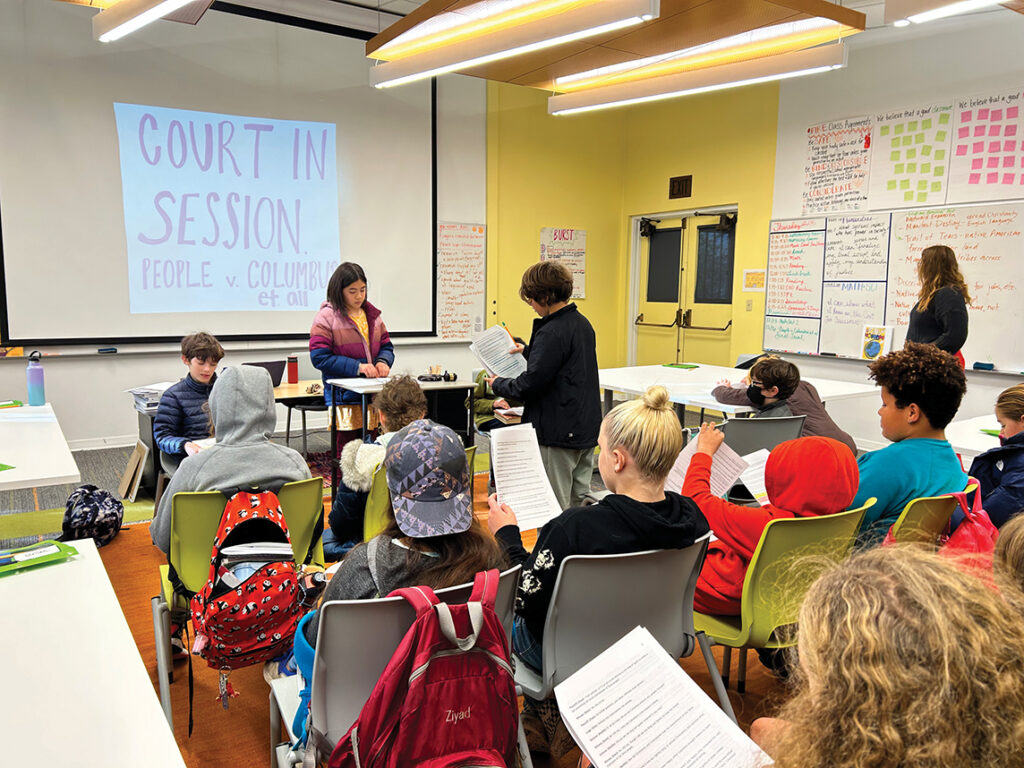
From there, we dove into the question of guilt through the lens of the mock trial in earnest. In my adaptation of the project, I drew on the work of Dorothy Heathcote’s Mantle of the Expert and principles of educational drama to draw my students into the role of lawyers. To mirror the U.S. justice system, I also introduced the idea of “innocent until proven guilty.” However, we quickly establish that no one in question is “innocent” of historical harm, and thus the larger question at play is rather “how is the guilt shared; how does power play into this?” From there, students studied primary and secondary source documents to gather evidence both for and against their assigned “defendant,” and then were assigned positions to craft arguments for the courtroom.
Finding a Voice to Speak Truth to Power
In this project, I don’t ask students to impersonate or step into the role of those enacting violence, like Columbus or Columbus’s men. The only exception I make in this activity is that students choose one “witness” they would like to call to the stand, usually either Friar Antonio de Montesinos or Bartolomé de las Casas — Catholic priests who documented and spoke out against the horrors enacted by the Spanish. In this case, I think it is valuable for my students to identify with a historical figure from the dominant society who acted courageously and at great personal risk to speak out against injustice.
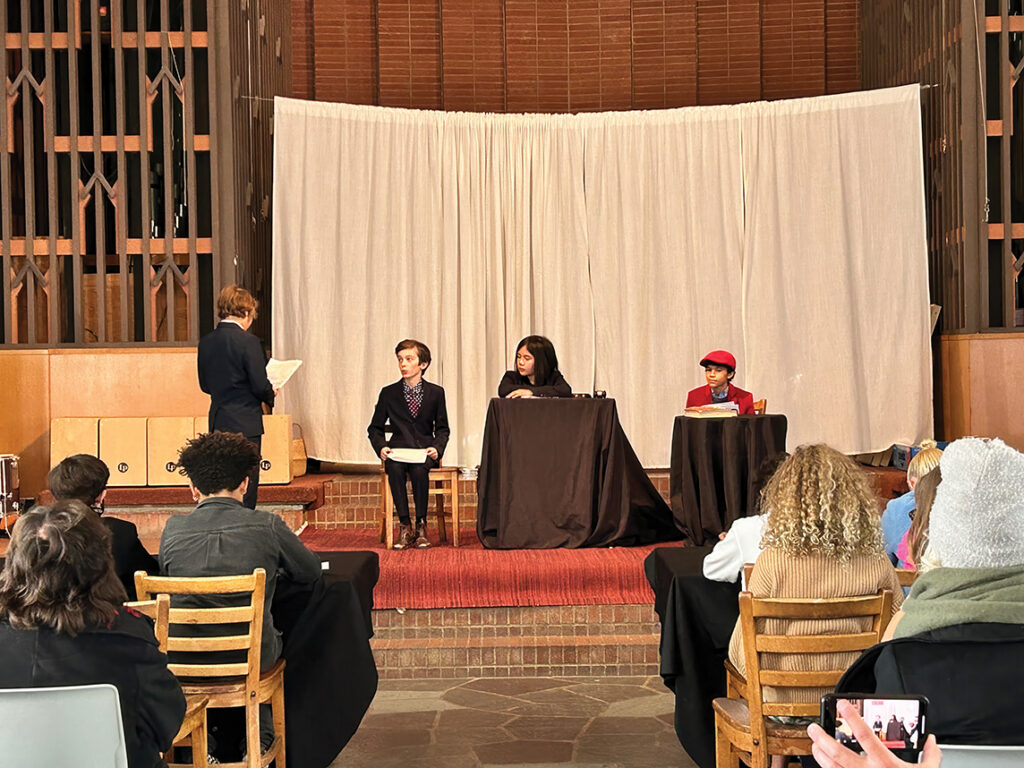
Otherwise, we move away from historical reenactment entirely and lean into the imaginative wonder and playful creativity that occur when students glimpse themselves in the adult world. We read the dress code recommendations for several district courts and I invite students to dress up as they choose to inhabit their role as lawyers. Students can enter a lottery to determine additional roles like the judge and bailiff, and those children in turn get to wear robes, carry gavels, swear in witnesses, and address the jury — all elements that add fun and authenticity to their self-expression in the performance.
Focusing the mock trial on the mantle of a lawyer also allows students to engage the past as their full present-day selves, rather than impersonating someone else. This helps them find their own authentic, authoritative voice as writers, speakers, thinkers, and historians. While the initial project from Rethinking Schools is conceptualized as a live action mock trial, I have found that my younger students benefit from a pre-prepared script. Taking away some of the pressure of extemporaneous speaking allows students more time and space to develop their tone and argumentation style.
Students who had struggled to write an academic paragraph at the beginning of the year were integrating historical evidence to argue nuanced and complex claims. For example, one student’s initial brainstorm read:
Some evidence that we believe supports our theory that Columbus was guilty. He threatened Taíno people with swords when they only had cane tools. And when they didn’t bring him enough gold from the mines he would chop off their hands. According to primary evidence from Friar Antonio de Montesinos, “With my own eyes I have seen Indians starving to death . . .”
The same student went on to complete a final draft that argued:
The testimony of Antonio de Montesinos states that Columbus committed horrible crimes that resulted in the near extinction of the Taíno people. Although Columbus gave the Taíno people gifts, he stated in his own diary that it was just to gain the trust of the Taíno people to proceed to enslave and colonize their nation to do his bidding. In conclusion, we believe that Columbus should be punished for his crimes.
As a teacher, it is beautiful to see the way a student can transform from typing pages of emojis to using words like “horridly” while arguing the relative responsibility of individual choices versus religious ideology, as another student later did:
Columbus’s crew treated the Taíno horridly and not all Christians agreed with how the Europeans were treating the Taíno. A quote from Bartolomé de las Casas’ journal says, “Why can’t you feed them and care for them? It is because you are so greedy for gold, you work them to death. You don’t even teach them about God, or let them go to church.” These words were spoken by Spanish priest Friar Montesinos, in an act to “open their hearts.” Many of his religious colleagues agreed. Now, the Christian systems of power did have a part to play, but this evidence demonstrates that many Christian priests were against the genocide of the Taíno people.
Imagining themselves as highly educated experts in real-world contexts allowed my students to more quickly and joyfully adapt their speech and writing to sound more “lawyerly.” In pretending to be lawyers, they were internalizing the structures and rhetoric of argumentation expected in many academic settings.
Centering Indigenous Resistance, Leadership, and Modes of Accountability
Most importantly, although the project and excitement of becoming lawyers is a lot of fun, I always remind students that we are talking about real harm, real people, and devastating history with lasting consequences. As we prepare for the trial, I work to center the Taíno people, their perspectives, their resistance, and their leadership throughout the unit, and invite students to contextualize this within the ongoing work of Indigenous people in our own neighborhood to address the impacts of colonialism as well.
José Barreiro’s essay in the second edition of Rethinking Columbus is an incredible resource for starting our learning about the Taíno people from a place of power and flourishing rather than pain. In my elementary context, the nonfiction book History Smashers: Christopher Columbus and the Taíno People, co-authored by José Barriero and Kate Messner is another valuable secondary source. I also take excerpts from Alvin Josephy Jr.’s Rethinking Columbus essay “Taíno Resistance: Enrique’s Uprising” to highlight Taíno leadership and resistance efforts in the face of European colonialism.
As a class, we explore the website of the United Confederation of Taíno People, where students can ground into the knowledge that Indigenous Taíno people still exist and live in their ancestral homelands. We familiarize ourselves with how the Confederation works to restore so much of the language, culture, art, and wisdom that was systematically destroyed in the genocide. From there, students brainstorm ways to honor those efforts and people in our own mock trial performance. In past years, this has included ideas such as a moment of silence, lighting a candle, sharing Taíno art or language, inviting donations and hosting bake sale fundraisers for the United Confederation of Taíno People, and an acknowledgement of the original people of our own school’s grounds.
We later extend our study beyond Columbus and into the lasting impacts of colonization on Indigenous Americans, including the ancestral people of the land where we currently live. The book Colonization and the Wampanoag Story by Linda Coombs provides us with a narrative bridge to Indigenous perspectives before, during, and after the early American colonies.
As a class, we always end our Mock Trial with a discussion about what true justice would look like, given that so much harm cannot be ”undone.“ I ask students what they think a fair “sentence” would be for the party or parties found most guilty in our trial. Inevitably, students start with silly, violent ways to punish Columbus or “give him a taste of his own medicine.” I let them carry on for a bit, while charting their ideas on the whiteboard. Then I ask, “Let’s think about the harm done that we are ‘punishing’ for. Would any of the ideas we’ve brainstormed make a difference for the Taíno people?” Together we look back over the list and star some that might come close (e.g., give back everything they stole). This allows us to explore Indigenous concepts like restorative justice and move the conversation away from carceral systems of punishment.
I then ask students to pause and make a list of all the ways the Taíno people experienced harm at the hands of European colonists. In addition to the brutal death, torture, and loss of land, we draw on our knowledge of Taíno life before colonization to identify some of more abstract losses as well: language, culture, wealth, leadership, art, etc. We then sit with the question: Given that there are still people alive today experiencing the effects of this genocide, is there anything that could be done now to address the injustice of the past? Students struggle a bit more with this discussion, but it allows us to explore some more contemporary Indigenous movements like Land Back and sets up future discussions about the idea of inherited injustice, privilege, and ongoing systems of oppression and supremacy.
Systems of Complicity: Responsibility for Current and Historical Injustices
History classes and historical interpretation are by nature affected by human bias and perspective and have thus long been the frontlines of larger ideological battles in the United States. In a world where events are increasingly obscured and warped by a multiplicity of conflicting accounts, it is essential that we equip young people with the tools to sift through the evidence and draw their own conclusions. Likewise, exploring responsibility and complicity is more important now than ever. In a world of “clickbait,” “ragebait,” and “doomscrolling,” the allure of a neatly packaged villain has never been stronger. Whether Christopher Columbus or a modern-day politician, it is tempting to collapse systems and generations of people’s influence into a tidy narrative of exceptional cruelty.
Year after year, I see the students assigned to defend Columbus struggle at the beginning of the project. How do you defend someone you perceive as a villain? And, given that we establish early on that no one involved is innocent, what should their defense even entail? In crafting their arguments, I help guide students to concede points of historical fact while also pointing out how many other parties are “as much if not more at fault.” The reality is that behind every villain are ordinary people using their power to uphold systems of cruelty. And while this in no way excuses or justifies Columbus’s actions, revealing this reality can help us see ourselves in the story more clearly. After all, the problem with having a storybook villain is that it leaves the rest of us waiting for a storybook hero to save the day. Helping students peel back the layers to see the machinery of empire is essential to them recognizing their own power to challenge systems of injustice.
All their hard work culminates when students perform their scripted trial in front of an audience of their peers and families. At the end of the event, we invite the audience to participate in the same pie chart activity about collective responsibility as we did at the start of the unit, then the 5th graders analyze and discuss the results. It is a joy to see the ways that these young people have grown over the course of the project to hold space for more complex understandings of responsibility. As a teacher, it brings up a bit of the spark of earnest hope I felt back in 2016, standing before my students and wanting to proclaim “It doesn’t have to be this way!” If guilt is a pie, we joke, there is plenty of it to go around. But then, if every human is held responsible for their impact on history, there is also plenty of other abundance to share.