Learning Under Occupation:
Community Resilience in Twin Cities Schools
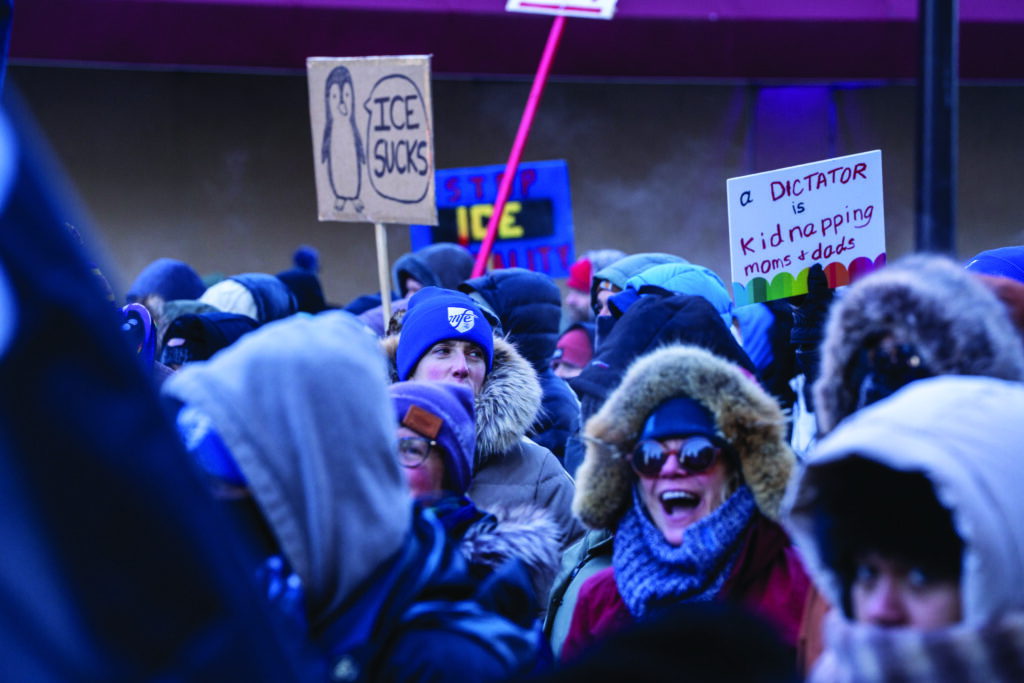
Since the start of the new year, ICE had been patrolling my Minneapolis neighborhood. One January morning, a Signal alert warned me that agents were attempting to abduct a nearby resident. I grabbed my whistle, ran out the door, and stepped into clouds of tear gas billowing from the icy streets. Blaring car horns pierced a wailing staccato of whistles. Protesters clashed with armed ICE agents in combat gear, full-body armor, and carrying assault weapons. As the crowd continued to gather, agents deployed pepper spray, sandbags, and more tear gas, sending protestors to the ground and scattering the panicked crowd. I felt defeated — and afraid for my safety — so I retreated.
A week before this violent confrontation, ICE agents shot and killed Renee Good, a nonviolent protester one block over. Weeks later, Alex Pretti, a second nonviolent protester, was murdered by federal agents, sparking large protests and national scrutiny.
Children are not immune. “My students live with the constant awareness,” educator Italia Fittante writes, “that anyone they love could be taken at any moment. They themselves could be next.”
But alongside the trauma and turmoil, I have watched my city organize beautifully. I’ve danced with my community in the frigid Minnesota winter to “Stand by Me,” blasted out by Brass Solidarity — my neighborhood’s justice brass band, formed in the wake of George Floyd’s murder in 2020. I’ve marched down Lake Street with hundreds of neighbors, alight with protest songs, pausing to honor and remember those abducted on corners just days before. Droves of volunteers show up to serve as constitutional observers during Friday prayers at local mosques. ICE agents have repeatedly approached my favorite neighborhood Venezuelan restaurant; each time, workers bolt the door and refuse entry. These stories show how communities can come together amidst tragedy to create something beautiful.
As I watch my city organize, I also see these lessons echoing inside schools. Amid the terror and trauma of the ICE occupation in Minneapolis, a network of care is taking root. Schools are more than brick and concrete — they are connective tissue. They have become central sites where care, resistance, and joy are organized and sustained in real time.
This pattern of defiance did not emerge out of nowhere. From the Little Rock Nine to the fight for Ethnic Studies curricula to the Sanctuary Schools movement, schools have long been sites of resistance. Minneapolis Families for Public Schools (MFPS), a collective advocacy group, was busy last fall preparing for a strike. As attendance began dropping and a climate of fear intensified, particularly for students of color, members formed a subgroup to prepare for a possible infiltration by federal immigration agents.
MFPS quickly created rapid-response groups. These volunteer-organized teams of parents and community members began monitoring federal agency activity near schools. They coordinated community support and alerts to protect students, families, and staff. Leaders borrowed tactics from similar hyper-localized efforts in Chicago and Washington, D.C. Coordinators circulated a Google Form allowing families to request help anonymously with groceries, rides, rent relief, and other necessities while sheltering in place. Once the foundation of support proved solid, more neighbors began carrying whistles and patrolling city streets. They also kept watch during key times, such as school recess and arrival and dismissal.
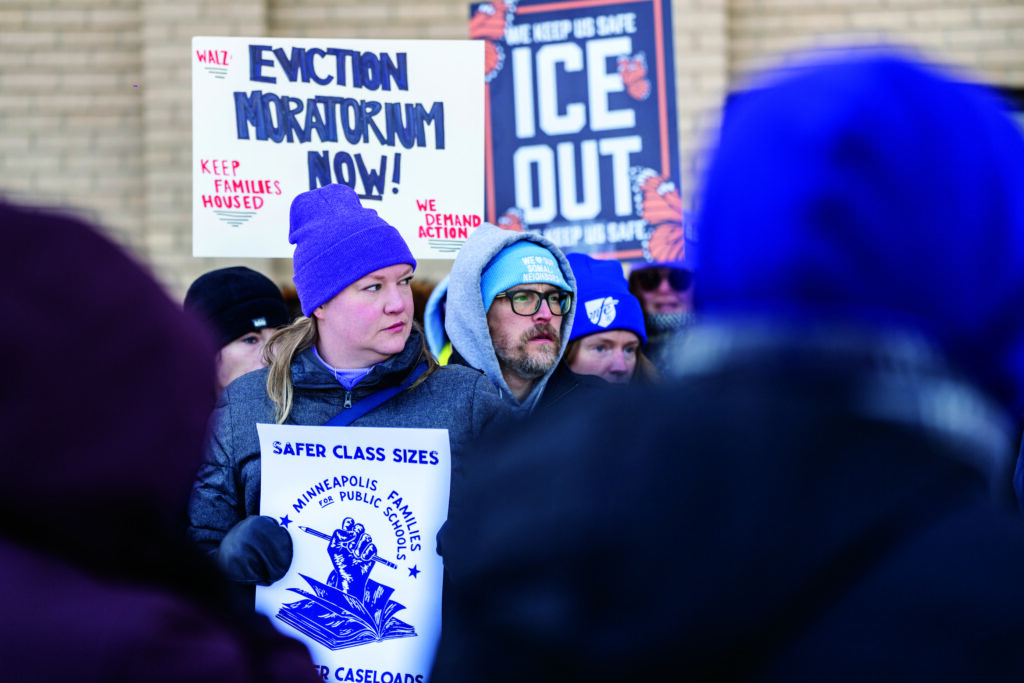
One neighborhood elementary school supports 80 families affected by Minnesota’s massive federal immigration enforcement, Operation Metro Surge. Neighbors say there’s no real secret to protecting, caring for, and mobilizing an effective coalition. “There’s nothing really unique about the ways people are standing up,” Molly, a Minneapolis parent, explains. “It doesn’t take professional organizers. When there’s a tidal wave of everyone doing this, it gives you the courage and permission to do it, too.”
Molly says these efforts can look both large and subtle at the same time. Effective tactics include the front office keeping a daily list of drivers and riders and monitoring who enters and exits the building. Volunteers help ensure kids get to school safely and deliver materials to those learning remotely. “And,” she adds, “it looks like a shit ton of white people with whistles on corners.”
At the helm of this grassroots resistance work are countless educators. In many schools, especially those serving large populations of students of color, a majority of students are too afraid to attend class. Some teachers implement courses in hybrid formats; others interact with students entirely online. On top of this expanded classroom load, teachers stretch their roles even further. They turn conference rooms into food pantries, conduct daily block patrols, deliver groceries to families, and monitor bus stops to keep students safe. After teaching a full day, some stay out late organizing strikes and marches.
“The level of bravery among teachers to face this head-on has been remarkable,” says Jehanne Beaton of the University of Minnesota’s Department of Curriculum and Instruction.
Teachers themselves describe what bravery looks like on the ground. Sofia, a St. Paul middle school social studies teacher, explains: “It’s grief every day, and then it’s hard work every day, and it’s no break, because you go home and it’s still happening. You come back to school, and you want to teach. You want to make sure your students online can learn, so you build those classes outside of class time, because you don’t have time during contract hours.”
Amy, an administrator at a K–12 Minneapolis school, begins her day by checking a routine threat assessment. She reviews the school’s emergency Google Chat and Signal Chat, where neighbors and families share reports of federal agents’ whereabouts. Nearly ninety percent of students at her school are Latinx. She says ICE agents have stalked school property, knocked on students’ car windows, and intimidated and threatened young people while circling the campus. After assessing the threat, she helps decide whether to initiate a secure dismissal or forgo recess that day. Each day, she walks the perimeter to monitor the area, and she and neighbors stand together on street corners to “see who’s rolling by.” This daily conversation and collective awareness fuel a quiet, fierce resistance.
As the occupation continues, students activate in ways aligned with their personal vulnerability and risk. For some, it means continuing their learning, one aspect of life they can control, from home. For others, it’s attending school even after being tailed by federal agents’ vehicles along the way. Many who feel safe enough to attend in person participate in demonstrations. On Jan. 12, hundreds of students at Maple Grove, Roosevelt, and other area high schools walked out of classes to protest federal immigration enforcement and heightened ICE activity in the Twin Cities. Participating students chanted, marched, and drew support from neighborhood crowds.
Inside schools, students’ engagement with civic life has taken on new intensity. Students with greater privilege and safety are making sense of the resistance through the formal curriculum. Topics once considered dry or purely theoretical have taken on a newfound immediacy. In Daniel’s Minneapolis high school social studies class, the widespread occupation has sparked a deeper level of engagement. “Bureaucratic discretion could be one of the most boring terms in a textbook,” Daniel says. “But when you connect it to domestic terrorism and anti-fascist ideology, it makes even the driest Civics 101 lesson seem vital to understanding what they want to say.”
In daily news briefings and discussion circles, Daniel’s students raise ideas of mutual aid and solidarity. They draw connections that extend beyond the traditional AP U.S. Government curriculum. Students are increasingly emboldened to debate and disagree, bringing in a wealth of information from on-the-ground footage shared on social media platforms such as TikTok and Instagram.
Daniel watches his students grasp complex civic principles — from federalism and equal protection to racial profiling and checks and balances — in more visceral ways. They recently analyzed Noem v. Vasquez Perdomo, a Supreme Court shadow docket decision that effectively allowed the agency’s aggressive, racially targeted roving patrols to continue in Los Angeles. Students asked sincere, probing questions, Daniel says, such as “What is the shadow docket?” “What is separation of powers?” and “What is the discretion of these federal agencies?”
In class conversations, sharp feelings of grief, rage, and uncertainty come to the fore
Beyond the classroom, school and district administrators respond by creating policies and guidance for teachers navigating these challenges. Many administrations have supported educators who incorporate the ICE occupation into their lessons. Some draw parallels between Renee Good and Viola Liuzzo, the white civil rights activist who was murdered by the KKK after the voting rights march to Montgomery, Alabama.Others compare and contrast the ICE detention centers with Chinese internment camps like Angel Island. Some teachers integrate the immigration enforcement surge into units on the history of migration. Social studies educators emphasize the historical context of immigration policing, connecting longstanding political trends to the present day, such as the 1882 Chinese Exclusion Act and the Johnson-Reed Immigration Act of 1924. Both laid the foundation for racially exclusionary immigration enforcement policies.
At the district level, some administrators broadcast a message of neutrality, encouraging educators to stick to offering students a stable learning environment. “The message from our school district,” Evan, a Minneapolis metro area educator, says, “has really been making sure that school is a safe space where we just do education, so students feel like they come to school and they know what to expect.” Yet, Evan notes, all teaching is political. Students naturally interrogate any sense of imposed neutrality. “All teaching is advocacy work,” he says. “What I have enter my classroom can either be a form of neutrality, which, in this case, is an acceptance of what’s happening — or I can have these things enter the classroom as [an act of] resistance and resilience.”
“We’re not explicitly teaching about the current situation,” Jason Benjamin, an elementary school teacher in Minneapolis, explains. “But guess what? It comes up. They know what’s right and wrong. And then it’s kind of like, ‘Well, what do you know?’ ‘OK, let’s talk about that.’ ‘How do you feel about that?’ ‘Are you close to somebody who’s stressed out or anxious because of possible vulnerabilities?’ And with that said, ‘What are some things we can do?’ We need to remember how important teachers are to conveying truths and values, and what a beautiful community can look like.”
In class conversations, sharp feelings of grief, rage, and uncertainty come to the fore. Molly, parent, organizer, and teacher-educator in St. Paul, uses a mood meter to help students check in with themselves and acknowledge the coexistence of conflicting emotions. “It’s possible to feel content and terrified at the same time,” she tells her students. Emotions are nuanced at any age, she adds, and often all “wrapped up” together.
Educators like Sofia emphasize the importance of voice and choice, inviting students to define what safety and comfort look like for them. Allowing students to tell their own stories gives them agency over both their learning and their experience.
When grief, care, joy, and resistance co-mingle with a routine school day, educators, families, and students look to one another to help hold it all. In this way, schools become hubs for weaving organized care and joy together with the spirit of resistance. Across classrooms, school spaces, and neighborhood streets, community members are joining the movement. “If you’re just sitting on social media and watching what’s going on,” one Minneapolis-area language arts teacher shares, “your heart feels like it’s in a cage. When you’re out on the street doing something, or helping somebody, it opens. The cage is off and the heart is free. At least for a little while.”