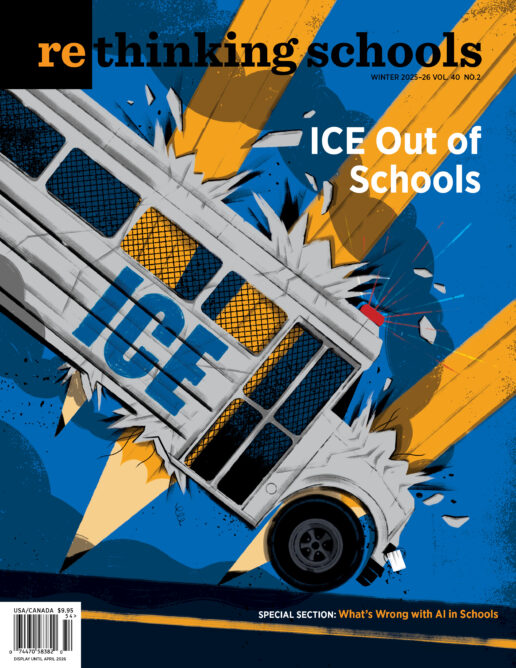
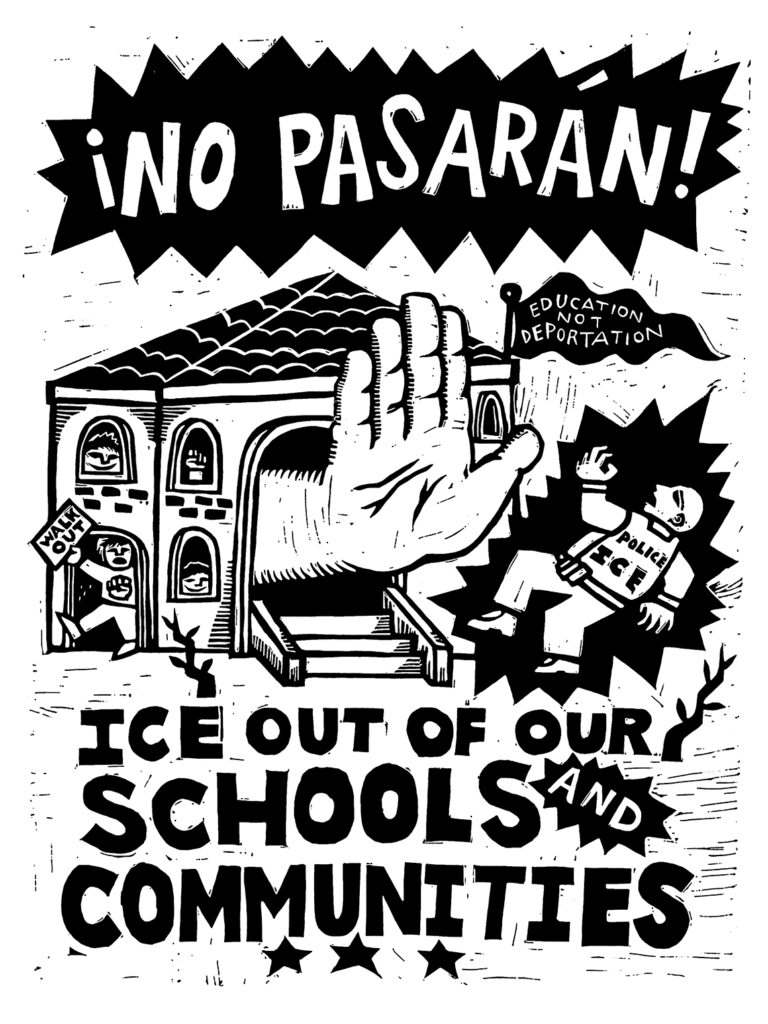
Kicking ICE Out of Our Schools and Communities
Illustrator: John Fleissner
Silverio Villegas-González, a father of two young boys in a small suburb of Chicago, just south of O’Hare Airport, woke up on Friday, Sept. 12, and, like he did every morning, drove his children to school before heading off to work as a cook.
First, he dropped off his 7-year-old son at Passow Elementary — where 76 percent of the students are Latine. Next, he headed to Small World Learning Center, a short drive down 25th Avenue — where 88 percent of the children are Latine. After dropping off his 3-year-old son, he began driving to work. But just down the street from the daycare, Villegas-González was stopped and shot as he attempted to flee Immigration and Customs Enforcement (ICE) agents.
Mary P. Meier, the director of Small World Learning Center, described Villegas-González as “friendly.” “If we needed something he’d bring it,” she told WBEZ Chicago. As educators, it’s hard to hear this story without heartbreak for the children and school communities devastated by the death of Villegas-González and the ripple effect of fear created by his murder at the hands of ICE agents.
Villegas-González is one of the latest casualties of the long war on immigrants and Trump’s recent escalation that has pit many of our school communities — and in some cases, entire cities — against ICE. Less than one week before Villegas-González was killed, Donald Trump posted an AI-generated image on Truth Social of the president in a U.S. Cavalry hat and aviator sunglasses in front of a burning Chicago waterfront with military helicopters flying overhead. The words “Chipocalypse Now” emblazoned the corner of the image in reference to the 1979 film Apocalypse Now about the Vietnam War. Echoing the infamous “I love the smell of napalm in the morning” line from that film, Trump wrote “I love the smell of deportations in the morning” to accompany the image, and added, “Chicago about to find out why it’s called the Department of WAR.”
Trump’s declaration of war on a major U.S. city is frightening, but what is scarier is that he is building the capacity to conduct one. Trump’s “One Big Beautiful Bill,” passed in July, funds the largest increase in immigration enforcement spending in U.S. history by slashing funds for Medicaid and food assistance that millions of Americans rely on. ICE is now armed with an annual budget of $28.7 billion, which would make it one of the top 20 largest military budgets in the world — just behind Canada and ahead of Israel before its latest assault on Gaza.
Whether it’s Trump’s removal of schools, hospitals, and churches as protected zones free from immigration enforcement, the targeting of political opponents and activists like Mahmoud Khalil, the inhumane conditions of ICE detention, the devastating impact of family separation, the Supreme Court’s stamp of approval for ICE to racially profile, or the deportation of young children who are U.S. citizens without meaningful due process, every week the news cycle offers new reasons the agency should be abolished instead of receiving a larger budget. With multiple videos circulating of ICE officers in plain clothes, wearing facial coverings, and driving unmarked vehicles while kidnapping civilians, comparisons to the Gestapo — the Nazi secret police — have become commonplace.
For too long both Democrats and Republicans have treated immigration as a security issue rather than a human one, steadily expanding the power of ICE and Border Patrol. Long before Trump made ICE a symbol of open cruelty, Obama and Biden helped build the deportation machinery. Obama’s Secure Communities program fused local policing with federal databases, fueling record deportations — about 3 million people, more than any president in U.S. history. His administration normalized family detention and surveillance, laying the groundwork for Trump’s mass raids and family separations. Biden continued to fund ICE at historic levels while utilizing enforcement tools like Title 42, a Trump-era public health order that allowed millions to be expelled without due process under the pretext of preventing the spread of COVID-19.
Students need to feel safe — physically and emotionally — to learn, and ICE’s presence in our communities destroys that sense of safety.
But the new rise in ICE terror has been met with a flowering of resistance. Teachers have been on the frontlines of building the struggle against ICE’s expanding cruelty. This should come as no surprise because an essential part of being an educator is caring about our students’ lives and the communities we serve. As D.C. elementary teacher Ross Irons writes in this issue, kids are coming “to school carrying emergency plans in their backpacks and worries in their hearts.” These worries can weigh students down. Students need to feel safe — physically and emotionally — to learn, and ICE’s presence in our communities destroys that sense of safety.
As last school year ended, Trump expanded ICE raids in and around Los Angeles — where an estimated 10 percent of the population is undocumented. When the community erupted in protest, Trump sent in the National Guard over the objection of Los Angeles Mayor Karen Bass and Gov. Gavin Newsom. But the resistance continued. Teachers in Los Angeles joined with community organizations to create neighborhood patrols to defend community members against ICE. As Ron Gochez, a history teacher and organizer with Unión del Barrio, told Democracy Now!:
The Trump administration is trying to make an example of Los Angeles. Los Angeles is the heart of the Mexican and Central American community here in the United States. And so they think that if they can break us, they can break anyone in the country. And so we understand that, and that’s what we know. We cannot afford to fail. The resistance will continue.
When Trump escalated attacks on D.C.’s immigrant population following the federal takeover of D.C. in August, community members began confronting agents — and in some cases successfully getting them to release detainees. Ensuring community members know their rights can increase their willingness to defend each other against abuses of power by ICE. What happened at Ross Irons’ school in D.C. is one example of the many ways school communities are protecting students and parents in this moment. “Our school’s administration responded to the unfolding crisis with immediacy, organizing know your rights sessions for families and coordinating with partner organizations in the community,” Irons writes.
An essential part of keeping our schools safe is asking ourselves who are our potential allies in protecting students — who are those potential “partner organizations” in our communities that Irons’ school identified? We need to be part of a united defense of our students and our communities. This ought to come with humility, asking immigrant rights organizations how schools can best support their work and not presuming that we have already figured it out. Educators need to be learners.
One of the most effective educator organizations repelling Trump’s attacks has been the Chicago Teachers Union (CTU). (See “The Chicago Teachers Union Is Showing Us How to Fight Trump,” Rethinking Schools Vol. 39, No. 4.) Even before Trump declared war on Chicago’s immigrants, Chicago teachers distributed know your rights fliers to parents, held virtual trainings, and created sanctuary teams at schools to monitor ICE activity.
Kathryn Zamarron, a Chicago music teacher, told On the Line, “There have been students whose teachers gave them exactly this information — what are their rights, what are they able to do — who were home when ICE came to their home when their parents were at work and they were able to keep themselves safe because they knew what to do in that situation.”
Effectively fighting ICE also has a curricular dimension. U.S. economic and military intervention throughout the world — especially in Mexico, Central America, and the Caribbean — has led to what amounts to forced migration to the United States, as people flee repressive regimes. Meanwhile, our government cynically criminalizes the victims of its own aggression. Our southern border itself is the product of U.S. invasion: the 1846–48 war against Mexico, which led to the theft of almost half of that country. And economic policies like NAFTA and other so-called free trade agreements have kicked millions of farmers off their land and shredded environmental protections. And the climate catastrophe, manufactured mostly in wealthy countries like the United States, but ravaging most severely the Global South, is another trigger for migration. All of this should be taught, especially in social studies and language arts classes, as crucial context for understanding immigration.
Our curriculum should also center the long history of how racially discriminatory U.S. immigration policy maintains an underclass, more easily exploited because of their immigration status. It has long divided workers and benefited many U.S. employers. We need to counter the racist myths about immigrants — that they are more likely to be criminal, that they “steal” jobs from U.S.-born workers, that they use up social services and don’t pay taxes, and so on — with evidence that reveals how these fabrications intentionally characterize our migrant neighbors as threats.
And let’s teach about ICE itself. ICE is not a natural phenomenon — it’s policy. A recent invention born from fear, not necessity, it was created in 2003 amid the post-9/11 “War on Terror,” fusing counterterrorism with immigration control and recasting migration as a security threat, families seeking refuge as enemies of the state. For more than two centuries, the United States functioned without this agency, proving it is neither inevitable nor indispensable. ICE hides its cruelty behind recycled myths about immigrants and wears a mask of legality. Let’s expose the lies and pull off its mask.
From the classroom to the street, we need to defend our students and together learn the most effective ways to kick ICE out of our schools and communities.