In It for the Long Haul: Increasing the Possibility of Freedom and Liberation for All
An Interview with Mariame Kaba
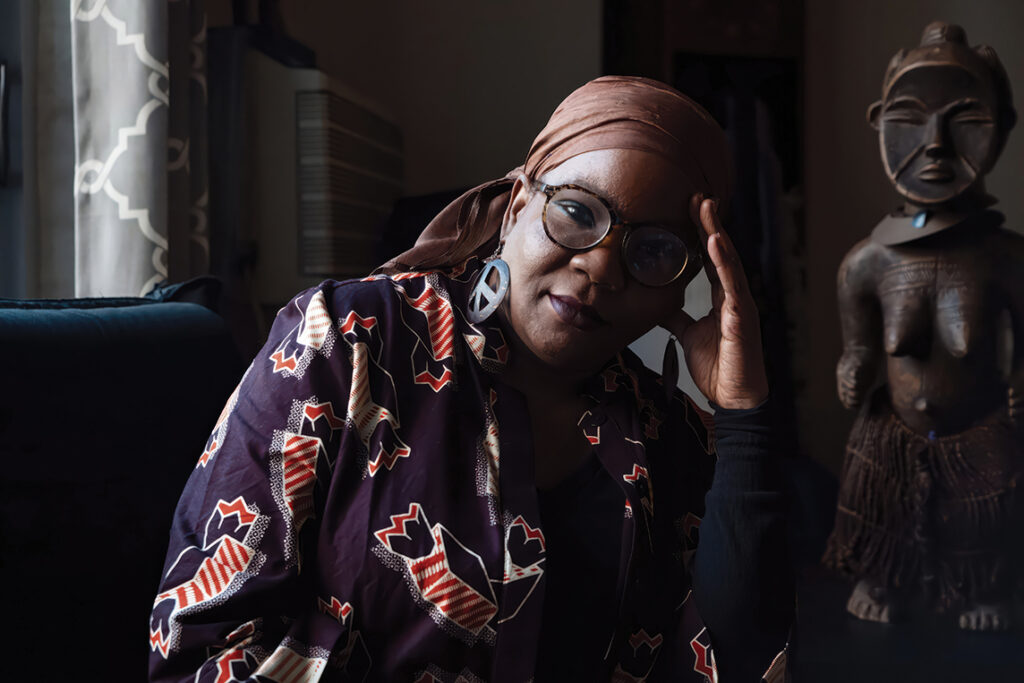
Mariame Kaba is an organizer, educator, archivist, and curator. She describes her work as “ending violence, dismantling the prison industrial complex, transformative justice, and supporting youth leadership development.” She lived and organized in Chicago for more than 20 years and moved back to her hometown of New York City in 2016. She is the author of several books, including We Do This ’Til We Free Us: Abolitionist Organizingand Transforming Justice and (with Kelly Hayes) Let This Radicalize You: Organizing and the Revolution of Reciprocal Care, both published by Haymarket. She was interviewed by Rethinking Schools executive director Cierra Kaler-Jones.
Cierra Kaler-Jones: How do you define abolition in the context of education and what can it look like? What can it feel like?
Mariame Kaba: I always think about prison industrialization complex abolition as a vision of a restructured society, basically in a world where we have everything that we need. Things that we need include food and shelter, education, health and beauty, clean water, and art. Those things that we need in a restructured society are foundational to our personal and community safety. Within that context, it’s not that you are taking abolition and putting it into an educational context; instead, it’s a process. It’s a practice, a way of being, and a way of acting in the world that provides you with an opportunity to reach the restructured world we are trying to build.
As an educator, you’re always making things. You are constantly iterating ideas and generating questions. You’re also doing that as a learner. Ruth Wilson Gilmore talks about abolition as an evolution of consciousness — that abolition is a self-perpetuating and expanding curriculum in and of itself. What I take from that, if you take it seriously, is that abolition really demands less of a focus on having the right answer to things and more of a focus on generative questions. What do we need education to be to allow for the formulation of better questions? And I think that we need institutions that will cultivate imagination. We need institutions that don’t constantly tell people they have to come up with the right answer.
CKJ: What do you see as some of the biggest obstacles to creating abolitionist classrooms or having abolition as a practice be a part of the schooling system?
MK: We’re constantly at odds in this country about what the purposes of education should be and are. I used to teach classes on urban education, and I would always ask, “What is the purpose of education from your perspective?” Asking that regularly of folks gets at what people think education is or should be, which is a lot of different things.
The wonderful writer and organizer Harsha Walia asks a question that is foundational to my abolitionist praxis: “Is what we’re doing increasing the possibility of freedom?” I would add to that the possibility of freedom and liberation for everyone. If you apply that to an educational context, you could ask, “Is what we’re doing in education increasing the possibility of freedom and liberation for everyone?” If the answer is no, then those are things that need to be done away with, overcome, shifted, or changed in some way. An abolitionist education means asking generative questions in the service of freedom-making and liberation for all. That sounds lofty, but that is at the core of the biggest obstacles. Everything else can be resolved. We can build better buildings, we can pay teachers more money, we can make classroom sizes smaller. We can provide nutritious food to all young people. We could do any number of things that would make the experience of having an education and being schooled much better for everyone. But in the end, what are we doing it in the service of? To what end? I think if you’re not oriented that way, then it’s easy to get batted around. It’s easy to lose your compass.
CKJ: What are some examples of abolitionist praxis, especially for schools resistant to change? At a time of attacks on public education and banning critical conversations about racism and oppression in schools, how can educators create space for a practice of abolition in their classrooms?
MK: I think about imagination regularly. It’s important to me because the horizon I’m working toward is one that I’ve never seen. It’s a world without policing, imprisonment, and surveillance. And my friend, writer, and artist-scholar Eve Ewing always says that to create pathways toward that which we have not seen, we have to lead with imagination. I would ask educators to think about whether they’re carving out spaces for collective imagining in their classrooms and in other educational spaces. Maybe you are running your own quarterly imagination and social dreaming lab for your students? And if not, why not? It’s so important for us to do imagination together in the spaces that we inhabit.
Create a social dreaming lab for students and find out what your students long for, what their deepest desires are, and their biggest dreams for themselves, for their families, and for the world. Let them play with those ideas. Let them escape the day-to-day grind of trying to be in a place and do things that are exhausting. You will also be building a different community for your students. My friend Lauren, at the height of COVID, went back to teaching. She teaches college students, and she had her students create a mutual aid map for themselves. She structured her whole class in pods so that they learned how to be together and build intentional small communities. Throughout the time they spent together, she put into practice a transformative justice way of structuring her class. At the end of the class, the students said it was the most impactful class, not because they learned deep things about religion, which is what she was teaching, but because they learned how to be with other people in a different way.
Imagination at its best is not a solitary act or an individual action. You don’t go away to imagine and then come back to present your work; instead, it’s a collective practice done with others on a consistent basis. Imagination is also neutral. There are plenty of destructive forms of imagination. We’re living in other people’s imaginations right now and we’re not happy with that. As an educator, you’re doing so much stuff that to add a list of abolitionist practices can be overwhelming. I would say do one thing. Do it consistently but create the space in your classroom to have that one thing be something your students can engage in with you on a regular basis. It starts small. Maybe it’s to incorporate circle practice into your classroom and have your students get used to that way of being able to communicate and to be able to talk with each other, to listen to each other deeply.
CKJ: You’ve given me ideas for my own teaching. I’m a dance teacher, so I think about how I can create space for students to dream with the body and collectively create choreography about the world around them. What are some examples of how you introduce abolition to young people?
MK: There’s a book that I enjoy called What If that I use with small people to talk with them about abolition without using terms around abolition. It’s a book that just asks some questions of a young person about what if there was no war? What if there were a whole series of different kinds of things like that? And we just start talking about what could that feel like? What could that look like? Imagine that you’re a visitor to a city that doesn’t have any police. How would you take care of other people? How would you ensure that others were safe?
I have a friend, a comrade, Robyn Maynard, who does something interesting. When she’s driving with her young son, they’ll pass by something — let’s say a police car. Her son will replace the car with something else in the environment. My friend Danielle does a similar thing. Her son invented something where he walks by a police station and says, “Candy store,” and reshapes his environment into a place he thinks is great — a candy store, a place where he can go in and enjoy himself, getting as much candy as he wants. There are many entry points. I don’t talk to them about it as abolition. I say, “Think about the best place you’ve ever been to before. Tell me what’s in those places. Tell me all the things you love about that place.” And then I say, “If something happens to you, for example, where would you go for help? Who would you ask? Who would come for you?” I take their lives, and I have them have conversations about their own concepts of safety. I have them think about the helpers in their lives and the people they want around them. I have them rethink the different ways to be in the world. And they come up with totally great things that aren’t the cops or prisons.
CKJ: I love that. It makes me think about this exercise I do with my students where we create our dream worlds. I’ve never seen a student put police in their dream world. They have things like a waterfall-powered home, a community center, and talk about everyone having equal rights, but not any police. You’ve done work to organize for restorative justice and to disrupt the carceral state in schools. Can you talk more about organizing strategies and what you’ve learned as an organizer?
MK: I spent more than 20 years living in Chicago, where I started an organization in 2009 called Project NIA. We sunsetted it in 2023. Our mission was to eradicate youth incarceration from a transformative justice lens. We worked with parent groups like Community Organizing & Family Issues and a lot of community groups. Project NIA ran a peace room at a local elementary school, and we wrote about that experience in an essay in a book called Disrupting the School-to-Prison Pipeline. We successfully pushed to make suspensions and expulsion data public through our organizing with others. Something that we learned about through New York was that they had something called the Student Safety Act that they were trying to pass. We created our own version, the Chicago Student Safety Act. We worked with Chicago Public Schools administrators, and they made the data public, which they had never done before. You had to file a FOIA request to get that information. But to be transparent about what you are doing with our young people in the schools, we need that information, and parents should be able to see that on the school report cards so that they know if they want to send their kid to a school that suspends every kid all the time.
We launched a project called Yes to Counselors, No to Cops. We fought to have the school district hire more school counselors, not police officers, in schools. I left Chicago in 2016, but of course, people had been organizing before I got there in 1995, and they continued to organize after I left. Last year, the Chicago Board of Education voted to remove Chicago police from Chicago Public Schools. When I saw that, I cried. It was the culmination of years, decades, of organizing by students, parents, educators, and community members. And it happened.
CKJ: I’m excited to talk about your newest children’s book, co-authored with Jane Ball, Prisons Must Fall. It’s beautiful. One of my favorite pages is the page called “Let’s Protest Together in Song.” I love that. I also appreciate the discussion questions at the end. They’re really supportive. Could you discuss the book and its inspiration?
MK: Prisons Must Fall comes after two children’s books that I’ve done. The first one was Missing Daddy. I wrote it after years of looking for children’s books that speak to the experiences of the young people I knew and loved who had incarcerated family members and loved ones. Some of their parents, some of their teachers, and others would ask me, “Mariame, is there a book that you recommend for this young child who’s 5 or 4 and has a loved one inside?” I always point to Visiting Day by Jacqueline Woodson. There is another book by Daniel Beaty called Knock Knock, which isn’t even a book about incarceration, but more about separation and loss that you could use to talk about that. There weren’t enough books about incarcerated family members.
Then I did a second book called See You Soon, with my friend Bianca Diaz. That one was inspired by a friend who passed away suddenly, who had been in and out of prison and had one of her babies when she was locked up. Her story always stuck with me, and I heard from children who said, “We need Missing Mommy,” especially one little girl who would email me regularly through her grandmother and be like, “Is there a Missing Mommy? I would like a Missing Mommy.”
She kept at it, and that pushed me forward on that piece. These two books are about separation, love, loss, grief, and all those things that children who have incarcerated loved ones experience.
Then, people started asking for a prison abolition for children book. That wasn’t of interest to me, but I started having the idea for this story, and my friend Jane — an amazing social worker, counselor, and parent — and I had been talking about working on something together, and we decided to go ahead and do it. The protest page that you like is the first thing I wrote down. So it’s really interesting that you pointed that out to me, but I had that idea in my mind, and then we built out from there, and that’s how the book came to be. This book is intended for a slightly older audience, approximately 6 to 9 years old. The other books are for children aged 4 to 8 years old. However, I hope it encourages people to start conversations with young people about abolition. The other two books don’t have to talk about abolition at all. It’s just about how you feel about not having your loved one with you anymore.
CKJ: Speaking of your hopes, how do you hope that your children’s books can be used with younger learners, or how can teachers use them?
MK: The books include discussion questions, designed to help caregivers and educators engage in conversations with young people and children in their lives. See You Soon birthed a project that I called Queenie’s Crew, after Queenie, the protagonist of the book. I asked my comrade, Zara, to coordinate a program. I said, “Hey, I have this idea for this thing called Queenie’s Crew that would bring together children with their parents or their caregivers to talk with each other about big themes of abolition.” Zara, with a bunch of other people, built up Queenie’s Crew for a couple of years, and people could go to the website, queeniescrew.com, and download the activities toolkit on that site. It has coloring pages, and activities that people can use with young learners to supplement conversations about abolition and issues related to the carceral state. I’m always thinking about ways to share information with other people and translate important concepts and ideas in ways that feel accessible.
CKJ: That’s amazing. How do you respond to critics who say that children are too young to engage with abolitionist ideas and practice?
MK: Children are the perfect people to engage with abolitionist ideas. Living through oppression hasn’t yet put a ceiling on their imaginations. They are open, they’re willing to go with you to imagination land. They’re already living there. Children are perfect for having these kinds of conversations, and they will push you to think differently because they’ll constantly ask you why things are the way they are. They are constantly pushing me. I don’t have children of my own, but I am surrounded by them and I am so interested in how they look at the world and what they’re noticing because they always bring a new perspective I don’t think about. I’m so jaded on so many fronts, and they’re just like, “but I don’t see why we can’t do this.”
CKJ: Are there other resources that you want to lift up, particularly for educators and caregivers looking to deepen their understanding and their practice of abolition?
MK: My friend Maya Schenwar and Kim Wilson edited a new book called We Grow the World Together: Parenting Toward Abolition. It’s a beautiful collection of interviews and essays. It’s a great place to start for caregivers who want to explore abolitionist visions and practices. Lessons in Liberation, an abolitionist toolkit for educators, is super valuable. I have a piece in there from a zine that I made a few years ago about the school-to-prison pipeline in the 1960s. I like Abolition for the People: The Movement for a Future Without Policing & Prisons. It’s an introductory piece about abolition that includes several essays.
I also tell people to read children’s books. They should read all the children’s books that they can, because children’s books are a way for people to talk about very heavy topics in simple, evocative, and often beautifully illustrated ways. One children’s book I love is Junauda Petrus’ Can We Please Give the Police Department to the Grandmothers?
CKJ: I’ve learned so much about hope from your work. In times like these, what keeps you practicing hope?
MK: I was talking to someone the other day who told me that they don’t have hope and are resentful of it. And I was like, “OK, well, if you give up hope, at least don’t give up trying.” I don’t really care if people use hope as a language that helps them make sense of their lives or themselves. For me, it’s action that keeps me in practice. I’m with Grace Paley, the poet, who said that the only recognizable feature of hope is action. That’s the school of hope that I come from. I’m committed to the marathon relay race, and so I continue to fight. I am also a disciple of Ella Baker, and she taught me that the struggle is eternal. I see action as the basis and the foundation for any practice of hope.
If I am not engaged in trying to do what I can within my capacity from where I am, I am not going to be a good person to be around. In the words of Mike Davis, “Fight with hope, fight without hope, but fight.” We have to choose to take action and we have to choose to remember that it’s for the long haul.