Get Plastics Propaganda Out of Schools
Fifteen years ago, Rethinking Schools exposed the coal industry’s attempt to sneak pro-coal propaganda into schools through a slick Scholastic-produced elementary curriculum called “The United States of Energy.” The campaign we initiated with the Campaign for a Commercial-Free Childhood (now Fairplay) was joined by environmental justice organizations around the country, and ultimately forced Scholastic to stop distributing its curriculum and to sever ties with the coal industry.
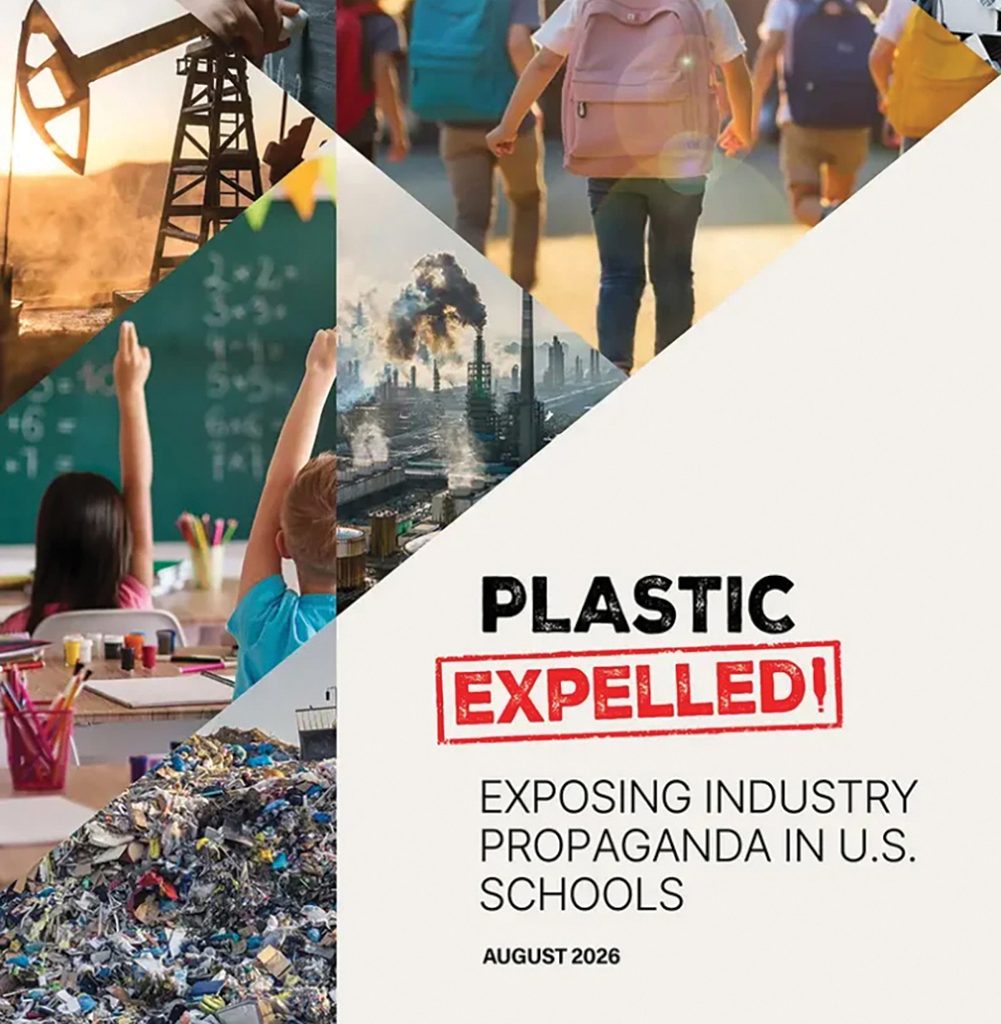
It seems that the more toxic an industry is, the harder it works to get its “we are really great” message into schools. A valuable new report, Plastic Expelled: Exposing Industry Propaganda in U.S. Schools, by Plastic Pollution Coalition, chronicles the many ways that the interconnected chemical, fossil fuel, plastics, and waste management industries seek to infiltrate schools: “By providing lesson plans, programs, and supplies to schools, the plastic industry works to curry favor with school administrators, teachers, and students across the U.S., while subtly dispensing marketing and misinformation — at the expense of the health and lives of communities.”
Plastic is ubiquitous — in the world, and in our classrooms. It also represents a dire threat to our health. As the new report points out:
About 40 percent of plastics produced today are designed to be used for mere seconds or minutes before being thrown away. And yet, plastics do not degrade benignly like natural materials. Instead, plastics break apart into smaller and smaller pieces, called microplastics and nanoplastics, which persist in our environment and travel into our bodies when we breathe, drink, and eat. Some plastic particles are so small that they can be absorbed through our skin.
Plastic Expelled details a host of ways that the industry attempts to paste a smiley face on its toxic products: lesson plans, textbooks, toolkits, and other materials paid for in whole or in part by corporations or trade groups; sponsored clubs, demonstrations, field trips, and traveling vans; and donation of equipment like 3D printers, school supplies, and infrastructure. The Society of Plastics Engineers even sponsors a patch program for Girl Scout councils, with the “Sustainable Packaging Patch” and the “Wonders of Polymer Science Patch.”
Ninety-nine percent of plastics are made from fossil fuels — plastic is “Earth’s biggest oil spill,” as the report notes sardonically — but the propagandists present plastic as both environmentally friendly and an answer to the affordability crisis. According to Plastic Expelled: “During the 1990s, plastic producers doubled down on efforts to enter classrooms and push their messages of recycling and individual responsibility to children.”
One piece of curricular propaganda described in Plastic Expelled is PragerU’s cartoon Leo Baekeland: The Innovator of Modern Plastics. As Karen Elias points out in her fall 2024 Rethinking Schools exposé “PragerU Ambushes Our Schools,” PragerU was founded in 2010 by conservative talk show host Dennis Prager to counter “left-wing ideology rampant in our public schools.” PragerU was originally funded by fracking billionaires and climate deniers Dan and Farris Wilks; Farris Wilks once said, “If [God] wants the polar caps to remain in place, then He will leave them there.” (Also see Jesse Hagopian’s “Erasing Palestinian History: The Propaganda of PragerU’s Israel Series” in the fall 2024 issue of Rethinking Schools.)
In about 10 minutes, the Leo Baekeland cartoon offers a playful free market populism, extolling the virtues of plastic. The plot centers around two youngsters, Layla and Leo, organizing to oppose a teacher trying to get rid of plastic use at school. They time-travel to 1934 to encounter inventor Leo Baekeland, who named the first fully synthetic version of plastic after himself: Bakelite. Baekeland brags to the kids about his discovery of “the material of a thousand uses.” He describes himself as an environmentalist, that his invention was an effort to find an alternative to the overuse of natural materials, like shells from tortoises and tusks from elephants, animals in danger of extinction. Layla eagerly agrees how “super selfish” it is for people to take items from animals. But adds her concern that “A lot of people are up in arms about how plastic is made from fossil fuels.” Baekeland is irate: “You mean to tell me people are upset about using dead plants and animals? Fossil fuels are cheap and plentiful. Thank goodness. So we don’t need to use living animals and we can create items to improve the lives of everyone.” And: “Not just the rich,” he adds, posing as a working-class hero.
In case young people missed the message, Baekeland concludes:
Children, I think it is important for you to leave here today knowing the why behind the creation of plastic. Plastics were developed as a humane solution to a problem that was negatively affecting the natural world. Nature can only give us so much tusks, wood, horn, metal, and bone. But with the development of man-made materials, for the first time we didn’t have to rely on the limited supply of nature and could work on helping the environment while also meeting people’s needs. . . . Secondly plastics were created to make life more affordable for the average person. Before plastics only the very rich could enjoy pricier items because they were so rare they were very expensive . . . but with materials like Bakelite, items like these became more common and therefore less expensive and more attainable for everyone.
Layla and Leo soak up Baekeland’s environmental and class-conscious paean to plastic. Layla: “I can’t even imagine what life would be like without plastic.”
That’s how the plastics industry wants it: Young people unable to imagine alternatives to our vast and poisonous consumption of plastic. And the web of corporations and foundations are doing all they can to fill schools with pro-plastics propaganda to ensure that young people’s imaginations fail to reach beyond the world they have inherited.
Plastic Expelled points out that the industry-sponsored and aligned materials infiltrating schools “avoid discussing plastics’ toxic impacts on health, fail to acknowledge companies’ conflicts of interest, and distort established science.” Plastic Pollution Coalition urges schools and school districts to prohibit teaching materials, programs, and equipment donations from the chemical, fossil fuel, and plastic industries. That is an important demand.
But just as teachers use the American Coal Foundation materials — like its chocolate chip cookie exercise on coal mining — to critique the coal industry, we can use propaganda like PragerU’s Leo Baekeland to help students interrogate plastic. We need the Leos and Laylas in our classrooms to be armed with the knowledge and critical capacities to challenge plastic propaganda — and to imagine a different world.