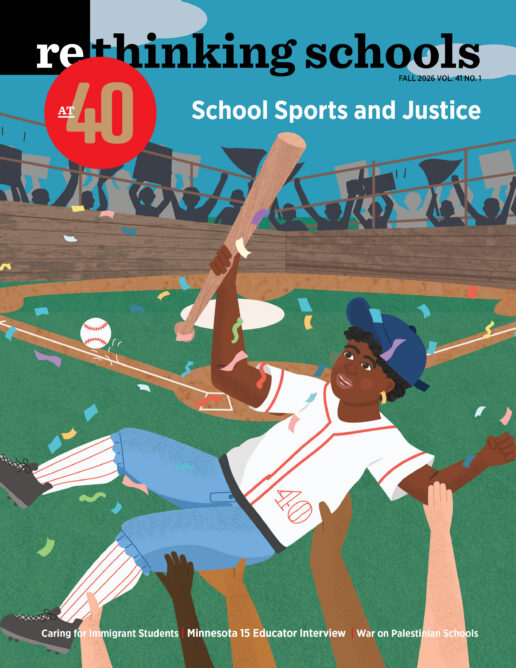
Forty Years Old. Still Here. Still Hopeful.
In our 30th anniversary issue 10 years ago, we opened our editorial: “Rethinking Schools was born in the time of Reagan. We celebrate our 30th anniversary in the time of Trump.” On this 40th anniversary, it would be easy to dip our pen in the inkwell of cynicism and lament how ugly and unjust these times remain.
But as we turn 40, we want to focus on some things that make us hopeful, that are sources of joy — not to ignore how grim and scary life is for so many in so many ways, but to remind ourselves that there is much to embrace. Even to celebrate.
We will talk about Rethinking Schools in a moment, but let’s pause first to note some encouraging developments in the broader social context. The electoral victories of socialists and progressives around the country have revealed a widespread desire for fundamental social changes and a willingness to break with the status quo. In Rethinking Schools’ 40 years, we have never seen these kinds of tectonic political shifts.
The United States and Israel waged an illegal and immoral war on Iran with barely a whimper of protest from the Republican Party and little more than that from mainstream Democrats, but every poll indicated that a majority of the country opposed the war from the day it began. Decades of antiwar activism have left people skeptical about bombing and invading our way to peace. And for the first time ever, a Gallup poll recently showed that more Americans sympathize with Palestinians than with Israel. In the 1980s, the world isolated apartheid South Africa through the cultural boycott, divestment campaigns, and efforts to sanction the racist regime. The fall of apartheid and Mandela’s presidency would have been inconceivable without this global pressure. Today, we see the early stages of a similarly powerful movement in solidarity with Palestine. It has come at an immense cost in human lives, but we have witnessed what amounts to a worldwide teach-in on Palestine and Israel.
The cover of the recent spring issue of Rethinking Schools announced “Resist Like Minneapolis ♥.” Confronting the vicious ICE and Border Patrol invasion, the resistance in the Twin Cities was breathtaking. The late-January “ICE Out” day was as close as we have come in the United States to a general strike since the general strike in Oakland, California, in 1946. As we wrote:
In response to a call for “no work, no school, no shopping,” and braving -20° weather, 75,000 people flooded into the streets of Minneapolis on Friday, Jan. 23. Schools shut down as teachers called in sick and nearly 1,000 businesses closed in solidarity. According to one poll, roughly one in four Minnesotans participated or had a loved one who participated in the mass action.
Educators were not mere spectators. They were “at the helm of this grassroots resistance work,” as Jey Ehrenhalt reported. Educators “turn conference rooms into food pantries, conduct daily block patrols, deliver groceries to families, and monitor bus stops to keep students safe. After teaching a full day, some stay out late organizing strikes and marches.”
All these developments represent a source of hope. As author and activist Rebecca Solnit writes: “Hope locates itself in the premises that we don’t know what will happen and that in the spaciousness of uncertainty is room to act.” The spaciousness of uncertainty: Some of the most dreadful times in history have been followed by profound and positive social changes. There are always grounds for hope — if we stay active.
Forty Years Ago
Once upon a time, there was no Rethinking Schools. There was no national journal dedicated to collecting stories about social justice teaching, or analyzing the political context that shapes schools and young people’s lives. Teachers of conscience were largely on their own. Of course, there were study groups, academic texts, inspiring colleagues down the hall. And there were writers, theorists, and organizers who laid a foundation for our work: the Freedom Schools of the Student Nonviolent Coordinating Committee (SNCC), the writing of Carter G. Woodson, Jonathan Kozol, Herb Kohl, Paulo Freire, and many more. But in 1986, when Rethinking Schools launched, there was no literature of social justice teaching. There was no sustained national conversation about how we live our dreams for a better world in our educational spaces.
Of course, Rethinking Schools didn’t just “launch”; the magazine, then a tabloid newspaper, was the product of organizing by Milwaukee educators, fed up with being on the receiving end of administrative fiats — basal readers, standardized testing in the earliest grades, racist curricula. With a wildly optimistic print run of 6,000 copies, soon growing to 20,000, the publication was made possible by its grassroots grounding in 160 Milwaukee public schools. That, and the fierce dedication of the volunteer editors.
In 1986, there was no quarterly journal, and there also were no books that collected practical how-to critical teaching guidance for K–12 teachers, written by K–12 teachers. When we published our first book, Rethinking Columbus, in 1991, in most U.S. classrooms, Columbus still sailed the ocean blue in 1492 and “discovered America.” Inspired by and in partnership with Indigenous and anti-racist organizations, Central America solidarity groups, and progressive teacher unions, Rethinking Schools challenged the conventional narrative that celebrated colonialism and racism. In those days, no corporate textbook even mentioned the Taíno people Columbus met and murdered. Our book — in its first iteration, more booklet than book — sold 1,000 copies a day for its first three months in print, and went on to sell more than a quarter of a million copies.
The success of Rethinking Columbus helped us, as an organization, grasp the immense hunger among educators for materials that presented a more accurate “people’s history,” and that went inside classrooms to offer an up-close look at what we came to call teaching for equity and justice. We wanted to offer teachers “this is what it looks like” examples, not just wag a finger about what they should be doing in their classrooms, or generate lovely theoretical statements. Thus in 1994, we collected our best K–12 articles from the magazine — from reading to math to social studies to language arts — into Rethinking Our Classrooms: Teaching for Equity and Justice. Like Rethinking Columbus, the book sold tens of thousands of copies and became a staple of teacher education programs across the country. We sought to offer teaching stories to illustrate our broad vision of education — teaching that is grounded in our students’ lives; critical; multicultural, anti-racist, pro-justice; hopeful, joyful, loving, visionary; participatory, problem-posing, experiential; activist; academically ambitious; culturally and linguistically inclusive and empowering. Yes, we set ourselves an audacious agenda, but what moved our work from utopia to reality is that we sought to flesh out these aspirations with concrete examples.
Supplementing our growing catalog of books on critical teaching were books and booklets that alerted readers to the threats to public education. At their best, public schools make a statement about solidarity: We are in this together; we have a stake in one another and in the welfare of all our children. As James Baldwin wrote, “The children are always ours, every single one of them, all over the globe.” From the beginning, Rethinking Schools argued for the transformation of public schools — but also for their defense. Rethinking Schools’ second booklet was False Choices: Why School Vouchers Threaten Our Children’s Future (1992), which warned of the “proposed substitution of markets for public schools.” Funding for Justice (1997) argued that “the heart of the matter is simple. Our schools don’t get enough money, and the money they do get is not distributed fairly.” Classroom Crusades (1998) warned of the “religious right and conservative movements’ attempts to stamp their own brand of politics and religion upon our country’s schools.” And Failing Our Kids (2000) and Pencils Down (2012) warned how “The tsunami of high-stakes testing and accountability has crashed on our educational shores with full force — threatening the foundations of teaching and learning, as well as the democratic aspirations of public education.”
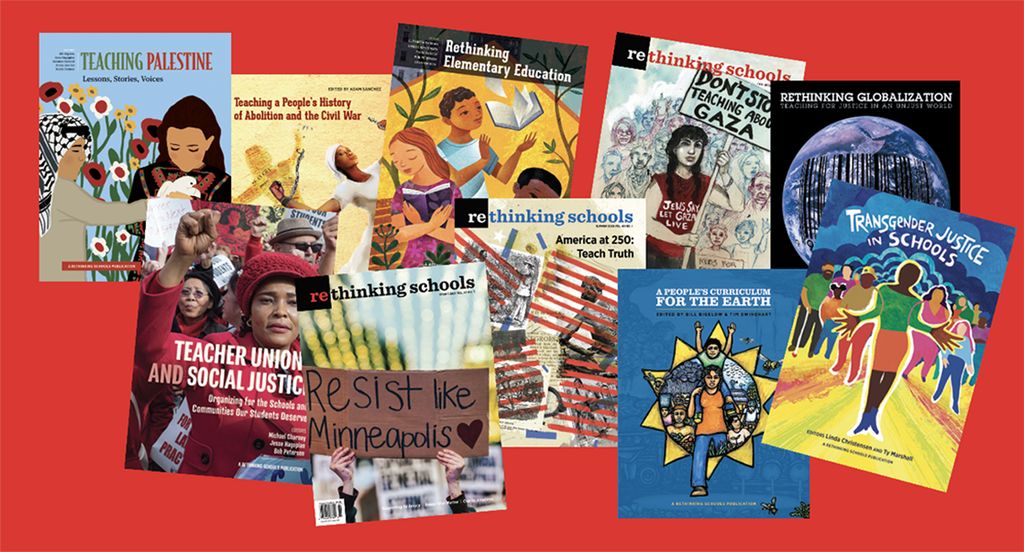
From early in our history, Rethinking Schools celebrated the work of teacher unions as key defenders of public schools and the interests of teachers, but we also argued that they must become “social justice unions.” We helped organize a social justice unionism institute that preceded the 1994 National Coalition of Education Activists conference in Portland, which produced a statement on social justice unionism that guided and inspired unionists for years. In a leaflet we published and distributed, based on the statement, we argued that a teacher union must “Defend the rights of its members while fighting for the rights and needs of the broader community and students.” This commitment animated our book Transforming Teacher Unions (1999) and its greatly expanded second edition, Teacher Unions and Social Justice: Organizing for the Schools and Communities Our Students Deserve (2021).
Today
Some 44 books after Rethinking Columbus, we continue to publish “teaching for social justice” books. We intend our publications to be organizing projects. Our books both grow out of and fuel social movements. As outrage exploded after the murder of George Floyd and the streets filled with millions of people demanding justice, Teaching for Black Lives (2018) offered teachers a way to show how Black lives can matter in schools and classrooms. Through our Zinn Education Project (coordinated by Rethinking Schools and Teaching for Change), we have sponsored more than 450 Teaching for Black Lives study-action groups in 44 states — participants receive copies of the book, Rethinking Schools magazine subscriptions, and membership in a community of educators committed to teaching for racial justice, along with support from our staff and Rethinking Schools editors. We have followed the pattern of study-action groups with our books Teacher Unions and Social Justice (2021), Transgender Justice in Schools (2024), and Teaching Palestine (2025). We now have dozens of Teaching Palestine study groups throughout the United States, and the world — from Puerto Rico to Ireland, from South Korea to Scotland, from Pablo, Montana, to Philadelphia, Pennsylvania. We have gathered study group participants in webinars, where they heard from book editors and shared their own teaching experiences.
Also in the category of “things that give us hope”: the diversity and heft of the books we have in production. Our just-published Science Teaching for Social Justice is the culmination of more than 10 years in the making. Next up: Teaching for Environmental Justice (a completely revised edition of A People’s Curriculum for the Earth); the second, also entirely revised, edition of Linda Christensen’s classic Teaching for Joy and Justice; a brand-new Teaching for Black Lives, Volume 2; Rethinking Arts Education; and Teaching a People’s History of Reconstruction.
Zinn Education Project
In his autobiography, the historian and activist Howard Zinn famously wrote: “To be hopeful in bad times is not just foolishly romantic. It is based on the fact that human history is a history not only of cruelty, but also of compassion, sacrifice, courage, kindness.” We coordinate the Zinn Education Project with our sister organization Teaching for Change. Almost 20 years ago, a former Boston University student of Howard Zinn’s, Bill Holtzman, approached Zinn about his desire to get a Zinn “people’s history” perspective taught in high school classrooms throughout the country. He’d seen the film Howard Zinn: You Can’t Be Neutral on a Moving Train, and was delighted by the scene when Zinn talks to students at Campos High School in Chicago.
Zinn put Holtzman in touch with Rethinking Schools and Teaching for Change, and we launched the Zinn Education Project to offer teachers free people’s history lessons and other resources. Forty years ago, ZEP didn’t exist. Now we have almost 190,000 educators who have registered at our site to download lessons. Despite the repression, and efforts to ban teaching about race and any history that might discomfort the wealthy and powerful, we continue to receive between 600 and 1,000 new registrations every month. Our most recent tranche of registrations included educators from Sandpoint, Idaho; Elgin, South Carolina; Harvey, Louisiana; Woodinville, Washington; Mount Sterling, Ohio; and Kaiminani, Hawaii. From smaller communities like these to large cities, educators are committed to teach a truthful history of our country. As a teacher from Staten Island, New York, wrote: “I learned about Zinn Ed from my wonderful professors at CUNY-Hunter College when getting my master’s in education. It is such a great resource especially when a school-offered curriculum has so many holes. I want to use these resources to both fill those holes and have students ask why the holes are there in the first place and who put them there.”
The Magazine
On our 40th anniversary, we continue to publish a magazine that seeks to amplify the diverse ways that teachers, administrators, and parents work to align schools with values of democracy and racial justice. The last year’s issues of Rethinking Schools magazine offer compelling examples. People are doing magnificent work. The Los Angeles educators who work through United Teachers Los Angeles to defend their students from ICE. The principal who draws on his own loss of language to insist on the importance of supporting dual language and biliteracy programs. The school administrator whose school and home burned down, and how he sought to help students and families grieve, tell stories, and find hope. The autistic library science student in Portland, Oregon, who demands that educators fight the stigma around autism with the literature they select. The D.C. elementary teacher whose colleagues organized a salsa cooking night to counter ICE with laughter and community. The trans math teacher in Montréal who tells about their conversations with the student who goes by “Nameless” about their painful decision to “detransition.” Researchers who detail the harm that AI poses to children under 6, and argue that “It’s only by working together that we can ensure kids a world where what’s best for children takes precedence over what’s best for corporations.” The Jewish Voice for Peace activist in Oakland who describes a three-part series they organized for kids and families on learning about Palestine. The teacher at an international school in Laos who draws on traditional knowledge of Laotian elders to teach about herbs and Indigenous medicine. The Massachusetts elementary school counselor who begins the day sobbing in the bathroom because of her impossible workload, but who “looks for hope in the quiet corners of the school building” and collective efforts to address the roots of the crisis.
* * *
Forty years ago, Rethinking Schools was founded on a simple conviction: Educators should not merely adapt to the world as it is — we should help transform it.
Today, that conviction is being tested. Authoritarianism is rising. Public education is under attack. Immigrant communities are being terrorized. State violence targeting Black and Brown people persists. Wars are expanding around the globe. Wealth is being concentrated in the hands of an elite few at levels not seen in generations. And educators are increasingly targeted for teaching the truth about all of it.
Authoritarians insist that resistance is futile. Cynics insist that nothing ever changes. Yet history teaches another lesson: Periods of profound repression have often given rise to extraordinary movements for justice.
As Rethinking Schools marks its 40th anniversary, we find hope not because we believe justice is inevitable, but because every day we document the stories of people engaged in remarkable struggles for educational and social justice. As the people of Minneapolis and St. Paul showed us earlier this year: Ordinary people, acting together, can create extraordinary possibilities.
As was true 40 years ago, today we want educators and our allies to know that they are not alone. We can listen to one another, learn from one another, support one another.
We are not naive. We know the breadth of injustice we confront. The attacks on public education will persist. But so will resistance. Rethinking Schools is committed to remain part of that resistance.