Crying Between Crises:
Confronting the Mental Health Crisis in Elementary Schools
Illustrator: Ebin Lee
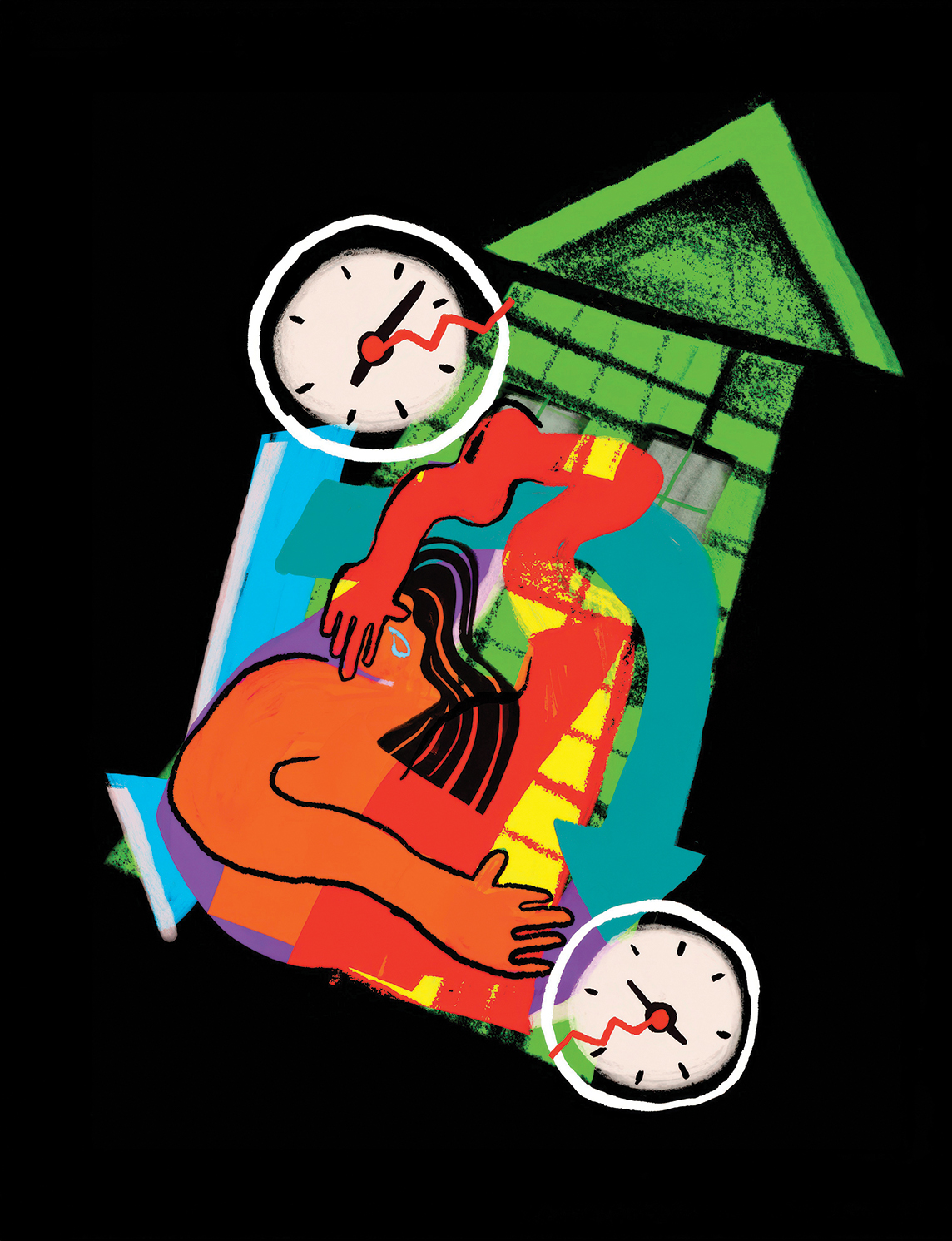
It is 7:55 a.m. and I am sobbing in the staff bathroom. Deep breaths, I tell myself as I glance at my reflection in the mirror and see red, puffy eyes staring back at me. I have a kindergarten student with intense needs I must meet in five minutes. Allegra is a 5-year-old refugee, carrying a robust amount of trauma too heavy for a child, and her body and brain struggle under the weight of it all. Every day, the second she steps into the school building, she runs and hides. Last week she exited the building and ran down the street. The time is now 7:58 and her teacher will be opening the door any minute. I exit the bathroom and walk briskly toward Allegra’s classroom.
As I walk, my walkie-talkie crackles, “Student support needed in 2P.” I know that’s for Sam, one of my other “frequent flyers,” who often exhibits unsafe behaviors such as throwing classroom materials and hurting others, which can lead to a full class evacuation. I finally arrive at Allegra’s classroom and am greeted by a panicked teacher who informs me that Allegra has already bolted and is hiding somewhere in the building.
As I search for the student, my walkie-talkie goes off again. Jay, a 7-year-old who was recently discharged from the hospital for suicidal ideation, needs support. It is 8:05 and I am needed in three different places in the school building.
I am a school counselor at a well-resourced public school outside of Boston. My school is racially, linguistically, and socioeconomically diverse. In any given classroom, you will find a mix of highly affluent students, low-income students, English language learners, and students with disabilities studying alongside one another.
As an elementary school counselor, I find joy in the many meaningful moments that come with supporting young people. On any given day I might be teaching a 2nd grader how to solve problems with friends, facilitating a lunch group focused on coping skills, supporting a student navigating their parents’ divorce, teaching a whole-classroom social-emotional lesson, or connecting a family to community supports.
I believe that preventive intervention, skill building, and accessing care at an early age can lay a positive foundation for the rest of a person’s life. I often feel blessed to have found a career that blends my skills and interests in a way that allows me to serve my community and make a difference in children’s lives. It’s a plus that I am a skilled Uno player, I am unbothered by glitter, and I have never met a 6-year-old I don’t like. This is more than a job to me; it is a calling.
Going into this work, I knew that I would juggle the messiness of being human. As my stance on glitter suggests, I am not afraid of getting a little messy. However, I hadn’t anticipated the sheer volume of students in active crisis, which has stretched my role beyond capacity and made it difficult to carry out the essential preventive and skill-building work I love doing. I conceptually knew, but was not fully prepared to face, an education structure that is utterly sinking. I knew to expect chronic underfunding, understaffing, and insufficient mental health support. It is a whole different beast to confront it head-on day after day. I was not prepared for a system that normalizes dysfunction so deeply and relies so heavily on the exploitation of its educators. I was not prepared for such a profound disconnect between policy and reality, where decisions that impact students and staff are made so far away from the classrooms they affect. All of this, coupled with a culture that appears indifferent to those most in need, has left me heartbroken. I am questioning if it is time to leave my dream career — not because I love it any less, but because I can no longer afford to pour from an empty cup.
Life is becoming more complicated for young people, and I see a mental and behavioral health crisis unfolding before my eyes. Kids struggle with emotional and behavioral regulation and schools struggle to respond accordingly. Meanwhile, families contend with food and housing insecurity, their own mental health concerns, and the structural inequities embedded in our society.
According to the American Psychological Association, one of the biggest challenges facing the growing demands of children’s mental health needs is a shortage of service providers. What makes schools markedly different from community providers is that we are required to serve every student in need, regardless of capacity. In public schools, there is no such thing as a waitlist. Given that Allegra is on a nine-month waitlist for vital therapeutic services, school is the only setting where she has access to care right now. In a public school it is our duty to teach and support whoever shows up, no matter the limitations of our current resources.
Being a clinician in a school means that I must find a way to do more with less. Unfortunately, the current trends of underfunding and understaffing schools only exacerbate the increasing challenges. When resources are limited, priority is given to students exhibiting the most pressing safety concerns. While necessary, this leaves other students who also require support at a disadvantage. For example, when Jay is presenting with imminent suicidal risk, I must cancel my weekly counseling session with another student. No matter how hard I try, it feels like I am always letting someone slip through the cracks.
Being strained beyond capacity not only heightens stress, it can erode safety. The National Education Association cites that teachers’ working conditions, including safety concerns and student behavior, are causing educators to leave the workforce at higher rates in recent years. Evacuating classrooms and being injured on the job have become all too common. For instance, when Sam is dysregulated, he becomes physical quickly. Supporting Sam and maintaining the safety of the classroom often places me and other response staff in the direct path of his kicks, slaps, and thrown objects. While no educator should have to go home with bruises, I also worry deeply about Sam — and his classmates, who bear the invisible marks of witnessing it.
I fear that I have poured too much of myself into this job, but I don’t know how to show up any other way. Caring and connecting are at the heart of my work, and they cannot be neatly contained or switched off.
Professional wisdom says to leave work at work, but some of it quietly follows me home. Some days the work has to come home with me, because certain tasks could not be completed during the mayhem of the school day.
Other days, the emotionally charged chaos of the day is hard to shake. Spending most of one’s day in a state of heightened alert — moving between urgency and care — leaves its mark. This work is energetic, spiritual, and deeply emotional. Even when I manage to mentally compartmentalize, my body remembers. I feel frozen and empty. Catatonic. Some days, it is difficult to take care of myself.
I am still developing my own practice of leaving the trauma and battle scars of the school day behind me, but something I cannot turn off is the connections I have made with my students. I carry them with me long after the echo of the school dismissal bell fades.
I am torn between the work that fuels my soul and my own needs that I must confront.
Take Allegra, for instance. This is her first time experiencing fall in a new country. She delights in the fallen leaves of autumn, savoring the crunch beneath her shoes and the explosion of colors around her. After school, I often walk my dog through the woods to clear my head, surrounded by leaves that snap and rustle underfoot. Inevitably, I think of Allegra. When I come across a particularly striking leaf — the bigger the better — I cannot help but scoop it up for her, knowing that this gift will bring a smile to her face and make tomorrow’s school day a little bit brighter for both of us. I don’t know if I will ever again admire the vibrant reds and crisp golds of fall without thinking of Allegra. Maybe when Allegra thinks back on her first year in the United States, she will remember being enchanted by nature’s offerings alongside a teacher who loved her — glimmers of joy existing within unimaginable hardship. Maybe not. But I will always remember.
Some might call what I am experiencing “burnout,” but I see it as a systemic failure rather than an individual one. Despite that, I do not believe a person can ever truly burn out. You can try to dim their light, but their fire will never fully extinguish. The term “moral injury” more accurately names what I am experiencing: the psychological and ethical harm that occurs when a system prevents us from practicing what we know is right for children and their families.
When a dedicated counselor pleads for help to protect the safety and sanity of herself and her students, only to be told to accept the conditions as unfortunate yet core features of our system, something breaks. You might wonder why I was crying in the bathroom on that Monday morning. It was not the anticipatory dread of the day to come, although that played a part in my breakdown. It was the experience of asking for help and being silenced, being told to endure the circumstances and that no support will be coming. That was not the first time that conversation happened, and it will not be the last.
As I grapple with the failures of our education system, I also wrestle with my own path forward. I am torn between the work that fuels my soul and my own needs that I must confront. Do I abandon ship, leaving my dream job and students behind in order to preserve my own well-being? How does one sustain oneself in a system designed to exploit them? No amount of individual self-care offsets the harms of working within a system that extracts care without providing support and fails to act in the best interests of children. I don’t need self-care. I need system change.
Some days this work feels hopeless, yet hope, however elusive, remains necessary if anything is going to change. Where does hope live? It lives beneath the dark stairwell where Allegra spent the first several months of school hiding, that dusty space becoming her only refuge within the walls meant to protect her. Now, when I pass that corner, I feel a twinge of hope. Not because her days are easy, but because she no longer flees and hides beneath the stairs. She continues to face complex emotional and behavioral challenges, but her progress reminds me that when systems fail, relationships still matter and relationships have the power to change lives.
If hope lives in the quiet corners of the school building, possibility lives in the collective action of educators seeking change. For years, educators in my building have been proposing a stronger response to dysregulated student behavior. For years, we have been shut down by administration. Refusing to accept defeat, I turned to my teacher union, joining the bargaining team responsible for negotiating our next contract. Alongside educators from multiple disciplines, I am advocating for a fair contract that ensures clear protections and protocols for responding safely to students and increased support staff. The extra work is tiring — showing up for my students by day and fighting the system by night — but I do it because I believe that change is possible.
So when I find myself back in the bathroom, crying at 7:55 on a Monday morning, I try to wipe away the evidence, forcing my breath and smile into submission. With my own tears barely dry, I face a logistical and moral dilemma. Whose tears do I dry next: Allegra’s, Sam’s, or Jay’s? Maybe the real question isn’t whose tears I dry, but why there are so many to begin with.