Building a Space to Belong
First-Generation Immigrant Students in Our After-School Classrooms
Illustrator: Sawsan Chalabi
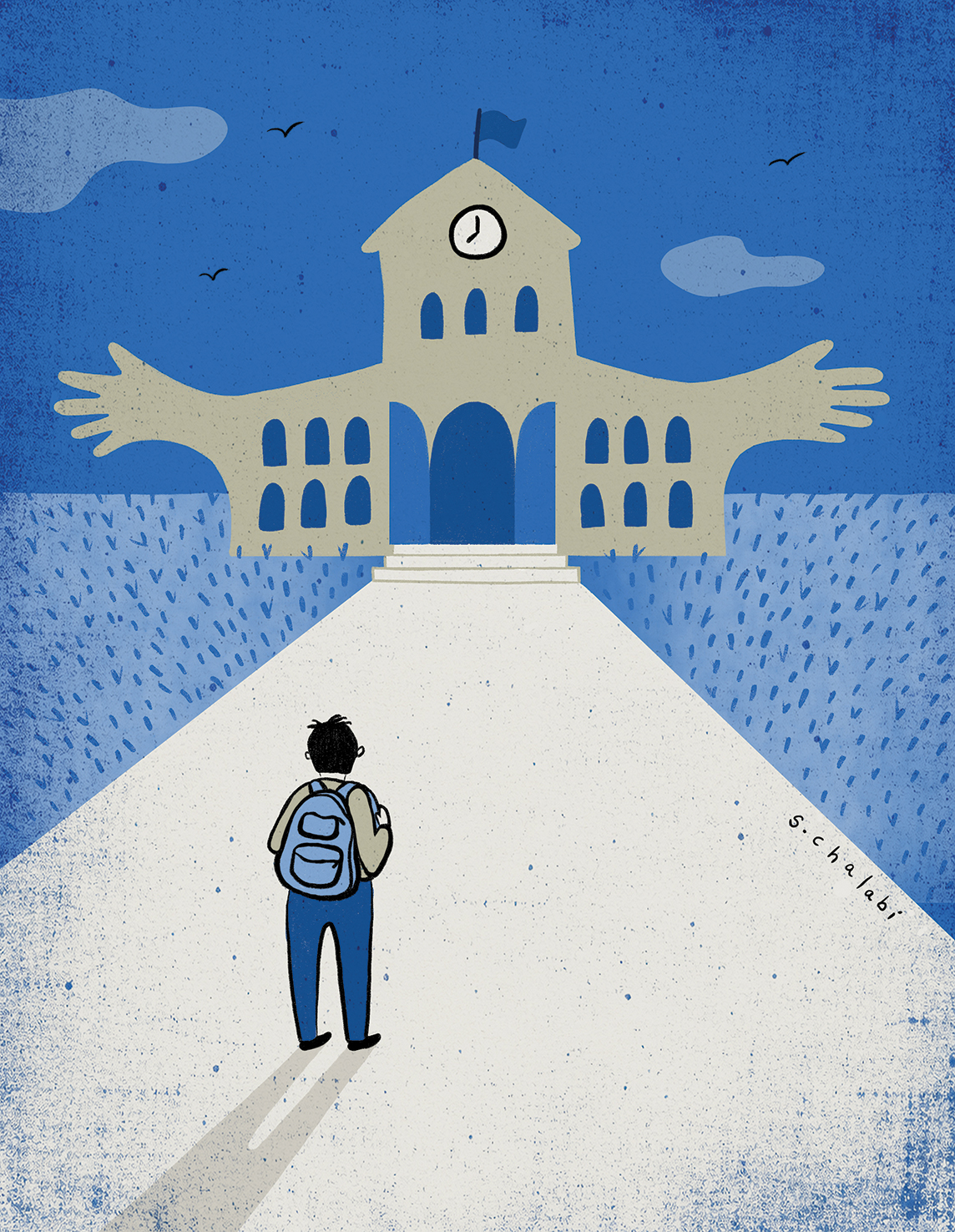
Diego arrived at my after-school enrichment class in Los Angeles with his backpack slung over one shoulder, eyes scanning the room before he chose a seat near the wall.
Our program meets three afternoons a week on a public school campus in a neighborhood shaped by immigration. Most of the students are middle and high school-aged youth from working-class immigrant families, students who have already put in a full day before the bell rings and the after-school hours begin.
For many of them, being there was not a choice. Enrollment in the enrichment program was required. The district framed it as academic support for English learners, newcomers, and students performing below grade level. School authorities told families that it was an intervention, not a punishment. But for students, it often felt like just one more place they were sent, one more hour they had to account for.
When Diego stayed quiet, I understood. He had recently arrived from Guatemala. He had been separated from family members, crossed borders as a child, and landed in a school system where everything, from the language to the unspoken rules, felt unfamiliar. Now he was expected to stay late, speak English, and trust adults he did not know.
During the first few weeks, Diego said little. He did the work. He watched closely. He noticed who joked easily, who pushed back, who asked for help without flinching. I couldn’t determine exactly what he was thinking, but I could tell how deliberately he surveyed the room: where laughter was safely placed, where a wrong response was corrected rather than mocked, which students were considered capable even when they were struggling. When I posed a question, he sometimes hesitated to respond until others had a chance to talk. When I wandered the room, he turned his paper toward me without looking at me. His silence seemed less a form of disengagement than caution, the kind that comes from needing to understand the rules before risking yourself.
Like many first-generation immigrant students I have worked with, he seemed to be studying the room, quietly asking himself: What happens if they do not want me to be here?
Teaching in this space forced me to be honest about what “enrichment” can feel like from the student side. For kids already worn down by a long school day, enrichment without peer belonging can feel less like an opportunity and more like teacher monitoring. Belonging does not make learning easy, but it makes learning possible.
Starting with Students’ Lives
After-school programs are not as tightly bound to pacing guides or tests, which gives teachers some breathing room. I learned quickly that how I used that room mattered.
Early on, I told students, “Before we work together, I want to know who is here.” I asked them to create a “Map of Me,” a drawing of places, people, languages, and experiences that shaped them. I made one too, talking as I drew.
“I’m the first college-educated member of my family, which means that a lot of things I learned in college were things I had to decipher for myself. I had to learn what college prep courses were, how to research colleges, and how to assemble an application package.”
I told students that I helped my parents navigate systems they could not easily access without English. I served as an interpreter, assisted with paperwork during the naturalization process, and took on significant household responsibilities while my parents juggled several low-paying service jobs — the kind available precisely because they did not require English fluency. I framed this not as an individual story of struggle, but as part of a historical pattern: Across the United States, children of immigrants have long grown up carrying adult responsibilities while institutions have benefited from their families’ labor.
By referencing the work they were already doing in their homes, I hoped they could see that what they brought with them into class each day — the work of navigating systems and taking care of others and working toward a common goal — wasn’t something that needed fixing.
“This does not need to be perfect,” I said. “It just needs to be yours.”
The room settled into a quiet focus. One student drew the apartment where three families share space. Another sketched the corner where she waits after school until her mom gets off work. Diego drew a small house and carefully filled the page with the names of relatives still in Guatemala.
When students shared in pairs, I listened from table to table. Later, during our whole group conversation, one student said, almost surprised, “I did not know other people missed people like that too.” No one laughed. A few students nodded. “Me too,” someone else added.
There was no objective written on the board that day. Yet, the students were doing real work, telling stories, listening closely, and making connections. Just as important, they were learning that their lives did not need to stay outside the classroom door.
Teaching Skills Through Belonging
Our after-school curriculum focuses on literacy, creative projects, and collaboration. Over time, I have learned that none of it sticks if students do not feel safe enough to open up.
When we started a storytelling unit, I shared short personal narratives by young writers published through the Los Angeles Times High School Insider student writing platform, including pieces about translating for parents at doctors’ appointments, navigating two languages at home and school, and feeling invisible in classrooms that move too fast. In one essay, a student describes staying silent in class not because she does not care, but because she is afraid of saying the wrong word out loud. I asked questions like “What makes this moment hard for the writer?” and “Where do you see them pushing back?”
Students wrote their own drafts. Diego’s first one was short. It focused on a single moment: standing in line at school registration while his aunt spoke for him, his name mispronounced again and again. The draft was only a few paragraphs long, written in careful sentences, but he described gripping a folded paper with his address on it, afraid he would be asked a question he could not answer. Instead of marking it up line by line, I wrote: “There is a lot here. Can you slow this moment down and tell me more?” I circled one sentence about the folded paper and asked what it felt like in his hand. When I handed drafts back, I told the group: “This is a draft space. Messy means you are learning.”
In a required after-school program, that message matters. Belonging is often what keeps students from shutting down or from not coming back at all.
Small Moves That Build Trust
Belonging did not come from a single activity. It came from routine.
We started each day with a short check-in circle. The prompts were simple: one word for how today feels, something you handled this week, and one thing you want help with. Students could speak, write, or pass. “You get to decide how much you share,” I reminded them often. A good number of students answered the same thing each day, and I accepted that. Some stayed that way, while others began to volunteer a few more on their own. It was important that the check-in was not a presentation, that students knew their interior lives were not unseen, despite not putting a voice to them.
That choice mattered in a space they had not chosen.
During group work, I paired newer students with peers who were patient and encouraging. I taught sentence starters out loud: “Can you show me how you did that?” and “I am not sure yet, but I want to try.” These were academic moves, but they were also about dignity.
“It helps because I do not feel dumb asking questions,” one student told me.
We treated culture as something to build with, not something to work around. The students initially chose to use Spanish, Mandarin, and Korean deciding to translate later. The students described the jokes that didn’t translate. When we were planning the group activity, students negotiated which songs to play and explained to each other the value of these songs during the long bus rides back home. When Diego mentioned a holiday that the other children didn’t know, we took a break to allow Diego to explain it. None of this was a special event. It was simply how we worked.
Belonging does not mean lowering expectations. It means giving students a real chance to meet them.
Letting Struggle Be Visible
After-school programs bring the weight of the school day. Students arrived hungry, frustrated, or exhausted. Some froze when asked to speak. Some disappeared for days at a time.
I had to stop seeing those moments as problems to fix quickly.
One afternoon, a student froze during a presentation and asked to sit down. After class, he lingered and said: “I like that you do not get mad when I mess up. It makes me want to come back.”
After that, I started naming the struggle out loud. “If this feels hard, that is OK,” I told them. “Hard usually means you are learning.” I wanted students to know that mistakes would not cost them.
A Right to Be Here
Belonging in required after-school programs is a social justice issue. These spaces can easily become extensions of sorting and surveillance, or they can become places where students practice sharing their voice. At our site, belonging meant students being able to choose where they sit instead of being placed in a particular location, hearing their languages spoken without them being corrected, seeing drafts receive questions instead of markings pointing out the wrongness of the answers, and not being punished for silence, struggle, and second attempts.
Belonging does not mean lowering expectations. It means giving students a real chance to meet them.
At the end of the session, I asked students to reflect on our group. One student, Katie, wrote about Diego: “Diego talks more now. He jokes. He helps people. He is part of us.”
By then, Diego was not sitting in the back of the room anymore. He raised his hand. He took risks. He trusted that trying would not cost him his place.
That shift did not come from a single lesson. It came from daily choices that sent the same message again and again: You matter here. You belong.