Beyond Loyalists and Patriots:
Centering Black and Indigenous Americans When Teaching the American Revolution
I began my first teaching position in 2007 teaching early American history to 8th graders. The entire first quarter was focused on the Revolutionary period from 1763 to 1783. I was responsible for teaching how the French and Indian War contributed to tension between the British government and their colonial subjects, how colonists resisted unjust British actions, and ultimately decided to declare independence and fight for and create a new nation founded on liberty and equality. The locality I taught for, attempting to focus on diverse perspectives, added the following content standard to those crafted by the state department of education: “The experiences of Native Americans, African Americans, and colonial women reveal a variety of motives and decisions regarding involvement in the revolution.” However, unlike almost every other topic, no instructional materials or resources were provided to teach this content; the teacher’s curriculum guide proclaimed, “The activities for this session are up to you to decide.”
An additional barrier to teaching about the impact of the Revolutionary War on Black and Indigenous people are the omissions and distortions found in history textbooks that prop up founding myths. For example, one McGraw Hill (2013) textbook names only one Indigenous person and one Black American who were involved in the conflict, Joseph Brant, a Mohawk ally of the British, and Peter Salem, an enslaved American who “served the Patriot cause.” Joseph Brant is also included in a sidebar of a Houghton Mifflin Harcourt (2018) textbook, but under the heading “Colonists Choose Sides,” obscuring his opposition to settler colonialism. Although more Black Americans sided with the British over the patriots, both textbooks fail to highlight any Black individuals who fought against the colonists. The McGraw Hill text completely excludes the role of Indigenous and Black women in the conflict. Perhaps the most glaring distortion in the McGraw Hill text is the emphasis on the brutality of Indigenous and British approaches, without mentioning any of the war crimes committed by the Continental Army, such as General Sullivan’s scorched-earth campaign against Haudenosaunee villages in New York destroying shelters and food supplies.
The new mixer lesson “Beyond Loyalists and Patriots: Black and Native Americans Fight for Their Freedom in the U.S. War of Independence” created by Mimi Eisen and myself, is meant to correct these types of omissions and distortions. The goal of a mixer activity is to surface the thinking and motivations of the historic figure students are assigned to read about. Students then share the stories of these individuals with their classmates. By focusing on experiences often left out of the dominant historical record, students learn the impacts of the American Revolution on Black and Indigenous Americans challenging the founding fairy tale that the American Revolution was simply a righteous struggle of colonists in eastern seaports to unshackle themselves from British tyranny.
The final grievance of the Declaration of Independence positions Indigenous and enslaved inhabitants in opposition to U.S. liberty and independence. Here, in accusing King George III of inciting enslaved and Indigenous people to rise up against colonists, the Declaration’s signers condemned Black and Native Americans’ freedom and sovereignty. The so-called liberty championed in the Declaration rested on what sociologist Eve L. Ewing describes as the “original sins” of bondage, displacement, and genocide — “cornerstones that irrevocably shaped the social fabric of this nation.” Rather than opposing freedom, Black and Indigenous Americans fought for their own liberty, rights, and sovereign claims to their lands. The choices they made about if and how to engage in the conflict were based on the calculus of what was most likely to improve their lives and secure their freedom dreams, which were in direct conflict with dominant colonial ambitions to seize Native lands and protect chattel slavery.
The mixer biographies offer students a nuanced portrait of the complex and varied decisions undertaken by people fighting for their own lives. These individuals were not pawns of imperial or colonial ambitions; they strategized and exercised agency to further their goals, not those of others. For example, students meet Boston King and Peggy Gwynn, freedom seekers who fled “patriot” enslavers and joined the British war effort on the promise of emancipation in exchange for service offered by Lord Dunmore. At the war’s end King evacuated to Nova Scotia with the British gaining his freedom, while Gwynn tragically didn’t meet the requirements demanded to evacuate with the British. As a result, the British turned Gwynn over to the enslaver she had escaped years earlier.
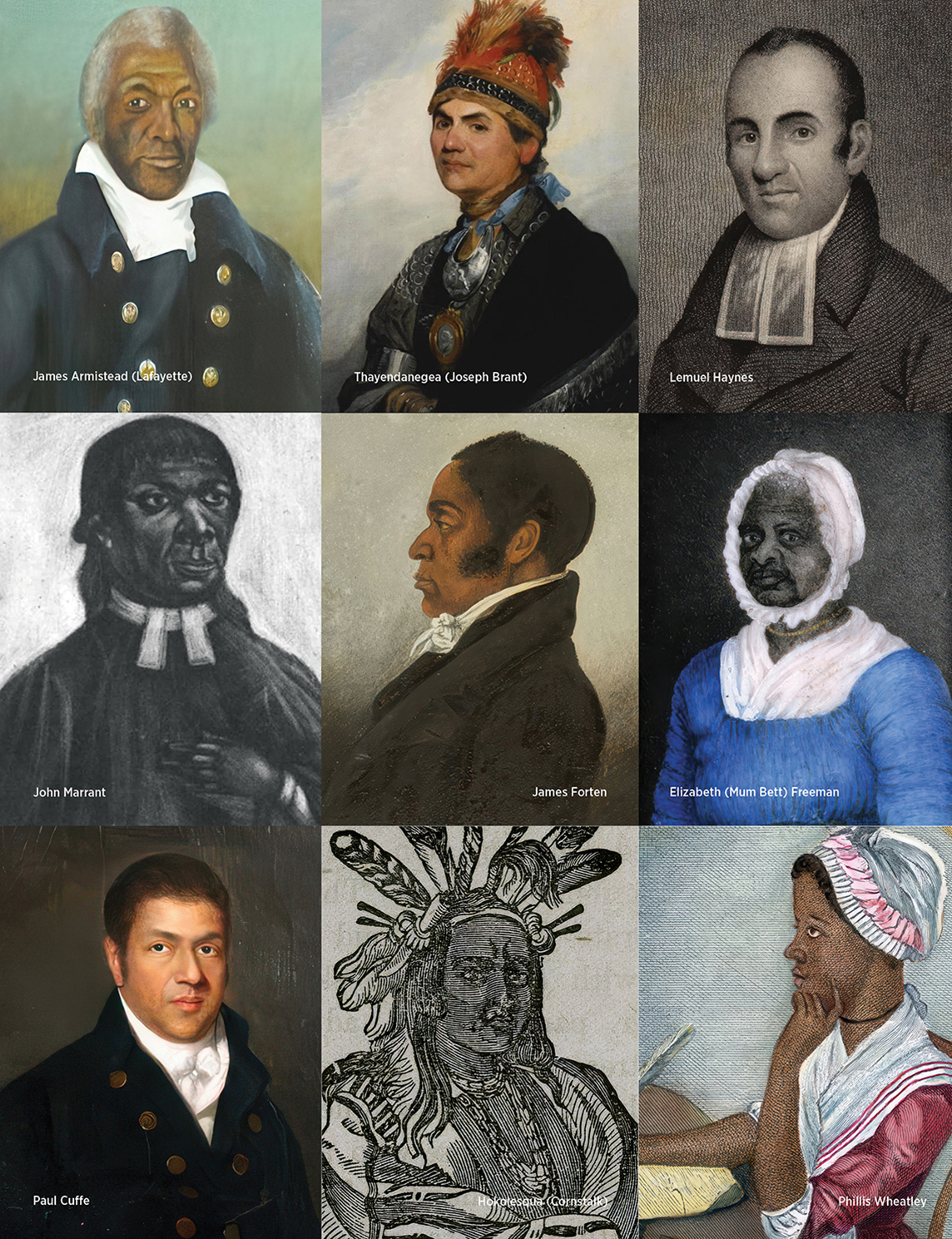
As part of the longstanding effort to resist settler encroachment on their lands, some Native nations allied with the British, seeing the Proclamation of 1763, which banned American settlers from moving west of the Appalachian Mountains, as evidence that the British Empire was more likely to respect their sovereignty. Students encounter Mohawk leaders Konwatsi’tsiaienni (Molly/Mary Brant) and her brother Thayendanegea (Joseph Brant), who had close connections to British Superintendent of Indian Affairs Sir William Johnson, Konwatsi’tsiaienni’s common law spouse. They allied with the British and urged the Haudenosaunee Confederacy to fight against the United States. In late 1775, Thayendanegea traveled to England. He met with King George III to secure promises to protect Mohawk land and interests in exchange for wartime support. In a letter to a British official, he noted,
It is very hard when we have let the King’s subjects have so much land for so little value, they should want to cheat us of the small spots we have left for our women and children to live on. We are tired out in making complaints and getting no redress. We therefore hope that the Superintendent may have it in his power to procure us justice.
True to their word, even after losing the war, the British granted Konwatsi’tsiaienni, Thayendanegea, and the Haudenosaunee large tracts of land near the Grand River in Ontario where the Six Nations continue to reside today in the most populous First Nations community in Canada. Members of other Native nations who allied with the British were not as fortunate. Students are introduced to Buckongahelas of the Delaware. After the war he moved farther west and joined Shawnee forces trying to repel invasions of U.S. settlers. After a 1794 defeat at the Battle of Fallen Timbers, Buckongahelas signed several treaties with the United States that forced Indigenous people to cede more land.
Other Black and Indigenous Americans who students learn about in the lesson chose to ally with the fledgling United States — also with varying success. Even though its authors intended to exclude Black Americans like him, James Forten, born free in Philadelphia, took to heart the Declaration’s claims that “all men are created equal” and entitled to “life, liberty, and the pursuit of happiness.” He committed himself to the patriot cause and would quote the Declaration throughout his life while fighting for racial justice. Students also learn of James Armistead, who was enslaved in Virginia and chose to remain with his enslaver, joining the Continental Army as a spy. After the United States won its independence, Armistead was returned to life as an enslaved man. In 1783, Virginia’s legislature passed an act to free enslaved people who had served as soldiers in the Continental Army. But because Armistead was classified as a spy and not a soldier, the law didn’t free him. In a 1786 petition, Armistead argued for “the just right which all mankind have to Freedom.”
Indigenous people who allied with the United States did not fare well or succeed in the goal of preventing the onslaught of settlers onto their land. Students meet Shawnee leader Hokolesqua, Delaware leader White Eyes, and Cherokee leader Onitositah, all of whom were murdered by the U.S. militia. Students also meet Cherokee Beloved Woman Nanye’hi, who came to see that the peaceful coexistence she had championed her whole life was not a goal for most U.S. leaders and settlers. She urged the Cherokee Council to hold onto their remaining land, writing:
Our beloved children and head men of the Cherokee Nation, we address you warriors in council. We have raised all of you on the land which we now have. . . . We know that our country has once been extensive, but by repeated sales has become circumscribed to a small track. . . . Your mothers, your sisters ask and beg of you not to part with any more of our land.
Historian Woody Holton argues that Native Americans suffered most from the outcome of the Revolutionary War despite their success in battle: “American Indians lost out where it mattered most — at the bargaining table in Paris, where of course they were not represented. Although British officials had never purchased or conquered the region between the Ohio and Mississippi Rivers . . . they nonetheless ceded this region to their former colonists in the peace treaty signed in Paris in 1783.”
While Indigenous people struggled to prevent settler encroachment of their land in the decades following the war, the outcomes for Black Americans were more complex. Although Massachusetts and Vermont abolished slavery in the aftermath of the revolution and some states moved to gradual emancipation, slavery became more entrenched in the Southern states and spread westward as settlers seized Indigenous lands. Historians have estimated that many more enslaved people — perhaps 10,000 or more — obtained their freedom by fighting on the British side than with the United States.
This mixer lesson exposes students to these often-unstudied historical figures to demonstrate the freedom dreams that motivated Black and Indigenous Americans and the complex choices they faced in determining whether and how to participate in the U.S. War for Independence. Learning the rich stories of diverse historical figures during the mixer, whose perspectives are often marginalized, helps students appreciate the nuanced choices Americans made, and that although some freedom dreams were realized, many were not. Participation in this activity gives students the opportunity to think outside the textbook, critique founding myths, and confront how the American Revolution expanded freedom to some while denying it to many.
Sample Roles
To access the lesson plan, handouts, and all 19 roles, visit zinnedproject.org/patriots
Deborah Squash
Deborah Squash was a child in the 1760s and ’70s. In those years, she was among more than 300 people held in bondage on George Washington’s Mount Vernon plantation in Virginia. In the fall of 1775, early in the Revolutionary War, colonial governor Lord Dunmore issued a proclamation. It encouraged Black people enslaved by patriots to escape and join the British Army. He promised freedom in exchange for taking up the British cause against the rebel colonies. Dunmore and other British leaders hoped that eliminating the patriots’ enslaved workforce would crush their war effort. His proclamation enraged patriot enslavers and drew them into open revolt against the British. Roughly 20,000 enslaved people seized this chance to free themselves.
In April 1781, a British warship sailed up the Potomac River near Mount Vernon, robbing and burning plantations along the way. Squash decided this was her moment to escape. She boarded the ship with 16 other enslaved people, fleeing Washington’s plantation. Washington’s cousin, Lund, followed them on board and offered the British ship’s crew supplies in exchange for their return. The crew took the supplies but blocked Lund from recapturing Squash and the other fugitives from slavery.
Squash made her way to New York City. There, self-emancipated people gathered to help British forces win the war and gain their own freedom. They often made do with scarce food supplies and shelter, because the British did not have enough resources to support them. Still, for Squash and many others, life in New York brought great joys and freedoms denied to them by their former enslavers. During this time, she met and married Henry Squash, who also hoped to gain lasting freedom by allying with the British.
But after several years of war, the British lost to the Continental Army. The 1783 Treaty of Paris formally ended the Revolutionary War and recognized the United States as an independent country. It also stated that enslaved people who had escaped to British lines must be returned to their patriot enslavers. British officer Sir Guy Carleton attempted to evacuate many of them from the United States. Thousands of loyalists and their allies had migrated to Nova Scotia, then a British colony. But patriot enslavers — led by Washington, then the U.S. commander-in-chief — intervened in Carleton’s plans. They forced a compromise between Britain and the United States.
Self-emancipated people in New York City had to prove that they had lived in the city prior to the drafting of the Treaty of Paris in November 1782. Otherwise, patriots would re-enslave them. Carleton’s clerks interviewed thousands of self-emancipated Black people in New York City. British officials decided who qualified for freedom. They gave certificates of freedom and arranged safe evacuations to those they determined to be allies of Britain in the war. This included Deborah Squash and her husband.
The Squashes set sail for Nova Scotia on April 27, 1783. On April 28, unaware of their departure, Washington wrote to a New York commissioner who arranged these voyages. Washington asked him to “secure” (imprison) any Black people who had escaped enslavement at Mount Vernon, “so that I may obtain them again.” But Squash was out of reach, never to be seen or enslaved by Washington again.
Onitositah (Old Tassel, or Corn Tassel), Cherokee
Onitositah was a Cherokee political leader and peace ambassador. He was likely born in Toqua, a Cherokee village in present-day Tennessee. He was also known as Old Tassel or Corn Tassel. He first appeared in the historical record during the Seven Years’ War between Britain and France. Indigenous peoples fought on both sides of the war in North America. In 1757, the British set up a fort on Cherokee land near Onitositah’s home. Cherokee warriors captured the fort in 1760 and forced the British to leave. He then served as a Cherokee ambassador in peace negotiations with Britain.
In 1763, Britain won the Seven Years’ War, forcing France to surrender most of its colonial territory in North America. After the war, Britain did not have enough resources to battle and seize land from interior Indigenous nations. King George III issued the Royal Proclamation of 1763 to try to calm conflicts between British colonists and Native peoples. The proclamation banned colonists from moving west of the Appalachian Mountains. It temporarily reserved that land for Native peoples. Many colonists refused to abide by the proclamation, believing that the interior was theirs to take. The Cherokee fought off swarms of colonists. Onitositah again joined peace delegations with Britain.
But many settlers were eager to claim Native lands in the interior and break ties with the government that tried to hold them back. By 1775, the Thirteen Colonies moved toward independence from Britain. Wealthy colonists seized a lot of land from Indigenous peoples out west, violating the Proclamation of 1763. These settlers forced the Cherokee into treaties that eroded their hunting lands in present-day Virginia, Tennessee (then North Carolina), and Kentucky. Onitositah and others still tried to negotiate terms that honored Cherokee sovereignty.
In the Revolutionary War, most Cherokee people allied with Britain. Invading settlers were a more immediate threat to their nation’s sovereignty than was a distant British government. The Cherokee had signed peace treaties with multiple Southern states, but U.S. settlers continued to plunder their tribal land. Onitositah condemned the patriots’ violence against Native peoples and the land itself. But in the early 1780s, it became clear the United States would win its war against Britain. So Onitositah tried repeatedly to reach peaceful compromises with the patriots. The Cherokee made him “First Beloved Man,” a title that recognized his role as an official political leader and elder of the tribe.
In a 1782 letter to a U.S. officer, Onitositah wrote, “We are the first people that ever lived on this Land — it is ours, and why will [the United States] take it from us?” But most U.S. leaders believed that victory over Britain gave them the right to control Native lands. In 1784, Onitositah wrote to Alexander Martin, a “Founding Father” of the United States,
[Y]ou promised to have your people taken off our grounds, but it is not yet done. When one goes off two come in his place. We are in a great deal of trouble about it. Our young men are afraid to go out hunting. Your people are always ranging through our Country, and marking our lands. . . . We fear you have thrown us away.
Through the 1780s, Onitositah continued to advocate for a true, lasting peace. But in 1788, under the guise of meeting to establish a truce, U.S. settlers killed him.