Hoodies, Identity, and Algebra:
Mathematics as Student Advocacy
Illustrator: Keith Henry Brown
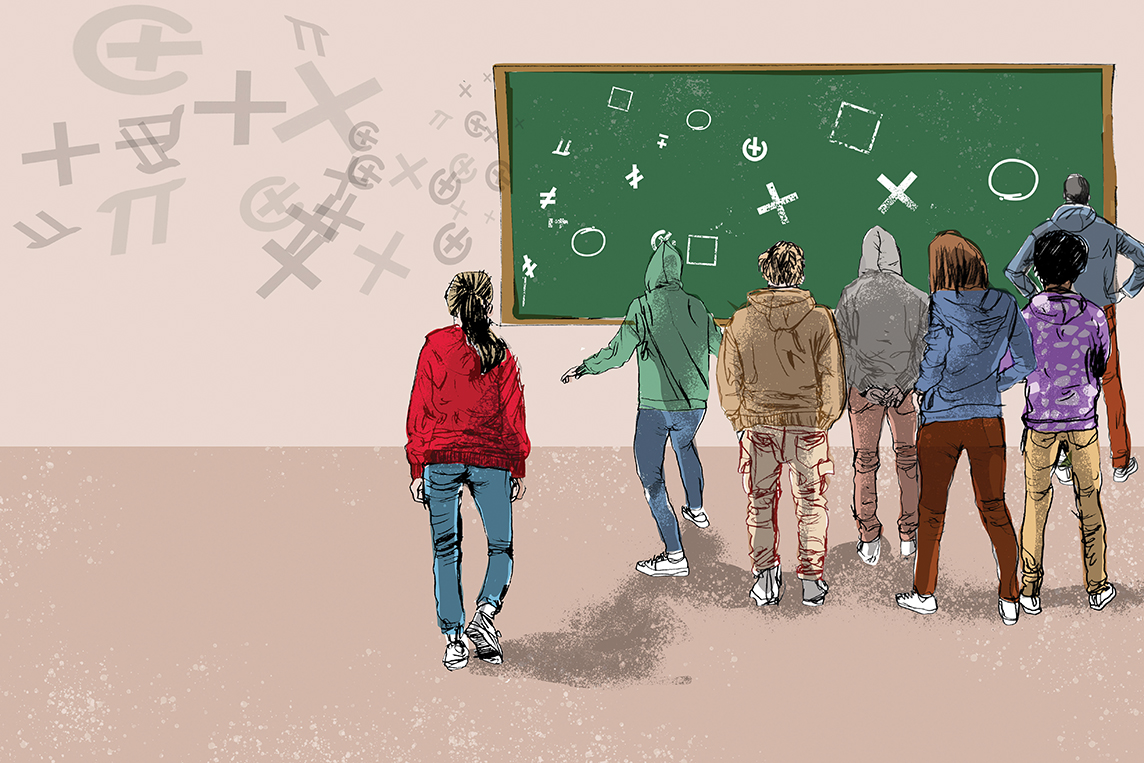
As my students came into my Algebra 1 class after lunch, their body language told a story of anger and frustration. One student dropped into his chair, still wearing his bookbag, and put his head down without even considering taking out his notebook. Another stomped through the door, didn’t return my greeting, and asked for a bathroom pass. Two girls skulked across the room with their arms crossed and murmured an unsavory description of a school administrator. This class usually brimmed with personality and enthusiasm. They often gleefully shared stories with me about their silly antics at lunch or in previous classes, and they were usually as bubbly and seemed as content as 13-year-olds can manage.
Their sour moods on this day were surprising and upsetting. I acknowledged the negativity and asked what happened. They erupted into a many-voiced, adolescent-angst-ridden unit, decrying the administrators in the building for their policy about students wearing hoodies. Our school had an official policy that students were not allowed to wear sweatshirts with hoods, regardless of whether the hood was up or down. The policy was not often enforced, but today during 6th-period lunch, the axe fell.
The Hoodie Policy
For these teenagers in New York, there is no denying that hoodies are a part of their culture. These sweatshirts are ubiquitous, regardless of gender, class, race, social status, or even weather. A rule such as this one, in a public school with no uniforms or strict dress codes, is a challenge both to justify and enforce. Although the population of my school was more or less evenly distributed among white, Latinx, and Asian students, the policing of hoodies smacked of the anti-Black racism associated with the murder of Trayvon Martin and rubbed many students and teachers the wrong way.Furthermore, research on youth culture highlights how dress can serve as a symbolic extension of self, particularly during adolescence. As such, policies regulating dress often function as mechanisms of instmutional control rather than neutral rules. It was no secret that students despised the rule and inconsistent enforcement of it made the situation worse.
Most days, students wore hoodies without consequence. Teachers struggled with enforcing the rule. Demanding that students take their sweatshirts off, only to be met with arguments and complaints, is an objectionable tone to set at the beginning of any class and most teachers simply didn’t think it was worth the trouble. My students, for instance, were able to engage in mathematical problem-solving regardless of whether their sweatshirt sported a hood. Most of the time, administrators in the building had bigger fish to fry, so the illicit hooded sweatshirts went unremarked upon.
Some seemingly random days, however, administrators decided a crack-down was needed. They would patrol the halls and sometimes storm into classrooms to confiscate the sweatshirts, which then had to be retrieved by students after dismissal. The day described above was one of these days. The lunchroom was, I learned, the scene of mass confiscations, resulting in the understandably moody, sulky teens sitting in front of me. One student piped up, “Why do they care what we’re wearing? It’s not hurting anyone, it’s not offensive, just let me wear what I want to wear!” She was met with murmurs of approval. “Right? What does it matter?” another student agreed. “This is how we dress; leave us alone. There aren’t any uniforms, so they need to stop trying to tell us we can’t wear our own clothes.” Students understandably felt that the policy was categorically unfair and they felt powerless.
Turning Point
While several other students expressed similar feelings, I considered my choices as a teacher. Instead of redirecting students away from their frustration, I wondered whether mathematics could serve as a legitimizing language through which students could articulate and defend their perspectives. I suspected that my lesson on linear regression analyses would be met with neither enthusiasm nor engagement. Instead, I thought that mathematics, in that moment, could become a means of cultural participation and resistance rather than an abstract idea. “I wonder,” I began. “Would it be possible to use math to show that the hoodie rule is unfair or nonsensical?” The timing of the great confiscation turned out to be perfect for my mathematical pedagogy purposes. In the previous two class periods, my students had learned the basics of linear regression and how to identify types of relationships among variables. My plan for this day was to assign a task that required groups of students to create two quantitative survey questions, collect data, and determine the strength and direction of the correlation between the two, and answer a few questions relating to the meaning and implications of their results.
With very minor spontaneous modifications, I was able to center the focus of the task on the hoodie policy. I asked why they think school administrators created and continue to enforce the hoodie policy. Some students had been told it’s a safety issue: Students can use the hood to hide their identities or pull on someone else’s hood to make them fall. (Though neither the students nor I could remember either of these issues ever happening in our school.) The students also felt, though none could remember being told explicitly, that administrators thought hoodies were worn by “delinquents and underachievers.” They did recall being told explicitly that hoodies were not “proper school attire.”
Using these attitudes and perceptions as an anchor, I asked students to think about how they might use quantitative variables to gather data. Questions like “What aspects of ‘delinquent’ or ‘underachiever’ or ‘proper for school’ can be measured using numbers?” and “How might we measure safety and disciplinary issues in a survey?” and “How can wearing hoodies be quantified?” got students talking animatedly about the dimensions of these hard-to-measure constructs.
They set about creating numerical variables related to their immediate and very pressing concern: wearing hoodies in school. For an entire class period, they brainstormed survey questions that could be answered quantitatively about safety/discipline and school performance/propriety.
Examples of safety/discipline questions that result in quantitative answers included:
- How many times have you been suspended?
- How many times have you been involved in a disciplinary incident?
- How many times has a teacher called your house because you got in trouble?
- How many fights have you gotten into this year?
- How many times have you seen someone grab someone else’s hood from behind to try to make them fall?
Examples of school performance/propriety questions that result in quantitative answers included:
- What is your GPA?
- How many marking periods have you spent on an honor roll?
- How many times this year has a teacher or other adult in the school corrected your behavior or speech because it was inappropriate?
- How many classes are you currently failing?
Their survey questions led to numerical comparisons between variables like the ones above and ones related to hoodie wearing or ownership: number of hours spent studying vs. number of hoodies owned, GPA vs. number of hoodies owned, number of times suspended vs. number of times per week wearing a hoodie, number of tests failed this year vs. number of days wearing a hoodie to school this year. Their collective hypothesis was that there was no correlation, and therefore certainly no causal relationship between hoodie-wearing and student outcomes. Using reasoning from previous lessons, they asserted that to prove their hypothesis, the correlation coefficient between the two variables could be positive or negative but had to be very close to zero.
The energy in the classroom over the next few days was palpable as students created and revised quantitative questions and began analyzing data. I overheard conversations like these:
Gabriella: If we ask it like that on the survey, they’re not going to know what we mean.
Adam: Why? I think it’s clear.
Gabriella: “What’s your GPA?” could mean a lot of things. Math GPA? GPA from last year? Cumulative GPA? The GPA you think you currently have?
Adam: OK, so let’s say “What was your cumulative GPA on your marking period 2 report card?”
Gabriella: This year. If we’re not specific, they won’t get it.
Joshua: Wait, why is this number so high? We asked how many days last week did you wear a hoodie, and this kid [one of the participants] said 300. It’s messing up the whole graph.
Devin: The most it can be is 7; that kid is just being an idiot.
Joshua: So can we just change it? Maybe they meant 3.
Devin: (laughing) How do you know what they meant? Do you think they accidentally typed zeroes?
Joshua: So what do we do? Just take it out? Can we do that? That would change the whole thing.
Devin: Yeah, but I think we have to. It’s not like it’s real data. It doesn’t make sense. That’s the y-variable. Find out what that same person wrote for their x-variable and take that out too.
The tone of both of these conversations was friendly and energetic, and both reveal some deep thinking about embedded mathematical concepts. They show students engaging in prediction about how datasets are affected by changes, and critical thinking about how real-world math, which is much messier than it is in textbooks, presents in this assignment. Phrasing and revising questions to elicit accurate data, considering the accuracy and validity of outliers, and determining how removal of an extreme value affects the overall measures are all standards in the Algebra 1 statistical analysis unit.
After collecting and cleaning their data, they began the analyses. Students entered each set of bivariate data into their calculators to find its correlation coefficient, create a scatterplot, graph trendlines, and find the equation for the line of best fit. Then, they considered implications with enthusiasm that would not have accompanied the original task.
They collectively found correlation coefficients between -0.01 and 0.017 when comparing school outcomes with hoodie use and correctly interpreted them: “See — no correlation at all. They have absolutely nothing to do with each other” and “Bro — I found a bigger correlation coefficient for shoe size and GPA than wearing hoodies and GPA.” Their scatterplots showed no traces of trends, and the lines of best fit didn’t fit at all.
They understood exactly what it meant for bivariate data to have no correlation, what results like these looked like on a graph, and how it compared to data that was highly correlated.
Armed with their newfound data and interpretations, they wrote a letter to the principal outlining their findings and requesting that the policy be changed.
Although this was not a formal research study, students exceeded expectations for conceptual understanding and statistical reasoning in Algebra 1. And they did so with a vigor that was certainly not evident in previous units.
Why Did It Work?
This task was successful because it honored students’ cultural identities and positioned their concerns as worthy of mathematical investigation. Culturally responsive mathematics education emphasizes the importance of validating students’ lived experiences and using mathematics to interrogate issues that matter to them. By allowing students to use statistical tools to challenge a policy they perceived as unjust, mathematics became a vehicle for voice and agency. It might seem trivial to adults, but the symbolic importance of clothing to adolescents is powerful. Hoodies were part of their culture, and they wanted to feel that their culture belonged in school. After this project, I began a class discussion: “I noticed a big difference in how everyone responded to this task vs. the one I gave in the last unit. Why do you think that was?” Some of my favorite responses included:
“It started because we were mad, but you didn’t just tell us to get over it and do math. We used the math to . . . I don’t know . . . fight back or whatever.”
“It’s like it was our math, not regular math.”
“It was about something we cared about, so we wanted to learn it. Like, I don’t care what a correlation coefficient is usually, but if it’s going to help me prove that this rule is stupid and make me sound smart when I’m arguing about it, then yeah, I want to know.”
At no point during this weeklong task did anyone ask, “Why do we need to learn this?” The answer to this valid question was implied and obvious to students. Many educators tend to shy away from social justice topics in math classrooms, preferring to embrace the objective truths that can be found in textbooks. This omission is a lost opportunity to enhance students’ sense of belonging in their classrooms, their schools, and their communities.
* * *
This mathematically fueled civic uprising didn’t have quite the satisfying narrative ending we sought. Our principal was not pleased with the little rebellion that I encouraged but she did eventually acquiesce, if only slightly. The new hoodie policy allowed students to wear hoodies, but only ones emblazoned with the school’s name. The only way students had access to hoodies with the school’s name was to buy them at the school store. “This is so messed up,” one student reacted. “Now we have to pay the school to wear hoodies?” But another student noticed, “Wait — the rule doesn’t say we have to buy it at the school store.” A general mathematical practice that I emphasize with my students is demonstrating precision in fidelity to formal definitions. I meant mathematical definitions, but the next day, my students came in wearing their own hoodies with masking tape over the chest displaying the school’s name.