Weaponizing Antisemitism:
From the 1968 Teacher Strike to Today’s New McCarthyism
I remember fondly as a child dressing up alongside my Hebrew day school classmates in Los Angeles. We acted out the story of Purim, where Queen Esther and her cousin Mordecai save the Jewish people from the Jew-hater Haman’s evil plot. I also remember gazing at the candles every night of Hannukah, hoping my present was not socks or underwear (which at least some nights it inevitably was). The lighting of the menorah commemorates the rededication of the Second Temple after the Maccabees fought and won against King Antiochus, who forced his culture and religion on the Jewish people.
In Being Jewish After the Destruction of Gaza, Peter Beinart makes a poignant observation about my favorite Jewish holidays that I have not been able to stop thinking about. Summarizing these stories as “they tried to kill us, we survived, let’s eat,” Beinart then points out that these biblical narratives don’t end there. After the story of Purim that I learned as a kid, Jews take revenge, killing not just Haman, but his 10 sons and 75,000 other enemies.The Maccabees become rulers who force conversion on other peoples just as King Antiochus did to them. “We tend to cut off these stories in our sacred texts at precisely the point that they might help us reckon with the Jewish capacity to be victimizers as opposed to victims,” Beinart writes.
Growing up in a liberal Jewish household, the son of two U.S. historians, there was another story about Jewish oppression I was told. For my mother, this one was deeply personal. Her father had fought in World War II and was captured at the Battle of the Bulge. The Nazis marched prisoners of war westward into Germany under brutal winter conditions and my grandfather’s foot became gangrenous. “He couldn’t go on. He fell in the snow, but a Black soldier picked him up and carried him the rest of the way,” my mother recalled. “I would beg him to tell me this story over and over, because I was proud that our family always believed in civil rights.”
I learned that Jews were major supporters of the Civil Rights Movement — not just that we marched with King, but that young Jewish activists were deeply engaged in the interracial grassroots organizing that built the movement. During the 1964 Mississippi Freedom Summer Campaign, Andrew Goodman and Michael Schwerner, along with their Black comrade James Chaney, were murdered by members of the Ku Klux Klan. Jews put their bodies on the line to ensure Black freedom because we understood the liberation of Black people and Jewish people are entwined.
For a long time, the story in my mind of Jewish support for civil rights ended there. It wasn’t until I taught U.S. history in New York City and began to familiarize myself with local civil rights history that I was confronted with a more complex picture of Jewish involvement in the Black freedom struggle. I learned about Jewish participation on both sides of the 1968 United Federation of Teachers (UFT) strike against the movement for community control of schools.
I’ve found myself returning to the history of this strike over the last year. Not only because it tells a more complicated story of Jews during the Civil Rights Movement, but also because it was a key moment where antisemitism was weaponized against the Black and Jewish left in the United States — a method that today is being utilized to silence critics of Israel’s genocide in Gaza.
How do I make sense of how frequently my work, my colleagues, and myself have been labeled as antisemitic?
Incredible Black anti-racist educators, whom I’ve co-written curriculum with in Philadelphia, have been attacked as antisemitic. The book I co-edited for Rethinking Schools, Teaching Palestine, has been called antisemitic. Other Jews have organized to cancel workshops I’ve offered because they claim the information I provide is antisemitic.
So in an attempt, as a Jew, who — most of the time — does not hate himself, and certainly does not hate people for sharing his customs, ethnicity, or religion, how do I make sense of how frequently my work, my colleagues, and myself have been labeled as antisemitic over the last two years?
To answer that question I needed to go back to 1968 and trace the evolution of how antisemitism was weaponized.
The 1968 United Federation of Teachers Strike and “Black Antisemitism”
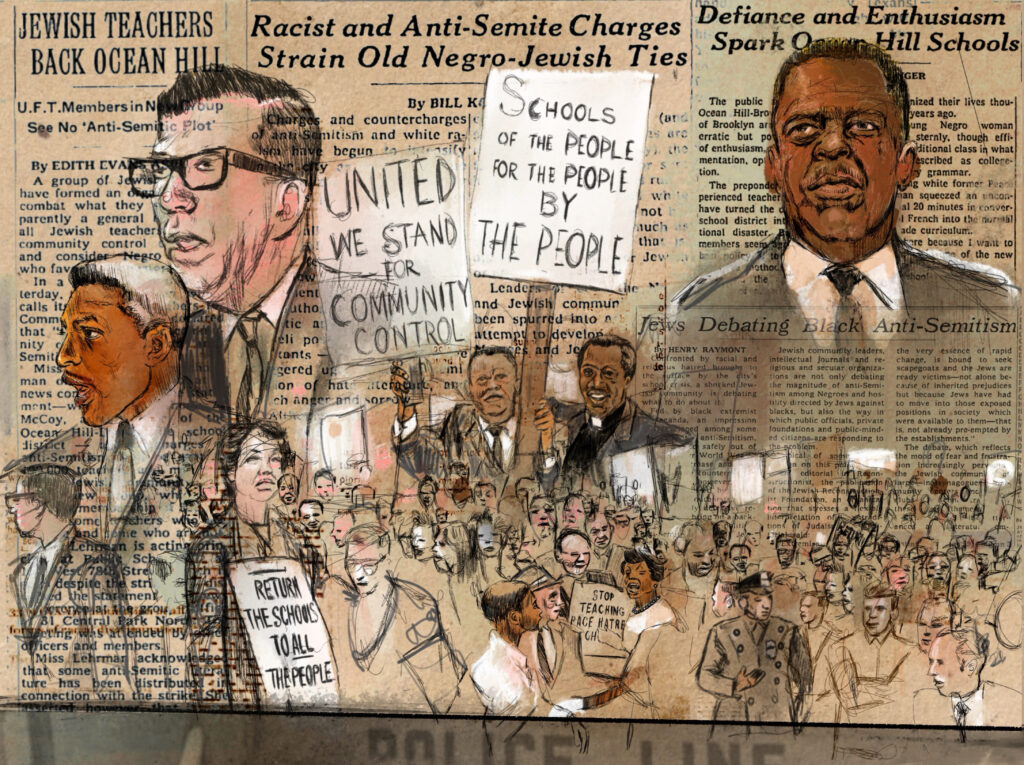
After a long struggle to fight segregation through integration in New York City, Puerto Rican and Black parents demanded community control over their schools. In 1967, the central board of education approved a pilot program creating new community-level school boards given the power to make hiring, policy, and budget decisions. On May 9, 1968, the Black and Puerto Rican-led community school board in Ocean Hill-Brownsville, Brooklyn, force transferred 19 teachers — most Jewish and all of whom the school board felt were standing in the way of community control. The stage was set for a strike that would play an outsized role in redefining the relationship between race, class, and Jewishness in the United States.
The 1968 strike is often characterized as caused by Black antisemitism. But in one of the best histories of the strike, Mark Winston Griffith and Max Freedman in their School Colors podcast expose this as largely a fiction created by the UFT to win support for their strike. As Freedman summarized in an interview with Jewish Currents, the UFT’s main objection at the beginning of the strike was “just that these teachers’ due process rights had been violated.” But he continues, “when that narrative didn’t capture hearts and minds — the teachers’ union, led by its president Albert Shanker, changed the story they were telling. The story became, ‘They tried to fire these teachers because they were Jewish.’”
In fact, Shanker essentially admits this, 20 years after the strike, in an interview for Eyes on the Prize. “Antisemitism was not, and it certainly had nothing to do with starting the strike,” he stated. “And it had nothing to do with keeping the strike going. And it had nothing to do with the settlement. It had an awful lot to do with how people came to see the strike in public terms.” This is an incredible admission given that the union, under Shanker’s leadership, was largely responsible for that public perception. UFT produced and distributed half a million antisemitic leaflets during the strike that they claimed, without evidence, originated from Black community members of Ocean Hill-Brownsville. “If community control wins,” Shanker told a delegate assembly during the strike, “they will paint swastikas on your schools.”
Nevertheless, many Jewish teachers organized for community control. Gene Bruskin, was teaching at P.S. 66 in the South Bronx during the strike and remembers being asked by another Jewish teacher to cross the picket line. “Some of us in the school feel like this is a strike against the community and we’re not going to participate. Why don’t you join us?” he asked Bruskin. Bruskin agreed. He and five other teachers went door to door recruiting students to attend school during the strike. “We marched, a contingent of like a hundred people, through the picket line,” Bruskin described to me. “The six teachers would walk in front and part the picket line, and then welcomed in the parents and students, while the other teachers — all white — would yell ‘scab!’ at these Black and Brown elementary school students and their parents.”
Half of the teachers hired in Ocean Hill-Brownsville as replacements during the strike were Jewish and not one complained about antisemitism. As the UFT leadership began disseminating the bogus leaflets, those crossing the picket lines increasingly organized to push back against the narrative of Black antisemitism. Three hundred and seventy-nine of Ocean Hill-Brownsville’s 541 teachers signed a statement published in the New York Times denouncing the UFT’s “massive publicity campaign” to label the Ocean Hill-Brownsville school board as antisemitic.
In October of 1968, a new group formed called Jewish Teachers for Community Control. Within a month, they claimed 500 members and held a news conference declaring “The struggle for community control of schools is not an antisemitic plot.” They accused the UFT leadership of disseminating antisemitic literature of “dubious origin” that created a “distorted picture of the facts” and characterized “Black parents asking [for] a reasonable and realistic role in the public school system” as “gangster mobs.”
Despite these efforts, the view of rising Black antisemitism the UFT leadership promoted during the strike became accepted fact in Jewish New York. A Harris Poll found that by the end of the strike, “Black militants” were considered by 68 percent of Jewish New Yorkers surveyed to have “a lot of anti-Semitic feeling,” while only 60 percent attributed these feelings to “right-wing groups like John Birch Society.” Black teenagers came in next at 42 percent and Black adults followed at 32 percent — both receiving higher percentages than every other category surveyed. Jewish New Yorkers considered Black people more antisemitic than “policemen,” “men who own big corporations,” “private clubs,” and “white Anglo-Saxon protestants.” These sentiments helped the UFT, which struck a deal with the city to end the strike and have the teachers reinstated.
There were economic realities in Ocean Hill-Brownsville that fueled both antisemitic beliefs among some Black people and Jewish dismissal of Black concerns. During the 1950s, the neighborhood was majority Jewish and by 1968 it was 95 percent Black and Puerto Rican. Jews who remained were often small business owners who could draw ire from newer residents as symbols of white authority and wealth. Jewish teachers were beneficiaries of a huge increase in government spending on public education in New York City, which quadrupled in the two decades following WWII. But they did not as frequently encounter the barriers that Black and Puerto Rican New Yorkers did — principally, the confinement to racially segregated schools and neighborhoods.
Yet as Daniel Perlstein notes in Justice, Justice, there is “ample data” from the time proving “that antisemitism was marginal to Black politics.” Indeed, major studies conducted by the American Jewish Committee and the Anti-Defamation League (ADL) in 1967 and 1968 found that Black people were less antisemitic than non-Jewish whites and that the more militant a Black person was, the less antisemitic they were likely to be. In 1967, the ADL’s national director Benjamin Epstein advised the Jewish community “to drop preoccupation with Negro antisemitism, which only serves to divert energy from the civil rights struggle.”
Two years later, as the New York State Legislature met to discuss the future of school decentralization, the ADL reversed course and released a new report declaring “a clear and present danger that schoolchildren in the city have been infected by the antisemitic preachings of Negro extremists.” The ADL report received wide publicity and three months after its publication the legislature voted to end the community control experiment.
“The report quoted a few threatening letters as though these were evidence of an antisemitic tsunami,” writes Charles Isaacs, a Jewish teacher who taught in Ocean Hill-Brownsville during the strike. “I took pride in the individual and institutional Jewish participation in the Southern Civil Rights Movement and welcomed the opportunity to support the new form that movement had taken in northern cities. I experienced the established Jewish leadership’s [offensive] against community control as a racist, deceitful attack not only on the Black community, but on the progressive character of what I still considered to be my own tribe.”
But for the ADL, championing a fictitious rise in Black antisemitism merged with their efforts to redefine antisemitism for use as a tool against the anti-imperialist left in the coming decades.
The Anti-Defamation League and the Redefinition of Antisemitism
In the year leading up to the UFT strike, the Black freedom struggle had taken an internationalist turn. In April 1967, Martin Luther King Jr. delivered his “Beyond Vietnam” speech declaring the U.S. government “the greatest purveyor of violence in the world today” and calling on the United States to “get on the right side of the world revolution.” A few months later the Student Nonviolent Coordinating Committee (SNCC), that at this point had more than 130 full-time staffers and a reputation for doing some of the most important civil rights organizing, took an openly pro-Palestinian position.
During the 1967 Arab-Israeli war SNCC’s research department issued a newsletter to provoke discussion among SNCC’s staff. An article by Ethel Minor listed 32 “documented facts” about Palestine-Israel. All were critical of Zionism and Israel. One of the 32 claims was fraught with antisemitic tropes. Five national Jewish organizations, including the ADL, denounced SNCC and accused the organization of antisemitism. “We are not anti-Jewish and we are not antisemitic,” SNCC’s Chairperson H. Rap Brown tried to clarify at a press conference. “We just don’t think Zionist leaders in Israel have a right to that land.” (See “Teaching Palestine-Israel from the Perspective of Civil Rights and Black Power Activists” posted at the Zinn Education Project for a lesson exploring these dynamics further.)
After the UFT strike, the anti-colonial critique of Israel continued to grow, as did Black radicalism. The simultaneous rise of the Palestine Liberation Organization (PLO), culminating in its recognition by the United Nations as the sole legitimate representative of the Palestinian people in 1974, projected the Palestinian cause onto the world stage. The resistance and agency of Palestinians resonated with the anti-imperialist left in the United States that was challenging the Vietnam War. The Black Panther Party, which was reaching peak membership at the time, declared in a 1970 pro-Palestinian statement that they were in “daily contact with the PLO.”
But the ADL understood after the UFT strike that the accusation of antisemitism could be a powerful weapon. The 1974 publication of The New Anti-Semitism, by Arnold Forster and Benjamin Epstein, two national ADL leaders, was a seminal moment in the redefinition of antisemitism. Forster and Epstein contended that “the Radical Left sees the Jewish community and its institutions as part of the ‘Establishment’: an affluent, smug, ‘liberal’ obstacle to the growth of revolutionary consciousness.” Therefore, they argue, social movements critiquing “the Establishment” were attacking Jews. They devoted an entire chapter to documenting antisemitic rhetoric found in media sources during the UFT strike, that they attributed — with scant evidence — to the African Teachers Association, a small group of Black educators that recruited teachers to reopen schools closed by strikers.
The ADL understood after the UFT strike that the accusation of antisemitism could be a powerful weapon.
They also tied criticism of Israel to a “new antisemitism” they saw emerging from the left. “In the rhetoric of the Black extremist and left revolutionary organizations, ‘anti-Zionism’ became a vehicle for antisemitism; Israel was labeled an ‘imperialist aggressor,’” they wrote. The book was the opening salvo in a coordinated effort to reframe the source of antisemitism, which had long been associated with the racist logics of the right. Forster and Epstein spend a mere 24 pages of their 324-page book focusing on antisemitism from the right.
For pro-Israel organizations this redefinition effort took on a new sense of urgency when in 1975 the U.N. General Assembly passed Resolution 3379, condemning Zionism as a form of racism. Instead of exploring what would lead 72 countries to associate Zionism with racism, Zionist organizations doubled down on efforts to silence criticism of Israel. “A planned campaign to create a coalition of mostly Jewish activist academics, pro-Israel and national representative bodies in the Jewish Diaspora,” writes Antony Lerman the founding editor of the Antisemitism World Report, was launched “to take discussions in an increasingly political and ideological direction, linking anti-Zionism and antisemitism ever more closely.”
The aim of this campaign was to promote the idea that Israel was the “collective Jew among nations,” and therefore criticism of Israel was inherently antisemitic. In Jewish communities, the goal was to deepen links between Zionism and Judaism by promoting stronger identification with Israel. This was coupled with an erasure of Jewish anti-Zionist history to promote the fiction that Jews in the United States have always identified strongly with the Israeli state.
But unlike Jewish support for Black rights, Jewish identification with Israel is a more recent phenomenon and a result of the decades long campaign launched by pro-Israel activists. According to Jewish studies scholar Marc Dollinger, polling data from the late 1950s reveals that twice as many U.S. Jews believed that being a “good Jew” demanded support for the “Negro struggle” than support for Israel.
The Black-Jewish coalition built during the Civil Rights Movement broke apart as Jewish leaders increasingly identified with Israel over Black rights. In the 1980s, Israel became the largest annual recipient of U.S. aid, as both governments moved rightward. Israel profited from arms exports to the South African apartheid regime, as Black civil rights leaders in the United States led an historic struggle to cut U.S. ties with South Africa through boycotts, divestment, and political sanctions. More mainstream Black leaders and organizations grew increasingly critical of Israel.
Jewish institutional leaders and organizations in the United States began withdrawing support for Black rights. In the landmark 1978 University of California v. Bakke Supreme Court decision, the ADL — along with the American Jewish Congress and the American Jewish Committee — submitted legal briefs against those fighting for affirmative action. In 1983, most mainstream Jewish organizations refused to support the 20th anniversary March on Washington. A few weeks before the march, the American Jewish Committee and the American Jewish Congress finally expressed support, but only after organizers agreed to avoid statements criticizing U.S. involvement in the Middle East. The ADL continued to withhold support.
The “War on Terror” proclaimed in 2001 launched a new era of partnership between politicians in the United States and increasingly right-wing governments of Israel, who argued that Israelis and U.S. citizens should identify as conjoined victims of Islamic terror. But as a new anti-war movement took shape in the United States, as Israel began their cyclical attacks on Gaza, and especially after the international campaign to boycott, divest, and sanction Israel was launched in 2005, it became tougher for Zionists to enforce the narrow threshold for criticism of Israel they had successfully implemented over the last decades. Pro-Israel politicians and institutions ramped up efforts to weaponize the redefined antisemitism against those fighting for Palestinian rights.
It’s in this moment where the International Holocaust Remembrance Alliance (IHRA) working definition — now adopted by 37 states and the District of Columbia — was developed. Because the IHRA definition fails to draw a clear distinction between antisemitism and criticism of Israel, it can and has been wielded against anyone — including Jews — expressing criticism of Israel’s anti-Palestinian laws, policies, and practices. For its part, the ADL ramped up its lobbying efforts to promote the adoption of the IHRA definition over the last several years, making them “the largest pro-Israel lobbying force on domestic issues” according to a Guardian analysis of federal records.
The ADL’s weaponization of a redefined antisemitism proved to a broader array of forces how effective this tool could be at attacking the left. Just as the ADL learned from the UFT, the Trump administration learned from Biden’s crackdown on the wave of pro-Palestinian encampments that spread across university campuses in the spring of 2024 about how reflexive charges of antisemitism could be an effective tool for attacking those resisting U.S. and Israeli imperialism in the Middle East. The weaponization of antisemitism has become an essential part of the right’s toolbox used to silence educators who dare to teach the truth. But it’s self-proclaimed liberals — from the UFT leadership, to the ADL, to Biden — that popularized this strategy and provide the legitimacy that makes it an effective tool.
Making Sense of the Moment
To return to the question I started with, asked in a less personal way: How do we make sense of this moment where accusations of antisemitism are used against a growing anti-imperialist left — a left that includes many Jews and Jewish educators like me? One way is to recognize that we’ve been here before — that this antisemitism-baiting was used against the left of the 1960s and ’70s.
But also, it’s important to remember that this tactic was refined against the movement for Black Power. The Ocean Hill-Brownsville experiment was about building institutions outside of white structures, reimagining how schools would be controlled and in whose interests. The leadership of the UFT and ADL’s subsequent discovery of “Black antisemitism” was a tool for preserving white dominance. Their actions limited Jewish support for racial justice and helped to launch the white backlash against the Civil Rights Movement. And it was in the following reactionary decades where Jewish identification with Israel was embedded into mainstream Jewish institutions.
But Jewish opinion and the opinion of the much more wealthy, well-connected Jewish institutional leadership are not the same. A few years ago, I sat in my mother’s kosher kitchen, eating cheesy scrambled eggs, using the “milchig” plates and silverware. I asked her why she had stopped going to synagogue over the last decade. “I didn’t want to go anymore because I just couldn’t stand what Israel was doing to the Palestinians!” my mother cried. “How could I continue to be the Jew I was taught while watching what they were doing to them? They were turning Judaism into killing people!” I wondered if my mother’s increasing frustration with Judaism — rather than simply Zionism — was a symptom of the left-Zionism she clung to for decades that equated support for Israel with Judaism. My mother always rooted her passion for racial justice in her Judaism and increasingly felt like she must choose between racial justice and support for Israel — causing her to abandon Zionism over the last decade. More than my evolution to anti-Zionism, my 82-year-old mother’s transition reveals how Israel’s actions continue to erode the Zionist consensus, carefully built during the previous decades.
Forty percent of U.S. Jews under 44 believe Israel has committed genocide in Gaza. Only 37 percent of U.S. Jews identify as Zionists. Even before the genocide, a survey found that one in four Jewish voters believed “Israel is an apartheid state.” In other words, there is no singular Jewish position on Israel or Zionism, much less a Jewish consensus that anti-Zionism or criticism of Israel is antisemitic. The ADL may spend millions on lobbying every year, but they’re losing the battle of public opinion. For the first time, a Gallup poll in March 2025 found that most Democrats sympathize with Palestinians over Israelis.
The weaponization of antisemitism has become a more important tactic for the pro-Israel lobby because if they fail to silence dissent with argument, they need to rely on fear and intimidation. As I began writing this article, a campaign targeted the New Jersey Education Association (NJEA), which had invited me to their annual conference to facilitate a workshop on Teaching Palestine. A New Jersey congressman wrote to the union demanding they cancel my workshop, claiming I have a clear “bias against the Jewish people.” The email threats got so bad that the Atlantic City Police Department insisted that a bomb-sniffing dog sweep through the workshop room at the convention center. But NJEA held strong and 10 minutes after the dog confirmed the room bomb-free, I engaged 40 educators in a gallery walk and discussion about Teaching Palestine.
“I teach in a district with many Jewish and Palestinian students, and I’m afraid to teach about Palestine,” one teacher admitted. “Do you have any advice?” I let a few others respond to her, so I could sit with her question. “Of course you’re afraid,” I began a few minutes later. “There was a whole campaign calling this workshop antisemitic, because we dared to spend 40 minutes looking at how to teach the Palestinian perspective,” I acknowledged. “But that’s also how they want you to feel. They want you to be scared into silence. And our silence — especially when we have Jewish and Palestinian students — also sends a message.” I pointed to the many lessons in our book that offer specific ways to carefully teach about Palestine from multiple perspectives, but what was clear to me in this moment is that we need more reasons to push past our fear. The effort to label teaching about Palestine as “antisemitic” is part of a broader project to shore up support for U.S. imperialism and racial oppression at home and abroad. This project is antithetical to the interests of teachers and the communities we serve.
We should join the work to drop the ADL from our schools as part of a broader strategy to take back the definition of antisemitism, so it is not conflated with criticizing Israel or opposing genocide. When we allow pro-Israel organizations to claim Israel’s actions as taken on behalf of all Jews, we encourage antisemitism. Therefore, we need to teach about the long history of anti-Zionism among Jews. And we must also find ways to teach about actual antisemitism, manifest not in criticisms of Israel, but in attacks on Jews — attacks rooted in the racial logics of the right that grow alongside anti-Black racism.
But we also need to unapologetically teach about the current genocide in Gaza and the history of Palestine, while understanding the ways that antisemitism has been redefined to attack us for doing so. We need to find ways to support each other against these attacks — whether through unions, professional organizations, study groups, or joint activities between teachers and Palestine solidarity activists. We need to build networks that understand our liberation depends on our ability to unite against the racist elite that divide us from one another. Examining moments in history where people have fought oppression, acted in solidarity with each other, or helped to reinforce systems of dominance can help shed new light on the moment we’re living through.
Fascism thrives on fear, but social justice relies on truth. It’s OK to be afraid. This world is frightening. Let’s teach the truth anyway.