Fighting for New Orleans’ Children
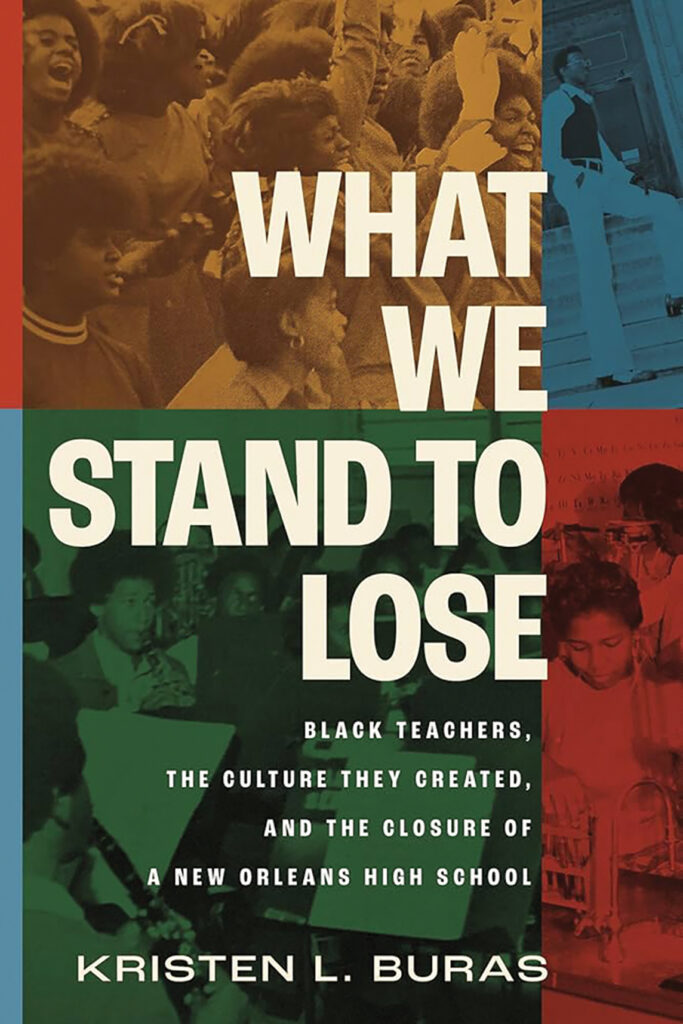
What We Stand to Lose: Black Teachers, the Culture They Created, and the Closure of a New Orleans High School
By Kristen L. Buras
(Beacon Press, 2025)
288 pp.
What We Stand to Lose is a compelling history of the fight by the African American community in New Orleans to educate its children. From the Jim Crow to post-Katrina eras, Kristen Buras documents barriers created by the daunting forces of white supremacy. She shows how Black teachers united with parents and community to support schools and provide the environment necessary to educate their children — and how much of their success is at risk from the privatization of New Orleans’ schools.
Buras chronicles the rich legacy of George Washington Carver Senior High, which opened in 1958. The all-white school board hoped a school specifically for Black children would curtail the demand for integration.
Located near the Desire Projects in the Ninth Ward, Carver was defined by quality teaching, high expectations, and caregiving by educators — part of the community’s daily life. Their focus was on the whole child.
Buras uses interviews of educators, alumni, parents, and community members to demonstrate Black teachers’ invaluable and often unrecognized contributions. As Danielle Foley, one of the many respected teachers, put it: “We didn’t have a lot. But that didn’t stop us. We were determined to educate our kids.”
Once Carver was built, white politicians provided minimal funding and support. Despite the lack of critical infrastructure, teachers led efforts to serve all the children’s needs. They achieved a long list of success stories — including establishment of a school-based health care clinic and a child care center to keep high school students with children in school. Buras describes Carver in the 1980s and 1990s as a “place of comfort and refuge from problems that plague neighborhood youth.”
The aftermath of the 2005 Hurricane Katrina changed everything.

Students and teachers returned to find the building unusable. In early 2006, the Orleans Parish School Board fired all New Orleans public school teachers, who were 75 percent African American. A Recovery School District (RSD) took over the city’s public schools. They reopened Carver in August 2007 in portable units elsewhere in the city, later moving those units back to the original site.
In 2008, the RSD received a grant from the Walton Family Foundation to engage in high school redesign. Teach for America provided “teachers” for Carver, mostly uncertified young white people from outside the area. Because of the high teacher turnover, by 2011 many African American educators had come on board, including teachers who had been fired in 2006. But that school year, once again all teachers were notified of year-end termination.
Two charter schools run by new networks took over Carver’s original site and the historic school was ultimately closed. In fact, charters replaced all public schools citywide. Instead of a full and culturally rich education, Buras shows, many students now face test prep mills where students describe a culture of alienation, anxiety, and abuse perpetuated by teachers and administrators. One student who left a school by choice said he “felt like a bird let out of a cage.”
What We Stand to Lose is an indictment of pervasive corporate “reforms” that do not consider the views and experience of communities, particularly communities of color. With 25,000 public schools closed over the past two decades, Carver’s story demonstrates how much is at stake.