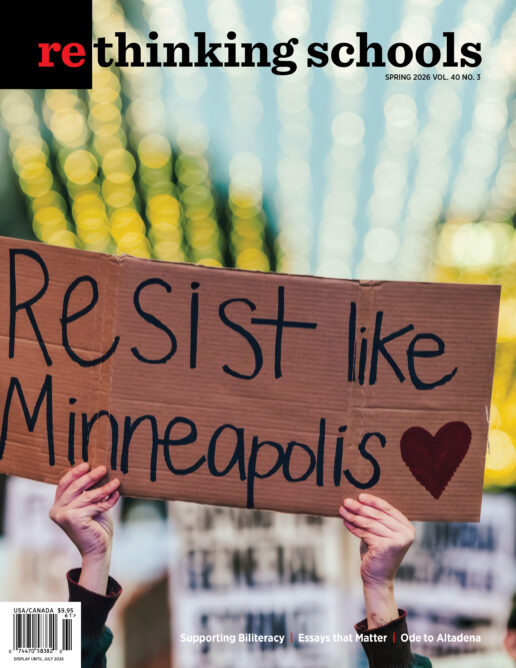
Twin Cities Educators Resisting for the Common Good
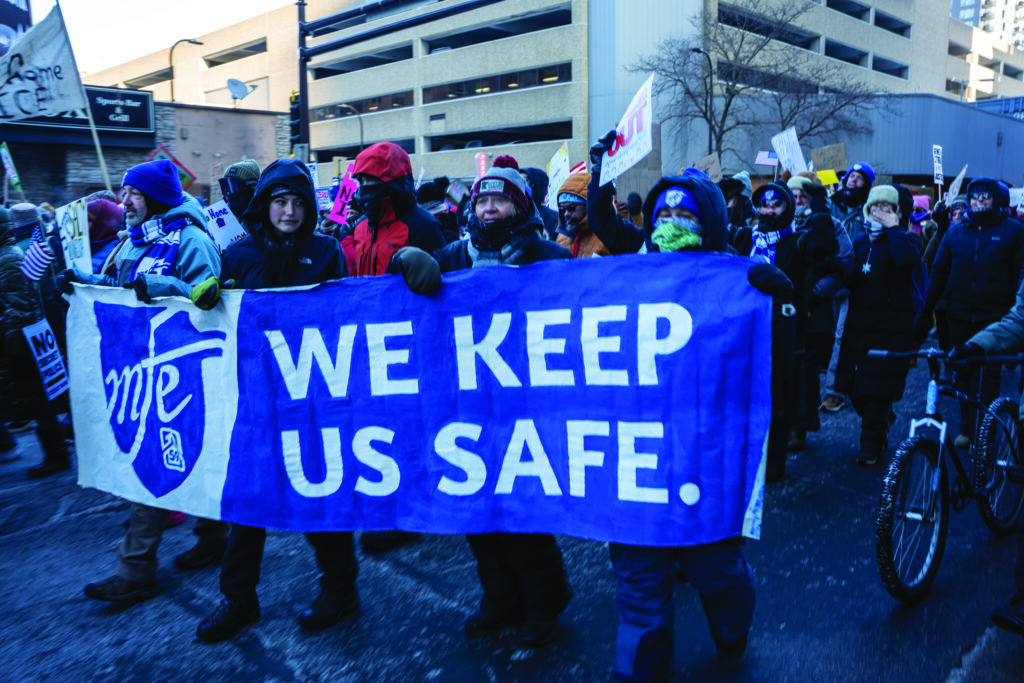
It was sometime in late December that Leah VanDassor went to the first community meeting to deal with the surge of Immigration and Customs Enforcement (ICE) and Customs and Border Protection (CBP) into Minnesota’s Twin Cities.
It wasn’t her first organizing meeting by a long shot, of course — VanDassor was elected president of the St. Paul Federation of Educators in 2021 — but this one was different. Neighbors gathered with neighbors, created Signal chat threads, and named their skills: “Who wants to do patrol? Who knows how to speak Spanish? Who wants to do rapid response? Who’s been trained in observing?”
Around Minneapolis and St. Paul, similar meetings were happening in December and January, bringing together experienced organizers like VanDassor with new activists and building the kinds of volunteer networks that have been disrupting ICE raids and kidnappings, delivering food and medication to people who are sheltering in their homes, and organizing proactive direct actions to demand businesses and elected officials act to stop the constant terror that “Operation Metro Surge” has brought into their lives.
Schools have become a hub of activity, with teachers and parents coordinating to keep students and immigrant parents as safe as possible. “We have built a huge parent and community member coalition of volunteers, like 2,300 people, might be bigger,” VanDassor said. “We have bus patrols, we have people delivering food to schools, we have people packaging up food, we have people shopping, they’ll do it where they’re needed. And the money that people donate goes to a general fund that gets distributed across the city.”
The term “sanctuary schools” has taken on new meaning, as parents in high-visibility vests patrol around schools while kids enter and leave. “We have them at every school and they’re sometimes spread two, three blocks away and then every block in between,” VanDassor said. Other volunteers are 3D printing whistles for signaling that ICE has been spotted or creating mutual aid hubs in their businesses and homes. “We find a spot for everybody.”
“What we’re doing, it is a continuation of what we’ve always done,” said Marcia Howard, president of the Minneapolis Federation of Educators–Teacher Chapter, “which is stay in coalition and collaboration with our community.” The kind of social justice unionism that the teachers in the Twin Cities have been practicing for years, one that sees racism and state violence as central impediments to students’ safety, well-being, and ability to learn, has prepared them to lead in a moment when the federal government has unleashed “shock and awe” on its own people. “As union members, we wind up being in the practice every two years of going out on the line and bargaining and fighting for ourselves. We were able to basically do increasingly heavier weights and more repetitions than the average union and average citizen,” Howard said. “And so it just became more natural for us to be on the front lines of the type of fights that I think bring our society forward.”
As of this writing, the Minnesota movement was still struggling daily against the federal invasion. The Trump administration pulled Border Patrol chief Gregory Bovino out of the Twin Cities, along with a reported 700 agents, after agents killed Alex Pretti on Jan. 24, and sent in “border czar” Tom Homan instead, but everyone I spoke with said that the raids and assaults — as well as the organizing, mutual aid, and the actions — were ongoing. Some 7,000 students just in the Minneapolis school district were learning remotely, as COVID-era programs for sheltering in place have been reactivated, and at some schools a quarter to a third of the student body receives some sort of mutual aid support.
In St. Paul, the union meets weekly to discuss how the schools are faring with remote learning and the ongoing siege, and they have recalled the bargaining team from last summer’s contract negotiations to meet and discuss future plans, because the temporary crisis has become an ongoing state of emergency, and teachers are stretched thin, trying to maintain some sense of normalcy in the classroom while also attending to the needs of students learning virtually while stuck at home. But this moment, VanDassor said, has also brought members who were relatively inactive within the union into motion. “This is the work they want to do and it’s been edifying for them, giving them agency and power and keeping them sane in this moment,” she said.
“I think the systems that we put in place here are replicable basically anywhere now. We made a lot of mistakes, we fixed them, we cleaned it up,” VanDassor added. “I remind people we started this work on Jan. 8.” The urgency meant that they simply had to get going and be willing to adjust on the fly, rather than expect perfection, and what they have learned they can now share with the other cities and states that will face similar invasions in the months and years to come.
* * *
It was 2014 when I first spoke to teachers in the Twin Cities about the transformation that they had begun in their unions. St. Paul was one of the earliest cities to follow Chicago down the path of social justice unionism, and as in Chicago, their work started with listening sessions and a book group. They read Alfie Kohn’s The Schools Our Children Deserve, created a set of principles and demands alongside the community, and took those proposals into bargaining: librarians and nurses, smaller class sizes, less standardized testing, access to Pre-K, time to build real relationships with students and their families. It was the early days of “bargaining for the common good,” and St. Paul helped shape the strategies that eventually went national.
Those relationships became central to the union’s organizing — they built a parent-teacher home visit project, training teachers to build partnerships, and got funding for the project through the bargaining process, teacher and soon-to-be union president Nick Faber told me at the time. Because Minnesota law required bargaining meetings to be open to the public, the union encouraged members as well as parents and community members to attend. Mary Cathryn Ricker, now executive director of the Albert Shanker Institute, was president of the SPFT (both the Minneapolis and St. Paul unions changed their names to “Federation of Educators” in recent years) at the time and told me, “It helped gain trust in the community, because here is the union saying, ‘Every Thursday we’re going to be negotiating until this thing’s done and come watch it. Give us feedback afterwards.’”
“If I’ve learned anything as a student of the labor movement, it’s that there are those watershed moments,” she continued. “When you peel back the story of those watershed moments, you see that there’s this incremental momentum building to that moment, where progress came in degrees.” Her words seem prescient now, in 2026, as the union has leapt into action and drawn on the groundwork they laid well before Trump’s first term. Teachers, she said then, were hungry to connect, within the district and across the country, and that feeling of connection, of being part of something bigger, in turn made the teachers braver and more willing to fight. “There’s a courage that comes with standing together to improve conditions for everyone.”
That courage showed up again when a police officer killed Philando Castile, a cafeteria supervisor at J.J. Hill Montessori Magnet School in St. Paul. The national AFT convention was in the Twin Cities that year, and SPFT reached out to the community group Neighborhoods Organizing for Change (now folded) and held a march through downtown Minneapolis, calling educators into the streets to demand an end to criminalization and state violence. This was one of the first times that educators did so as a union. That organizing led into their next contract campaign, Faber told me in 2018, and helped them build to strike readiness. They also expanded a restorative justice project in the schools, bringing in restorative justice practitioners to train members as part of professional development. “It is not perfect, but it is a way,” he said, “to repair harm and build community instead of just perpetuating the school-to-prison pipeline.”
To work on racial equity in the schools, Faber continued, “With our group of parents and community members and educator members, we created this team called our TIGER team, which stood for Teaching and Inquiring in Greed, Equity, and Racism,” and that team tied together the racial equity work with demands for full funding, for corporations to pay more taxes to help fund the schools properly. They targeted U.S. Bank, and alongside community organizations, held actions around the Super Bowl, which was in Minneapolis in 2018. It was a moment, Faber said, of flexing their power: “We will strike and we can put 300 to 400 people on the street in the middle of the night on a Monday night in downtown St. Paul in the middle of the winter when it is really cold.”
The more activist union approach, Faber said in 2018, helped engage new members in the union from the start. When he started as a teacher, the union’s introduction to members was along the lines of “If you are in trouble, we have got your back.” That didn’t work, he noted, because new teachers assume they aren’t going to get in trouble. Now, they tell the story of their organizing, and ask new teachers “What resonates with you?” Teacher unions have been told that they can only bargain around wages and benefits, he noted: “When you do something different, they tell you, ‘No, you are supposed to stay in your lane.’” Instead of allowing the district and national politicians to paint them as purely self-interested, Faber said, “We are going to decide what our lane looks like.”
The union’s strength, VanDassor told me, has held during occupation. Their steward networks and action teams serve to communicate across schools and neighborhoods, and the networks of organizations across the Twin Cities have been able to support one another; strong collaborative relationships already existed that are both being tested and strengthened.
But, VanDassor said, “I don’t want people to think, ‘Well, we haven’t been organizing for 12 years, so now what?’” The important thing, she stressed, is to start now.
* * *
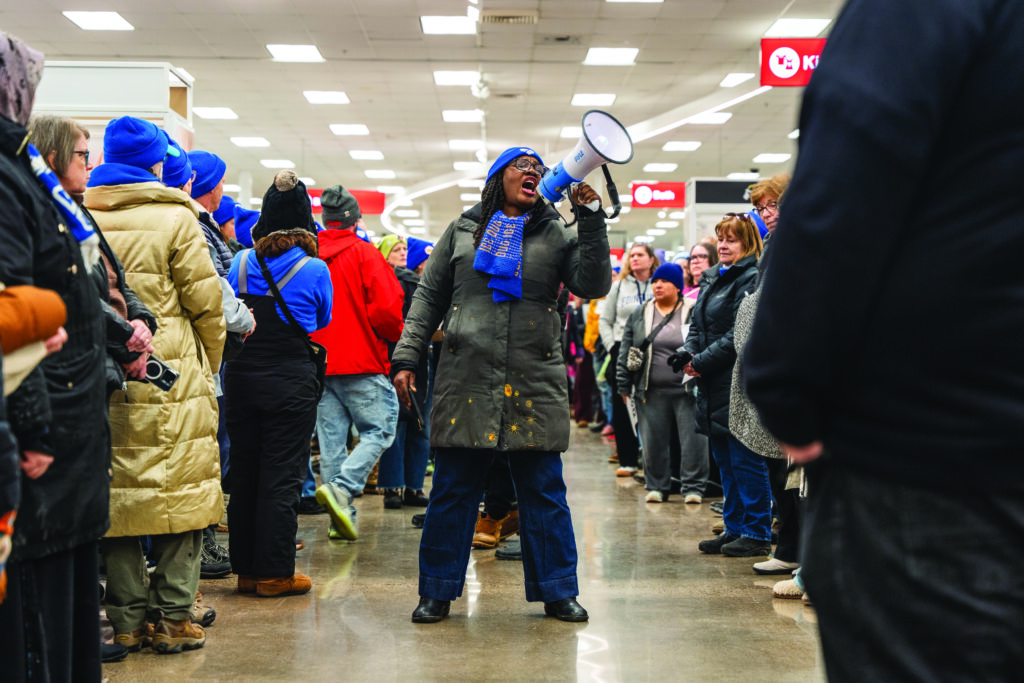
In 2022, the Minneapolis Federation of Teachers went on strike. Actually, both SPFE and MFT had coordinated contract campaigns and filed their intent to strike on the same day, but SPFE’s strike was averted by a deal at the last minute, and MFT went on to walk out and stay out for more than two weeks. The Minneapolis educators had watched their colleagues across the river win improved conditions through their own strike in 2020. “We have sat back and really admired some of the things that they’ve been able to secure through that process,” Ma-Riah Roberson-Moody, the first vice president of the educational support professionals (ESP) chapter of the union at the time, explained. “They have things in their contract that we want in our contracts. So that’s been a lot of conversation, longtime relationship building.”
Roberson-Moody’s salary when we spoke was less than $27,000 a year. But the fight was — as it almost always is — about more than money for her. It was about respect, specifically, being respected as an essential part of the educational process. “Our members want to be taken seriously,” she said.
Those ESPs had staffed emergency child care sites across the city during COVID lockdown, when schools were closed, and they continued to be in daily contact with the most vulnerable students in the district. The union, stepping into its own bargaining for the common good practice, was calling for more counselors and social workers and mental health supports for students, and talking about the way that state violence — particularly but not exclusively the police killing of George Floyd in 2020 — affected their students. “We all can recognize that in a district where we serve more than 60 percent students of color, it’s really important that they’re represented in the people that are teaching them. So retaining and recruiting those educators of color is really important,” Roberson-Moody said.
It was the killing of George Floyd that radicalized Marcia Howard as well. Darnella Frazier, the young woman who filmed Floyd’s death, had been her student. Before that, Howard had been a rank-and-file union member, but when she saw the video, she went straight to what is now known as George Floyd Square, and stayed out. “My union supported me,” she told me in 2024. MFT led a march into the square, and even the national AFT sent support to her there.
The union officials saw in Howard the kind of leader they needed and asked her to speak to the members. “There were rumblings that we were going to take a strike vote,” she said, “and then all of a sudden I found myself basically rallying troops.” While the bargaining team was inside, she was outside: “on the truck, in front of the governor’s mansion, in front of the state capitol, on avenues and boulevards with our members.”
The teachers who had marched for Black lives were now marching for themselves, in a gendered profession in which the ranks of power were often racialized — the ESPs, who were paid the least, were more likely to be women of color. “We could walk and chew gum. We could talk about pay parity too. We could talk about having safe and stable schools for kids,” Howard said.
Howard was willing to step into union leadership, but, she said, “Our members have to be brave. Labor has to be brave in this moment.” When we spoke in February, she recalled that previous conversation, in which she had said labor would need to lead in struggles for racial justice, for Black liberation, and now to keep their immigrant students safe.
“In the last six years, I’ve been actively involved in three contract campaigns and have either gone on strike or have voted to strike three times in a row to good effect,” she said. “We have made demands for the common good. We’ve made demands around the safety of our students in their identities, and we see this fight against the incursion in our city as an extension of that.”
* * *
Parent support has been central to the work of the Twin Cities educator unions since the first group of St. Paul parents formed a Facebook group to stand with their teachers. But the moment now has called on parents in a new way, to truly see every child in the district as theirs and to put their bodies on the line to keep those students and their caregivers safe.
It is hard to know the long-term effects of this invasion on the children of the Twin Cities. Even the students who have continued to go to school ask questions about what is happening that are hard to answer; there are children, meanwhile, who hadn’t left home in something like two months at the time of this writing, and the very devices they use to keep in touch with friends are also feeding them video of ICE kidnappings and killings. They have been thrown back into something like pandemic conditions, but as Howard noted, “This was manmade, and it could be ended with a single phone call.” Even if the rest of the federal agents all left tomorrow — even if they have left by the time you read this article — the long-term effects will be lasting.
Minneapolis Families for Public Schools (MFPS), an organization now affiliated with the larger group TakeAction Minnesota, has held sanctuary school trainings and built out the parent and community patrols outside of schools — some 4,000 people had expressed interest in attending one of their trainings, and they’ve been expanding into the suburbs and other cities as well.
The sanctuary schools model that they use has three components: clear school policies around immigration enforcement, communicated between administrators, educators, and families; supporting families through official school channels as well as external mutual aid networks that coordinate rides, food, and rent relief funds; and protective presence and deescalation training. The work has ranged from making sure to bring a birthday cake to a family sheltering in place to knowing what to do when chemical irritants are deployed at a school.
As part of a parent patrol, Christin Crabtree was at Roosevelt High School in the hours after Renee Good was killed and came face-to-face with Gregory Bovino as Border Patrol agents streamed onto school grounds. (They detained one school staffer, according to reports.)
“The students were seeing these agents tackle their teachers,” Crabtree said. “There were lots of people in the area and yet the agents seemed to feel that it was appropriate for them to just tackle more than one of our educators and then use chemical agents in this huge group of people that are literally just leaving school for the day, a place kids are supposed to be.” She recalled being terrified that they would shoot someone else.
Crabtree has been a Minneapolis public school parent for about 21 years and was a co-founder of MFPS; her younger child is graduating this year. She cited two reasons for getting involved in organizing around the schools: the teachers’ strike in 2022, and the George Floyd uprising in 2020. Before that, she recalled being changed as well by the killing of Trayvon Martin in 2012, and the early days of what would become Black Lives Matter.
“As caregivers, we already had networks that we had built in our schools coming together in solidarity with our educators around their contracts,” she said. “That organizing really gave us the opportunity to take what we’d already done and build off of it to create networks of care.” Those caregivers are also workers, members of organizations, political activists in other areas, and have skill sets and personal networks that add power to the work they do as parents, grandparents, guardians. “There’s some of us who have been mutual aid people for a long time, and some folks who are maybe new to that, but [we’re] giving people the opportunity to learn.”
They can see, Crabtree said, that the problems in the schools and in the streets are the same; that the violence meted out by federal agents on immigrants and Black people and the organized abandonment of public services are connected. They’ve come together around calls for an eviction moratorium, understanding that people who cannot leave the house cannot go to work and make the rent money. That people who are already unhoused are taking the brunt of the federal invasion, as they have nowhere to hide, and may not have documents to prove their identity if they are picked up.
“Minneapolis is a lot of things, but we sure do know how to organize and we know how to meet the moment in a time like this,” Crabtree said. “I’m seeing how each time that something tragic has happened and we’ve built networks of care, how then years later, those networks have made possible huge amounts of progress and transformation in our community, and they’ve made the next movement more possible too.”
* * *
“They want to destroy us because of the way in which we care for each other. They hate us because we don’t hate each other.”
Minnesota is a target, Marcia Howard said, because of the power of that movement, because it has been a sanctuary state and its people willing to stand up to federal immigration directives to defend their neighbors. “They want to destroy us because of the way in which we care for each other,” she said. “They hate us because we don’t hate each other, so they will continue to come after our Liberian population, our Somali population, our Latino population, our Hmong population, our Black population. They’ll come after all of us, and we’ll still stand on the corners with the whistles and our phones saying ‘We love our neighbors, ICE out of Minnesota.’”
The strength of those communities has been deliberately built over time; many call it the Minnesota Model. Their wins have built up over time as well: those union contracts for MFE and SPFE but also free school meals for every student in Minnesota, a program spearheaded by Philando Castile’s mother Valerie, and drivers’ licenses for undocumented people and regulations of rideshare platforms and worker victories at Amazon warehouses. Those wins made possible because the organizations stand together even when they have nothing immediately to gain: “We understand that we are our neighbor’s keeper,” Howard said.
It was that power that helped pull off the closest thing to a general strike that the United States has seen in 80 years on Jan. 23. “I always believe that revolution isn’t going to come with a Facebook invite,” Howard said. “I know that the type of change that needs to happen has to be from a spark or it has to come from a fire that’s sparked in that moment. But that’s not to say that Jan. 23 happened at the spur of the moment. It took planning and coordination, but this is from people who had the practice of being able to pull something like that off because we had had that practice of coordinating and collaborating multiple times before.”
That’s why Leah VanDassor stressed the need for other cities to be preparing now for what may come their way. “Find your people now, get your people trained now so that when you need a bus patrol, you’re ready to go,” she said. “Use Minnesota as your motivator and avoid the pitfalls that we had by getting yourself ready and organizing your coalition groups and your neighborhood watch groups now so that you’re ready to go and you’ve practiced.”
Public educators, Howard said, are used to staving off despair and instilling hope in dark times. “You cannot see a student being inculcated with knowledge and see their growth and wide-eyed wonder and their development and not understand that there’s opportunity for change and growth,” she said. “I don’t think any teacher can fully despair. I just don’t think we have it in us.”
And so, while they are being asked yet again to do far more than any educator should have to do, they are doing it with poise and determination, she said. “Somebody chose to break Minnesota, but they’re finding out that we’re unbreakable.”