
| Home > Archives > Volume 23 No. 3 - Spring 2009 > Review: Dignity and a Haircut |
Review: Dignity and a Haircut |
|
Spring 2009
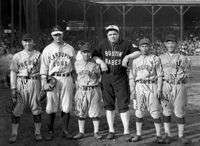
Photo: Courtesy of Nisei Baseball Research Project (http://www.niseibaseball.com) American Pastime and baseball under mass incarceration American Pastime By Wayne Au Dignity. If there is one thing that unifies most peoples' struggles to survive forms of oppression, it is the fight to maintain human dignity. Whether it's the enslavement of Africans, the colonization and attempted genocide of Native Americans, the exploitation and abuse of workers, or any other efforts of systematic domination of a group, at a minimum people survive and resist simply out of a struggle to maintain their human dignity. The same can be said of Japanese Americans, 120,000 of whom (both citizen and noncitizen alike) suffered race-based mass incarceration in so-called relocation camps by the United States government during World War II. Collectively and individually, Japanese Americans' dignified survival took many forms, including creating Japanese language poetry clubs, designing rock gardens, crafting furniture from scrap lumber, constructing ofuro baths, playing music, making art out of found materials, striking and protesting their imprisonment, and even just working to pass the days in the camps. And of course, there was baseball. One of the ways Japanese Americans sought to make their lives in the camps just a little bit better was to organize baseball teams and leagues where ballplayers could play, others could watch, and all could perhaps forget for a moment that they were imprisoned behind barbed wire under the watchful gaze of armed guards. American Pastime tells this story through the experience of the Nomura family, taken from their Los Angeles neighborhood and forcefully relocated to Camp Topaz outside of Abraham, Utah. While incarceration interrupts their lives and places great strains on their relationships, the gaze of the film falls on the two Nomura boys, Lane and Lyle. Lane is the rebel. He loves and plays both jazz and baseball with equal passion, gets into trouble for drinking, manages to get beat up by racists in town, and even enters into a risky interracial relationship with the daughter of white military sergeant Billy Burrell (the commanding officer of the camp and an aging baseball prospect in the New York Yankee farm system). But Lane is a rebel for good reason. He is a baseball pitcher, and he lost his baseball scholarship to San Francisco State University because of internment. Lyle, on the other hand, is the "good" son. He is obedient, doesn't cause problems, listens to his father, and even joins the 442nd Infantry—a segregated regiment of all Japanese American soldiers who earned great fame as fighters during World War II. After Lyle goes off to war, Lane becomes the central character in American Pastime. We get to watch him go through all of the alienation, pain, suffering, and even intermittent good times that happen during day-to-day survival in the camps. But while Lane serves as the protagonist, the struggle for dignity ultimately binds both brothers. Nearing the final act of the film, when Lyle returns home a war hero—minus one leg, he heads for a local barbershop run by Ed Tully, player for the local semi-pro baseball team and resident racist of Abraham. Tully refuses to give Lyle a haircut because he doesn't cut "Jap" hair and the story culminates in a baseball game where the Camp Topaz team squares off against the local Abraham semi-pro team, predictably led by Sgt. Burrell and Tully the racist barber. Suffice to say, without giving up too much more of the plot, sometimes dignity simply rests upon the outcome of a ballgame and a haircut. There is a lot to like about American Pastime. It is easy to follow, and middle to high school students should have no problem keeping track of the major plot turns and characters. It also illustrates the power of baseball—aided by an undercurrent of the power of jazz—to bring folks together and survive difficult times. American Pastime also thoughtfully delves into several of the central themes of the internment experience. Citizenship, life in the camps, cultural strains, familial strains, racism, the 442nd infantry, and childhood under incarceration, among others, are prominent themes in the story. American Pastime is also better than the other mainstream movies dealing with Japanese American incarceration during World War II, namely Snow Falling on Cedars (1999, Universal Pictures) and Come See the Paradise (1990, Twentieth Century Fox). While it has the glossy and slick feel of these Hollywood productions, it is actually a film that comes from within the Japanese American community itself. So not only are the writing and acting solid, but the characters are more fully human—unlike the above-mentioned mainstream Hollywood films. Despite its strengths, American Pastime isn't perfect in its portrayal of the camps. So while I strongly support teachers' use of this film, I would also encourage keeping a critical eye here. For instance, one character in camp who, aside from being a great hitter, is supposed to be of Japanese and Native Hawaiian descent. The problem is that almost every time this character appears on screen (save the one scene during relocation and incarceration itself), he carries an ukulele and happily sings everywhere he goes. So at the same time American Pastime breaks stereotypes of Japanese Americans, it reinforces stereotypes of Native Hawaiians. Additionally, American Pastime does not give camp resisters their due as an important part of the Japanese American community. Instead they are given only a glancing look and just written off as being disloyal. And this points to a larger critique of the overall camp narrative constructed in American Pastime. Like many other mainstream portrayals of the incarceration of Japanese Americans during World War II, this film is largely concerned with proving that Japanese Americans are just as "American" as everyone else—hence its preoccupation with both the 442nd and "America's pastime," baseball. The problem is that Japanese Americans shouldn't have to prove anything to anyone. The real issue is the racism and xenophobia that led to the incarceration of Japanese Americans in internment camps in the first place. Despite these criticisms, American Pastime is a good movie. It makes many aspects of the Japanese American internment experience accessible to viewers, and, despite some Hollywood-like predictability, it does so in an entertaining and engaging manner. With supplementary materials, American Pastime is definitely worth showing in middle and high school classrooms. Supplementary Resources for ‘American Pastime’ A Classroom Guide for American Pastime Diamonds in the Rough: Baseball

and Japanese-American Internment Nisei Baseball Research Project Baseball Saved Us The Densho Project The Japanese American Relocation
Digital Archive ( JARDA) Rabbit in the Moon |
CONTENTS Cover Story Features When '21st-Century Schooling' Just Isn't Good Enough: A Modest Proposal Knock Knock: Turning Pain into Power Reinventing Schools That Keep Teachers in Teaching Tellin’ Stories, Finding Common Ground 10 Ways to Move Beyond Bully-Prevention (and Why We Should) COLUMNS AND DEPARTMENTS |
| ORDER | Current Issue | Article Index | Archives | Web Resources | Publications | Just For Fun | Who We Are | | |||||
|
© 2002 Rethinking Schools * 1001 E. Keefe Avenue, Milwaukee, WI
53212 * Phone(414) 964-9646, or (800) 669-4192, |
|||||